by | October 20, 2026
Carlton Ward Jr. Captures an Avian Surprise in Marks Pond
A night heron and a limpkin make for a striking consolation prize on the hunt to photograph Florida panthers.
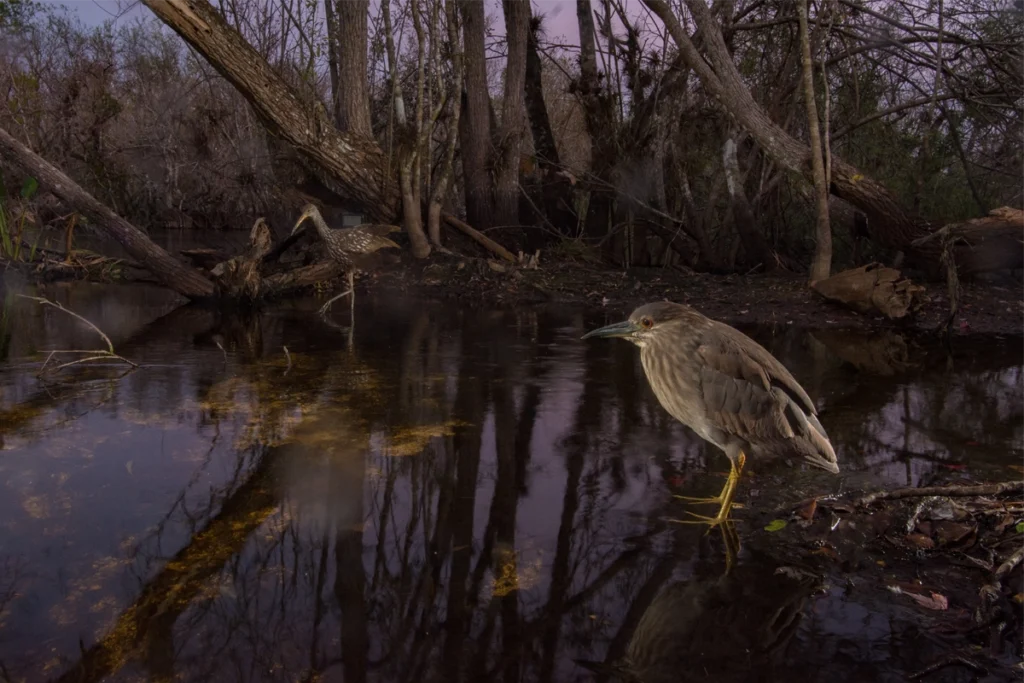
In my quest to capture photographs of the endangered Florida panther, I found a trail in the northern reaches of the Fakahatchee Strand, deep in the Florida Panther National Wildlife Refuge. There was a primordial power to the place, a swimming-pool-sized stretch that filled with water from the adjacent ponds during the wet season. I saw it for the first time while hiking with a group of scientists who were searching for ghost orchids—icons of the Everglades almost as rare and elusive as the panthers I sought. By the time the scientists had discovered a cluster of ghost orchids hanging from pond apple trees just a stone’s throw away from the flooded trail, I was already imagining panthers wading chest-deep in the swampy water.
The site was difficult to access, requiring a long hike from the edge of Alligator Alley up a narrow trail lined with poison ivy and Smilax vines.
—Carlton Ward Jr.
I pursued those panther photographs for several years. A Wildpath team member or I would return monthly to change the batteries and cards on my camera traps and ensure that the tripods standing in water were at the right height and well-secured to their dog-leash anchors. (We had to swim down to tighten them.) The site was difficult to access, requiring a long hike from the edge of Alligator Alley up a narrow trail lined with poison ivy and Smilax vines, fording ponds where alligators lurked and always under the looming threat that a bear or panther could be sharing the path.
Most years, the swamps filled with summer rains in June or July and would begin to dry down in the spring, usually by March. At the start of the first dry season, I arrived at the camera trap to find all the batteries dead and the camera card filled with more than 1,000 photos of birds. Apparently, the water levels had settled at just the right height for wading birds to stand and forage on fish trapped in the steadily shrinking pools. I was frustrated at first, thinking of the panthers I may have missed while the camera sat dormant. But the consolation prize was a collection of intimate and ethereal bird portraits I never could have captured with a handheld camera. In this photo, a juvenile night heron stands in the foreground looking over the pond while a limpkin forages in the background. Both birds are beautifully side-lit by hidden camera flashes, balancing the pink and purple hues of the twilight. Instead of imagining a panther in the frame, I learned to be grateful for the avian surprise. After years of trying to photograph the panthers, they eventually came, a story you can read about in my Summer 2021 Florida Wild column.