by | October 15, 2026
Florida Stone Crabs: The Hidden Cost of a Seafood Delicacy
Their claws are harvested for seafood dishes. But what happens to Florida stone crabs after they're tossed back?
Many Floridians know all about the sweet pleasure of dipping a hunk of succulent claw meat into warm melted butter or a tangy mustard sauce, but few connoisseurs stop to think about the life and times of that crustacean they just cracked. Florida stone crabs are the jocks of the sea—so beefy that they can’t even reach their claws to their backs. “They have these incredibly strong ratcheting claws, so perhaps what they lack in flexibility they make up for in brute strength,” says Kate Rose, a Florida Sea Grant agent. The thick-shelled bottom dwellers scuttle along the ocean floor, using their claws to crush and pinch prey. “They’re like little tanks,” Rose says.
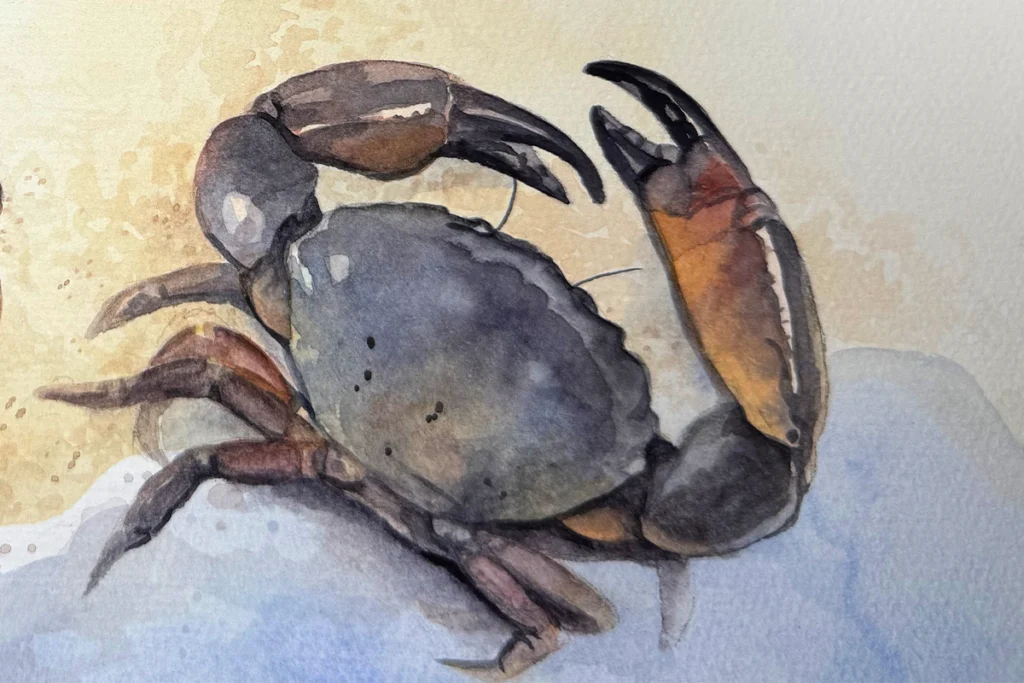
Each fall, a network of crab pots descends into Florida waters, waiting for unsuspecting crustaceans to walk in. Crabbers hoist up the pots, sort the crabs and, with a swift pull, break off a claw. “The trick to help the crab is actually to twist it in a way that makes the crab sever its own arm,” Rose says. “It reduces the amount of injury that the crab suffers.”
Conceptually, it seems like the perfect Floridian food source: Crabs lose a claw, but they’re tossed back into the ocean and get to work growing a new one—no harm, no foul. In practice, it’s not so simple. The process of regeneration can take nearly three years. “Herein lies the challenge with the mortality,” Rose says. “They have a lifespan of about six to eight years.”
They have these incredibly strong ratcheting claws, so perhaps what they lack in flexibility they make up for in brute strength.
—Kate Rose
During apoptosis, crabs under stress can lose and regrow a claw, which is a helpful trick to evade predators, but not one without its costs. “They’re losing the ability to feed themselves, and that’s why there are these reproductive impacts, because you know their body is trying to compensate for it, and they effectively say we don’t have the energy for eggs this season,” Rose explains. When a fisher doesn’t properly remove the crab’s claw, the crustacean’s life is at stake. Up to 59% of stone crabs die after having one claw removed, and around 13% die just from handling alone.
For now, the Florida stone-crab fishery isn’t in immediate danger, Rose says. But in a state that has seen a once-abundant species pushed to the brink of extinction, regulators aren’t taking any chances. Officials are keeping a close eye on the industry and employing restrictions to safeguard its future. Although stone crabs have recently been documented as far north as Virginia, roughly 99% of the U.S. harvest comes from Florida, with the bulk of them pulled from The Florida Keys. That makes protecting of the Sunshine State’s most coveted seafood traditions primarily Florida’s responsibility. “It’s the epitome of a local Florida industry and delicacy.”
For more on Florida’s native wildlife, click here.
About the Author
Helen has an aptitude for finding alligators and a passion for covering the weird and wonderful of Florida. The Tallahassee native graduated with her bachelor's degree from the Medill School of Journalism at Northwestern University.