by | September 22, 2026
Chancho King: Jacksonville’s Ecuadorian James Beard Darling
Chancho King brought the flavors of Ecuador to Jacksonville and caught the attention of the James Beard Foundation along the way.
You’re born and raised in the South, so you think you know everything there is to know about pork. You’ve been eating barbecue since the crib. Even now the aroma coming from a smokehouse along a country road brings back memories. Family holiday drives took you to rural Georgia, where your great-uncle raised his own hogs in a pen full of robust mudslingers whose cacophonous grunts made beautiful music. Decades pass. You’ve been to Spain and eaten the paper-thin sliced ham of the black Iberian pig, those free-range legends stuffed on forest acorns. You’ve been to Texas Hill Country, with its fat honking hot links. You’ve had carnitas at the divey-est Mission District burrito joints in San Francisco. You’ve even indulged in the regional specialty known as the “white hot,” a frankfurter made famous by the long-defunct Zab’s franchise of Rochester, N.Y., and a component of the city’s notorious “garbage plate,” a concoction meant to be consumed only after midnight under the considerable influence of alcohol.
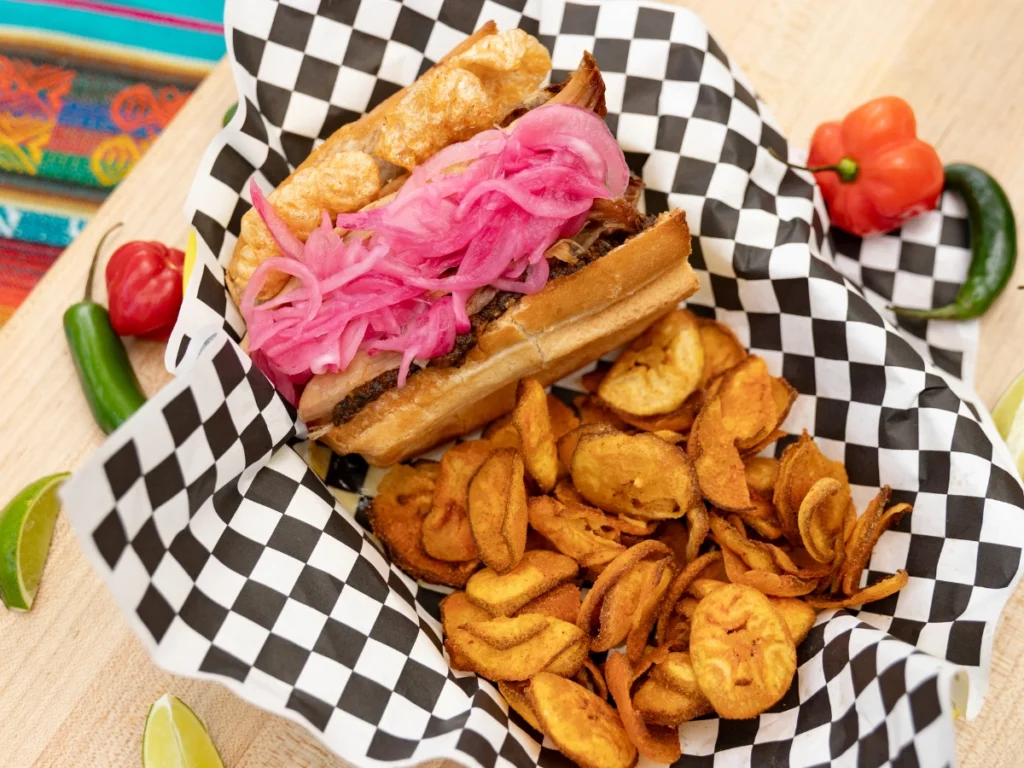
Then one day you pull up to a bright storefront in Murray Hill, a chill, artsy neighborhood near downtown Jacksonville. You’ve heard the buzz about this place and its signature sandwich, the very thing that inspired its name: Chancho King. Chancho means pig in Spanish, and the royal designation implies a certain imperial grandeur—a crowning majesty of porkdom. The single-page menu downplays any hoopla. It offers a “pork sandwich” at a modest price ($7), but there is nothing modest about what slides across the counter a few minutes later.
I’ve literally seen numerous people take a bite of our pork and cry. It’s so beautiful.
–Chason Spencer
There it is before you, like nothing you’ve ever quite experienced. A hunk of pork the size of a fist, blessed with two sauces—a mild tomato aji and a spicy pepper aji—topped with a pile of pickled red onion and the house-made chicharron (fried pork skin) for a vivid crunch. All of it is barely contained by two slices of Cuban-style bread, poised to land a knockout punch to your palate. You’d rather go nice and slow, taking time to savor the blend of flavors. You pull a piece of pork loose to admire the delicate cotton-candy strands that come apart so easily after two days of preparation—a process that imparts everything that makes this such a moment of porcine transcendence.
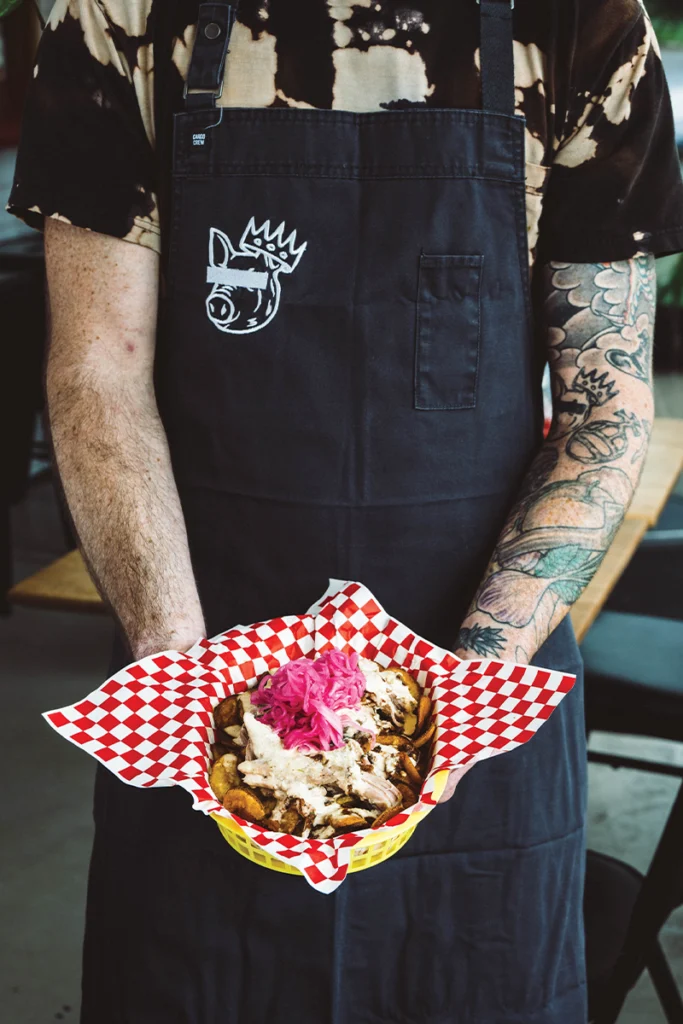
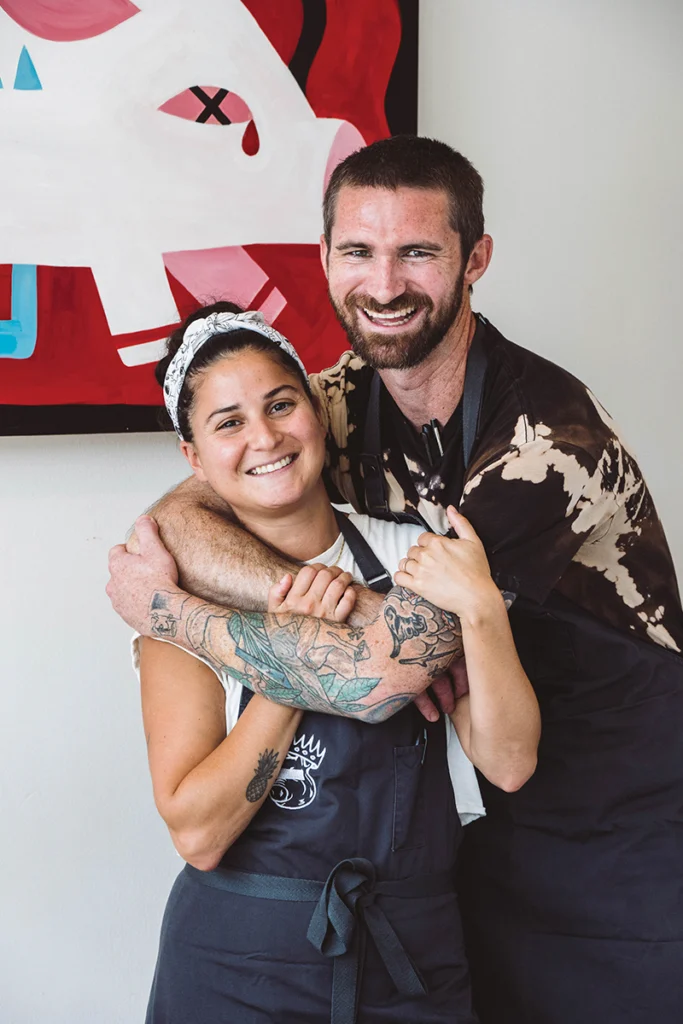
“I’ve literally seen numerous people take a bite of our pork and cry. It’s so beautiful,” says Chason Spencer, who launched Chancho King in 2023 with his wife, Maria La Mota, after years as a pop-up sensation. They were soon joined by partner and friend Francois Castro. One of the few, if not the only, Ecuadorian restaurants in Jacksonville made news earlier this year when Spencer and La Mota, both 33, were finalists for the “Best Chef: South” category in the 2026 James Beard Awards, representing Florida along with fellow nominee Bryce Bonsack of Tampa’s Rocca.
The couple, who first met in 2014 while enrolled in culinary classes at the now-defunct Art Institute of Jacksonville, have staked their ambitions on that sandwich, whose history winds back centuries. (Pigs were first introduced to Ecuador by Spanish colonizers in the 1500s amid Francisco Pizarro’s bloody conquest of the Inca Empire.) “I grew up eating this specific sandwich,” says La Mota, who was raised in the coastal city of Guayaquil and whose family recipes inspired the restaurant’s menu.
Spencer tried it on a visit and knew right away. “I was like, ‘Jacksonville needs something like this.’ The South is known for barbecue so it’s easily recognizable, and it’s freaking delicious. The guy at the place that she showed me, Don Pepe, he’s been doing it for 50 years, and it’s a shack.”
A pork butt spends a minimum of 36 hours in the marinade (although Spencer prefers as much as five days), then gets roasted overnight. Jus, the liquid released from the pork, is the magic ingredient. “We strain it. We chill it so all the fat separates. We take all that liquid, we reduce it down further,” Spencer says. Bones are added to the stock, which then goes back on top of the pork. “Rather than folding in all the stuff that comes out of it, we refine that liquid so it’s a whole process that’s been developed out of that pork.”
As newlyweds, the budding chefs decided they could build a business with the sandwich.
“We had no money, like under $2,000,” Spencer recalls. It was enough to cover some paperwork, buy a tent and a couple of folding tables. Chancho King became a popular stop at downtown markets, along with the Keg & Coin arcade bar. “We’re talking from 10 a.m. until 3 in the morning. We still have those customers to this day, and that was seven years ago.”
The pandemic was a catalyst. “It really skyrocketed us,” Spencer says. Furloughed from their jobs, they went for it: “working seven days a week, selling to anyone we could.”
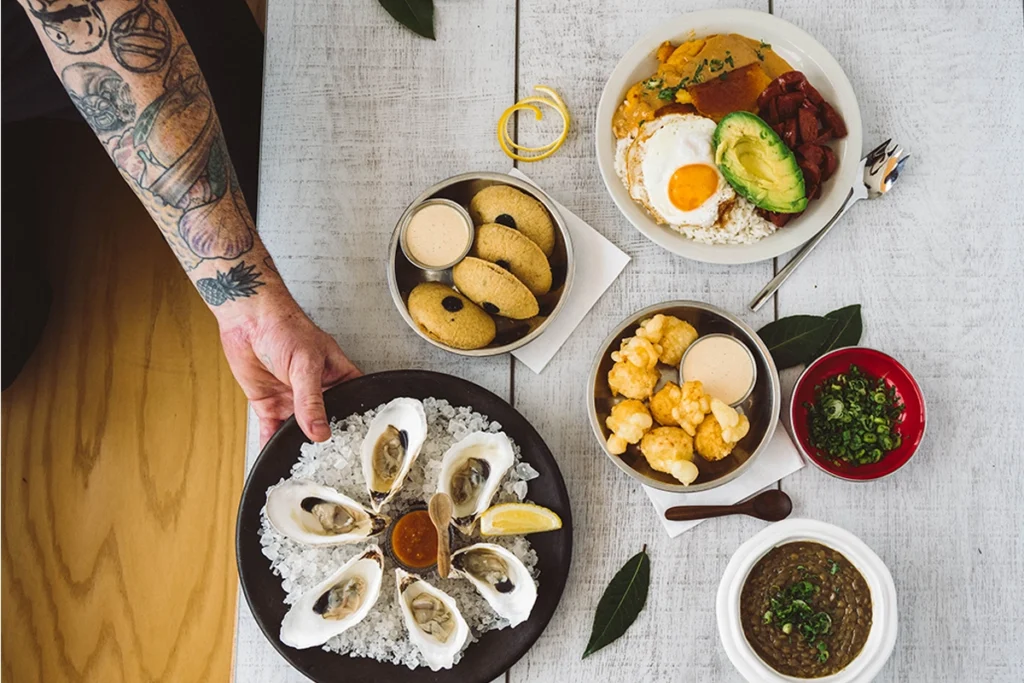
They moved up to a food truck. Then the restaurant. One sandwich at a time.
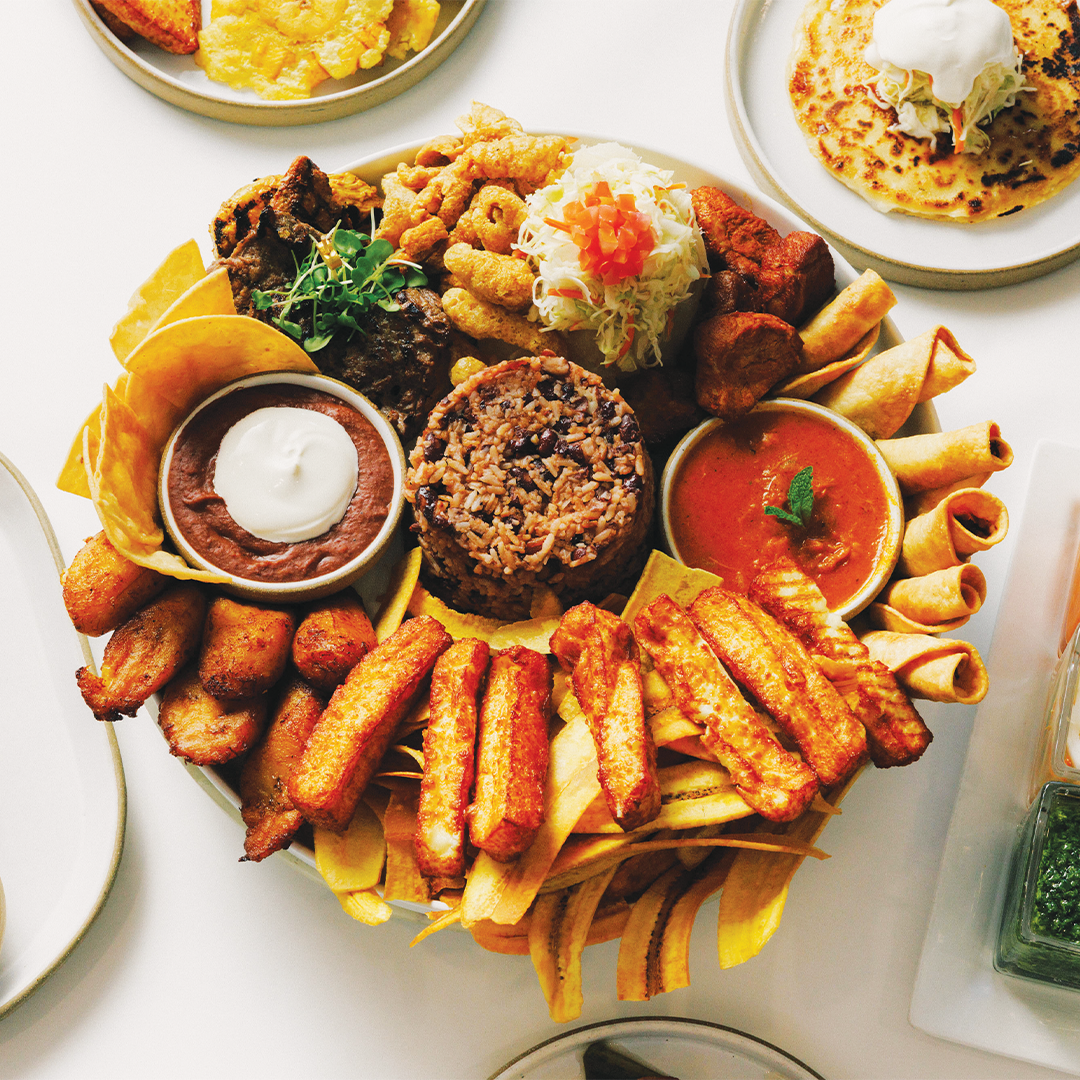
As its menu has expanded, Chancho King has become an exciting conduit for Ecuadorian cuisine in a casual community setting. The cultural influence is pervasive. Crowd-pleasers include pan de yuca, made from the starchy, fiber-rich root vegetable, a dish Spencer calls “little cheesy clouds of goodness,” and llapingacho, a platter of potato cakes with peanut sauce, white rice, a fried egg and chorizo or another protein. “We cook the potatoes [in] achiote oil, so it tastes a little bit different,” La Mota says. Conceptually, it’s an approach to food that is full of surprises and novel twists.
“You use ingredients and combinations that you think you would never like, but when you try it … like peanut and tripe stew, that’s one of my favorite dishes,” Spencer says. “They use lime to season a lot of things, like a blood sausage soup—also one of my favorite dishes.” The chef can’t access the abundance or variety of sources available in Ecuador. “In the Andes, you’re going to find 10,000 different types of potatoes,” he notes. La Mota adds, “We get one type of banana here. You go to a farm [in Ecuador], you have like 30.”
Although the options are quite different in northeast Florida, Chancho King’s plates are a showcase for local sources. The vegetable salad is a colorful display of cukes, squash, melon and tomatoes sourced from Jacksonville’s Down to Earth Farm, one of the restaurant suppliers stocking their kitchen, along with Chandanko Farms and 5 Points Farm. Shark Bite Oysters, farmed in Indian River Lagoon, are the exclusive source for the shellfish. Freshness is the word, either served up raw or fried and smothered in aioli and chopped scallions and looking like a gloriously exploded po’boy. “When it gets to us,” Spencer says, “it’s been in the water that morning.”
The restaurant’s coastal affinities find their fullest expression on Sundays, when the ceviche bar headlines a weekly brunch menu loaded with specials. “We are always experimenting,” says La Mota, who, with Spencer and Castro, presides over a Murray Hill ritual as guests flock to the rear patio, which has a buzzing, neighborly vibe. The dish taps deeply into La Mota’s heritage.
On visits to Ecuador, the couple absorb as much as they can from the people who know the most about it. “We’re learning from the ladies in the kitchen,” Spencer says. “They’re making it the same way that we’re doing it. They’re doing it for five to 10 people. We’re doing it for 60 to 100. But the flavor profile is exactly the same.”
The leche de tigre—tiger milk—is key. “We’ve been rolling it since before we started the restaurant,” Spencer says. “So we almost never run out of it.” The recipe includes 15 to 20 ingredients. There’s lime from the old mother sauce, yellow mustard, cilantro, scallions and a bit of serrano pepper. If there’s a secret ingredient, it’s the stock used to cook the octopus for the dish, which pulls double duty by enriching the ceviche base. “We usually do shots of it in the kitchen,” Spencer says, “because it’s so delicious.”
So, too, are the chunks of farmed redfish swimming in a bowl, garnished with pickled red onion and avocado, with plantain chips and a handful of popcorn on the side. It’s the restaurant’s go-to. “It’s got a bite to it, and the fat content gives it a lot of flavor,” Spencer says. “Other fishes can get lost in the sauce.” Proof is offered in an extra special dish of redfish cheeks with an intense butter sauce that goes off like a flavor bomb.
Redfish is more budget-friendly than red snapper, and meatier. “It’s got more muscle because they’re fighters,” he continues, labeling the snapper as lazy in comparison “because it hangs around coral reefs all day, and it doesn’t have to swim super hard. [Snapper] bruises really easily. It flakes really easily. When you’re breaking it down, it can get really ugly really fast.”
Since the James Beard nomination, the restaurant has had to expand its staff and scale up its operations. “It’s cool because we never really changed anything that we were doing,” Spencer says. “All we did was try and refine a little bit more and try to get better at what we’re doing every single day.”
The chefs’ particular kitchen chemistry continues to lead them on an adventurous path. “They tell me I’m the epitome, for lack of better words, of fucking around and finding out,” Spencer says, while La Mota “brings that nostalgia, the memories, she knows exactly the flavor she’s looking for, and then she’s a lot of the aesthetics. A lot of the stuff that we have in the restaurant is because of her eye and the way she wants to see it.”
And what La Mota sees is the joy in bringing the dishes that have fed generations of her family to a wider world that has yet to fully experience them in the way she has. “I think our Ecuadorian gastronomy is just starting,” she says. “It’s not popular at all, but I have traveled the world, and I still love my food way better than anything. It is ridiculous-good. The ingredients are amazing, the creativity behind it. It’s very Andean cuisine, very ingrained in our roots. We have it here because this is what I crave to eat.”
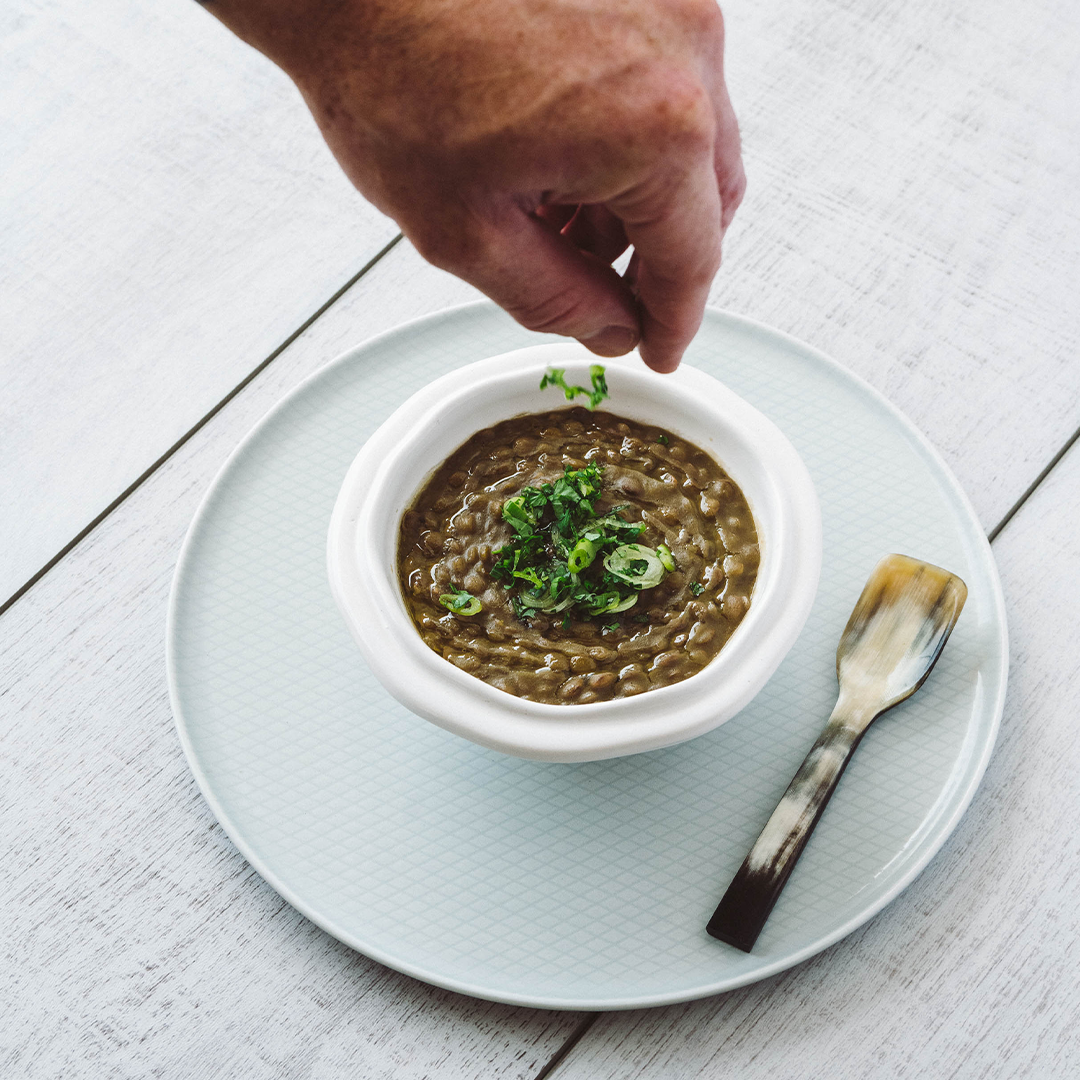
To learn how to make Chanco King’s menestra stew, click here.
About the Author
Steve, a Tallahassee native and Flamingo contributor since 2017, has written about film, music, art and other popular culture for publications including The Wall Street Journal, The Washington Post, the Atlanta-Journal Constitution, GQ, and The Los Angeles Times. He is the artistic director for the Tallahassee Film Festival and writes a monthly film newsletter for Flamingo, Dollar Matinee.