by | December 4, 2025
An Expert’s Guide to Finding Wild Manatees in Florida
Find the state's beloved sea cows at these five hotspots across the state.
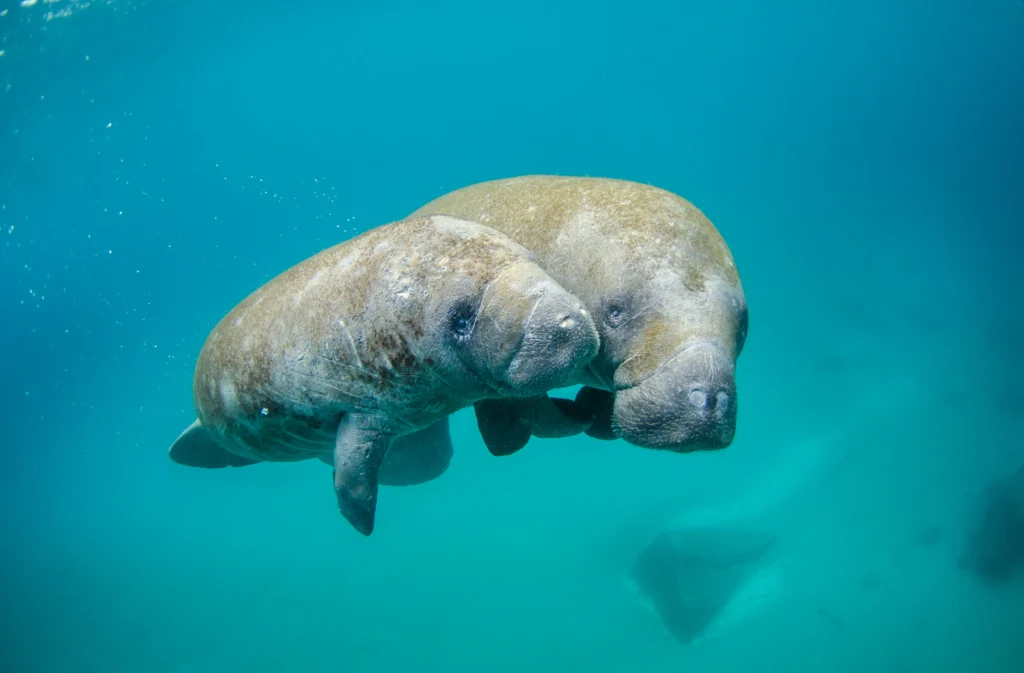
Florida’s most adept snowbirds aren’t birds (or silver-haired humans) at all—they’re 1,000-pound gray aquatic mammals. Manatees despise the cold just as much as the rest of us, and they can’t survive in it. That’s why, as temperatures elsewhere in the nation start to drop, manatees that spent the summer months cruising channels as far north as the Chesapeake Bay head home to Florida, ready to winter in warmer waters. Thanks to the Sunshine State’s milder climate, November through March is the prime time to spot the creatures as they take advantage of what our relatively balmy aquifer has to offer.
“Manatees, while they are marine mammals, don’t have complete blubber layers like seals, walruses and whales,” explains Patrick Rose, aquatic biologist and executive director of Save the Manatee Club. “They also have a fairly low metabolic rate, so they need to stay warm.
“Manatees need to have water that’s right at 68 degrees or warmer … most critical are those places where there are natural springs,” Rose says. In Florida’s springs, water flows straight from the ground at a constant temperature of around 70 degrees—perfect for manatees year-round.
Here are Rose’s tips for where—and how—to respectfully find manatees this winter.
Where to Meet the Manatees
In North Florida, where temperatures tend to be colder than the rest of the state, winter manatee activity can be a little unpredictable. Still, spots like Wakulla Springs and Silver Springs welcome plenty of the marine mammals in the winter. “We’re seeing more and more manatees at Wakulla and that will, I think, continue to grow,” Rose says. “We’re seeing more of them now making their way from the St. Johns River all the way to Silver Springs. I would say it’s probably a 70% chance at Wakulla during the winter that they’re going to be able to see manatees, but it’s not a for-sure, and they’re going to move in and out depending on how cold it is.”
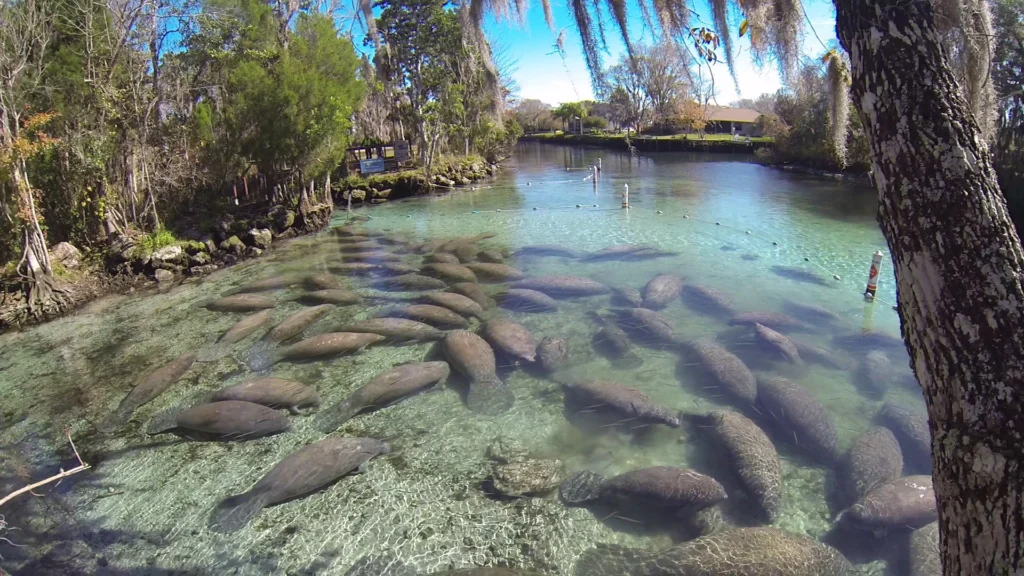
Further south, Crystal River is known as the Manatee Capital of the World for good reason. Each winter, so many manatees take up residence in the warm waters that it would be harder not see a sea cow. Kings Bay—the headwaters for more than 70 springs in the area—is a popular spot for visitors. To better protect the manatees, Rose recommends stopping by Three Sisters Springs instead, just about a mile and a half away. “Kings Bay is the one place that there is a lot of swimming with manatees,” Rose says. “Three Sisters Spring (is) managed by the US Fish and Wildlife Service. There’s the boardwalk there. People can come and see the manatees in the beautiful spring water and not disturb them.” Just six miles away, Homosassa Springs is often teeming with manatees and offers a unique vantage point from its underwater observatory.
Head due east to find manatees at Blue Spring State Park in Orange City. There, visitors can also observe the gentle giants from a boardwalk, leaving the creatures to swim among fish and leisurely graze on grasses.
Protecting the Gentle Giants
Spots like these give manatee enthusiasts great views while protecting the threatened species. According to Rose, when visitors swim with manatees, rather than viewing them from a boardwalk, it puts the sea cows at risk.
“When (manatees are) forced away from the warm water, (it’s) more dangerous in terms of the cold. Manatees are more likely to be hit or injured as well (by boats) when they’re away from those most important protected areas.”
The creatures are also known to gather around power plants, where the water used to cool steam turbines is warmed and pumped back into the ocean.
“Manatees found that over the years, and have become dependent on it,” Rose says. And while they can enjoy those spots now, “That’s also something that is a very serious future issue, because if we’re going to deal with climate change, we’re really going to need to eliminate the carbon-based CO2 production from those power plants over time. And so we’re going to have to come up with suitable alternatives for manatees.”
With the power plant-fueled warm-water oases likely to disappear in the future, protecting and supporting Florida’s natural springs is more important than ever to keep the Sunshine State’s beloved mammal thriving.
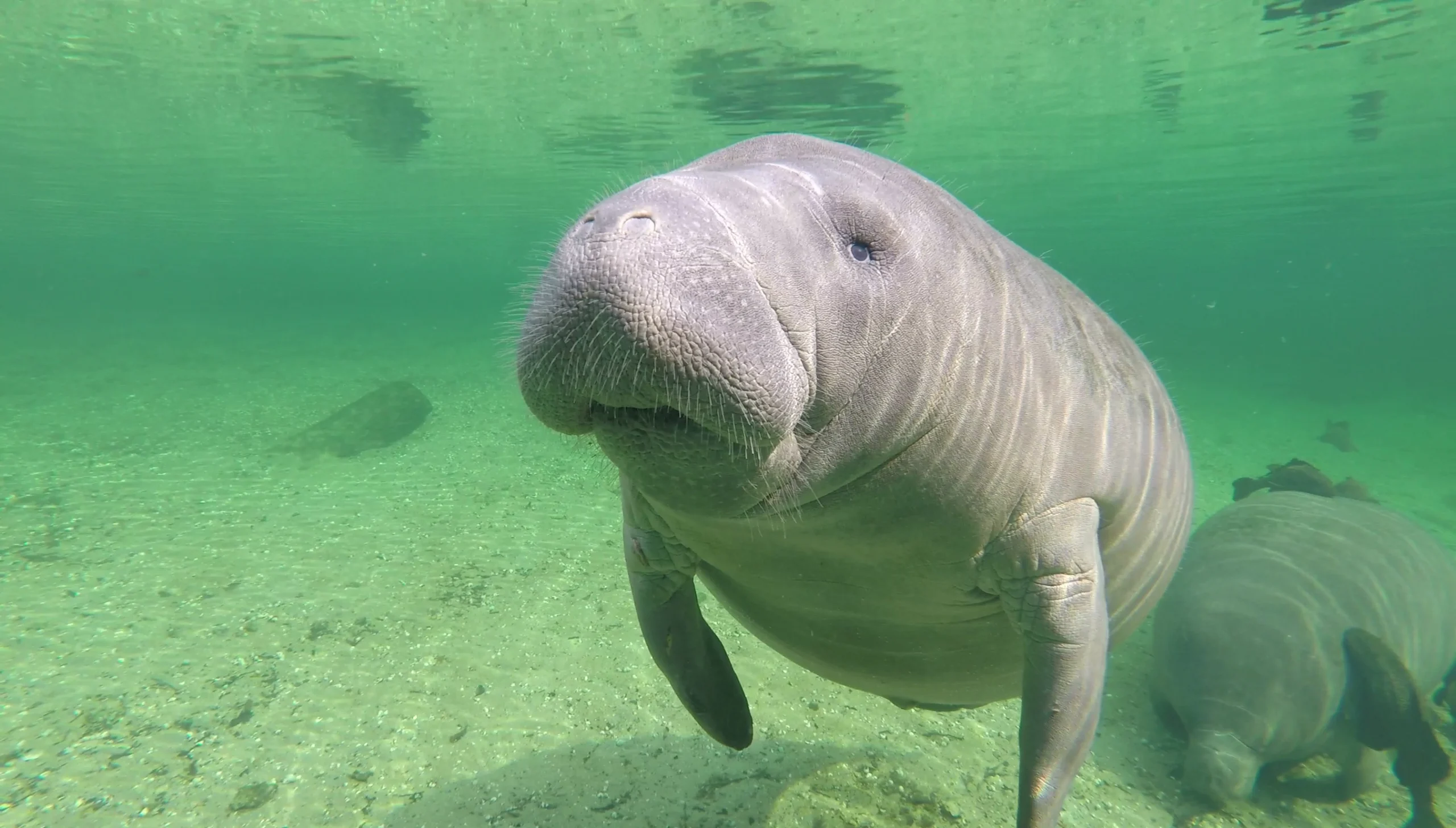
Manatees are truly gentle giants: “They’re the only marine mammal that I know that just don’t have the ability to be aggressive,” Rose says. “They can be just so tender with one another. They use their pectoral fins to embrace another manatee. They’ll sometimes come up to each other with their muzzle, almost like a manatee kiss. And the mothers just do a fantastic job of taking care of their calves when they’re born.”
Rose hopes that observing these interactions from a respectful distance helps people understand why safeguarding manatees, and the springs they rely on, is so critical.
“Watching them in that clear spring water seeing how they’re interacting with one another—just how docile they are—it makes you understand why they need us to protect them,” he says.
For more on Florida’s wildlife, click here.
About the Author
Helen has an aptitude for finding alligators and a passion for covering the weird and wonderful of Florida. The Tallahassee native graduated with her bachelor's degree from the Medill School of Journalism at Northwestern University. At Flamingo, she helps organize advertising and write stories (usually about Florida's fantastic fauna).