by | December 1, 2025
Welcome to DeLand, the Skydiving Capital of the World
From Tom Cruise to 100-year-old seniors: why every skydiver has this iconic Central Florida drop zone on their bucket list.
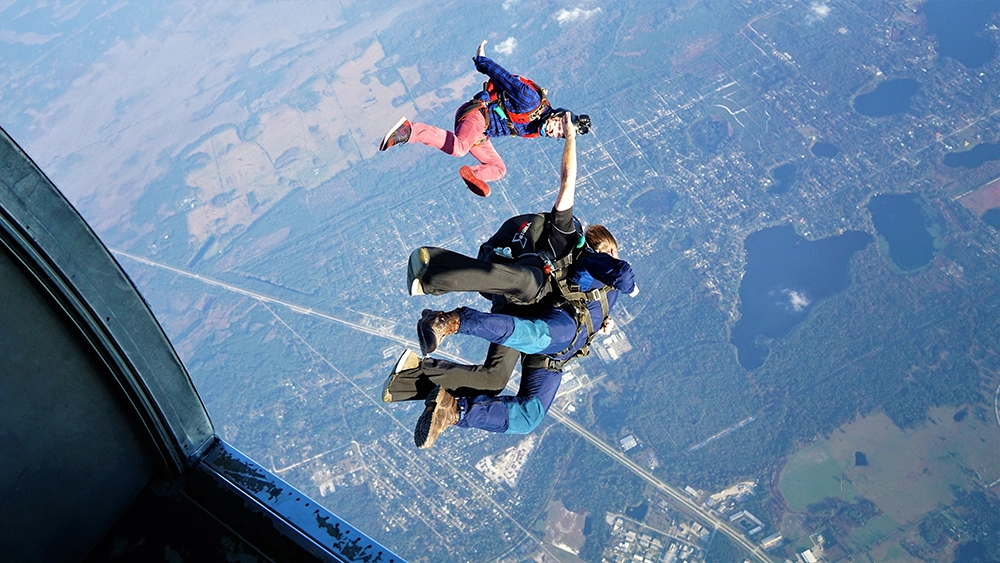
Russ Manhold is afraid of heights. He avoids rooftop bars and doesn’t climb ladders or trees. But when an airplane door opens at 13,500 feet, Manhold doesn’t hesitate to jump out.
“When I’m wearing a parachute, I have confidence that everything is going to be OK,” says Manhold, an 82-year-old Miramar resident and avid skydiver. Nearly every Saturday morning, Manhold—a retired pilot who used to “chase drug smugglers” for U.S. Customs and Border Protection—rises at 3 a.m. to be at Skydive DeLand, his preferred drop zone, in time for breakfast with fellow skydiving lifers at The Perfect Spot, an eatery at Skydive DeLand, which overlooks one of the landing zones.
There are drop zones closer to his home in South Florida, but Manhold and other regulars at Skydive DeLand consider it an iconic place unlike any other in the sport. Skydiving in DeLand began in 1959, when Dr. John “Doc” Gaffney brought his Falling Angels club to the local airport, turning it into one of the country’s rising new hubs for skydiving. In the years that followed, DeLand became ground zero for the sport—home to national champions, world records and innovations—attracting skydivers and industry leaders from around the globe.
Today, with elite teams, military training programs and dozens of skydiving equipment manufacturers, DeLand more than lives up to its nickname as the Skydiving Capital of the World. How did a city in Central Florida with a population shy of 50,000 people become skydiving’s mecca? What kind of people willingly jump out of airplanes, and is it really safe? For answers to these questions, travel to West Volusia County—perhaps the only place in the country where jumping out of planes is considered normal.
The Skydiving Capital
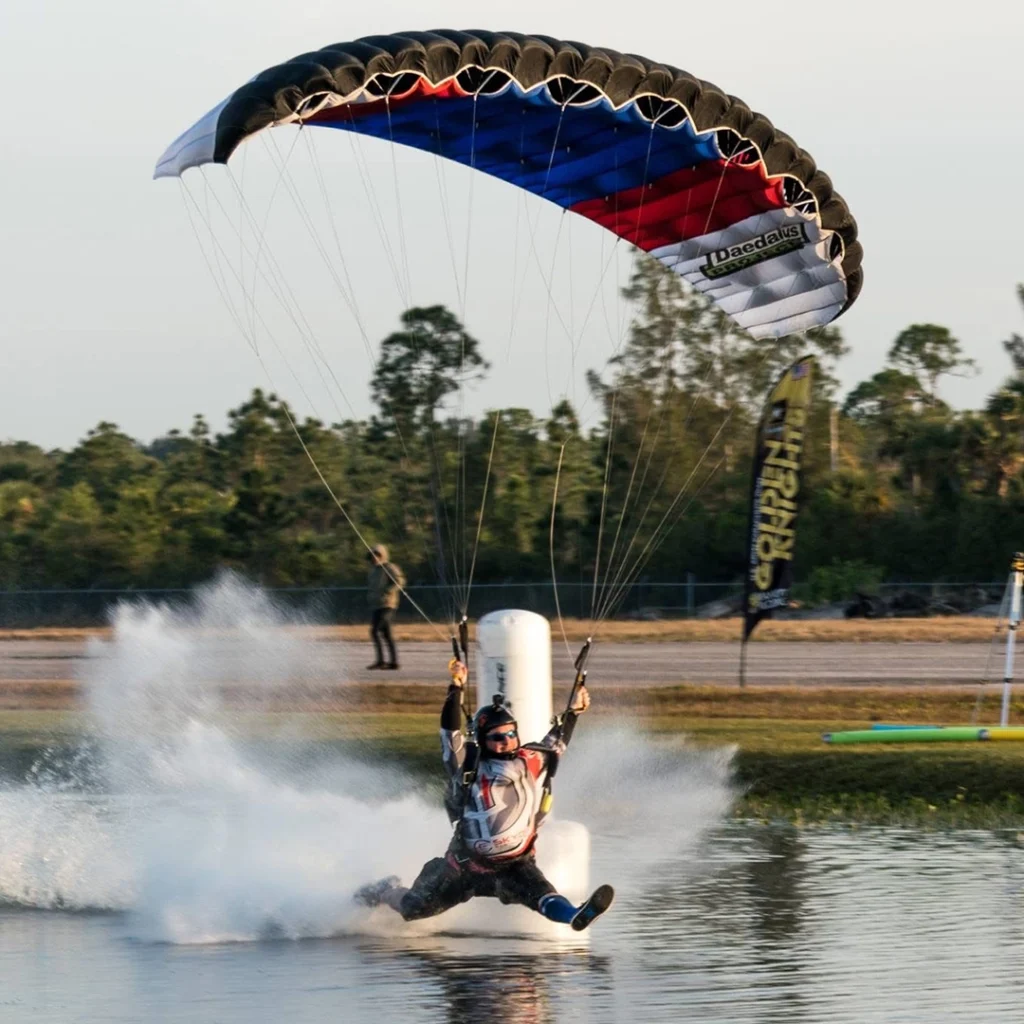
Drive through the unremarkable streets south of DeLand Municipal Airport, and you might miss a remarkable concentration of businesses tied to the skydiving industry. There’s United Parachute Technologies (UPT), which manufactures containers—the backpacks that hold two parachutes that every skydiver uses. There’s Alti-2 Technologies, which makes altimeters that signal the parachute to deploy. And there are canopy manufacturers and gear companies like Performance Designs, Icarus World, Aerodyne Research and Aero Tech Products.
DeLand has hosted the National Collegiate Parachuting Championships and the National Parachuting Championships in the past. Talented skydivers from around the world have been moving to DeLand to pursue their passion for decades.
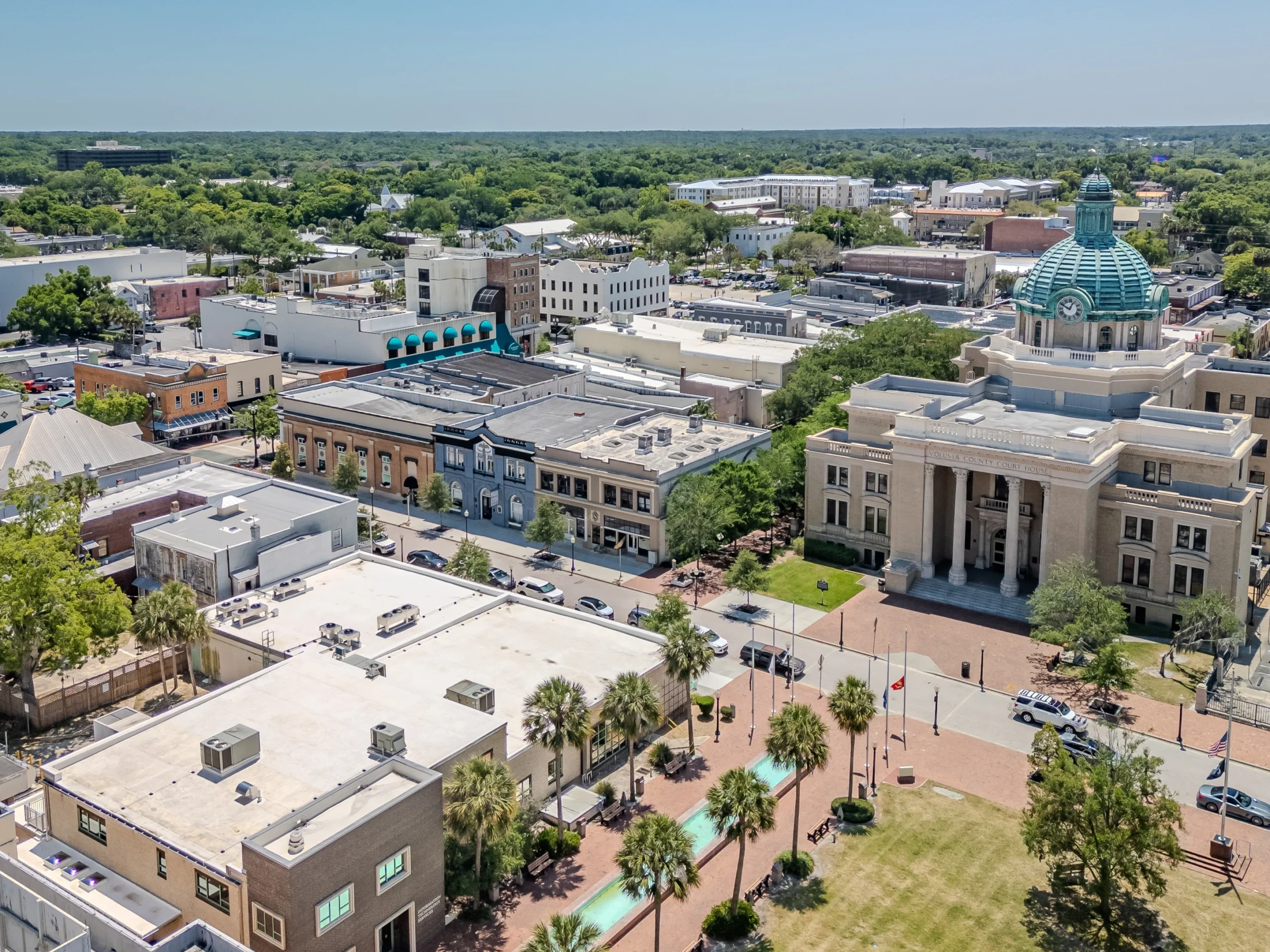
Click here for our recommendations in DeLand’s charming downtown.
In a small museum at UPT, Mark Klingelhoefer—an eight-time medal winner at the United States Parachute Association (USPA) National Skydiving Championships and the company’s account executive—demonstrates how far the sport’s equipment has evolved since UPT moved to DeLand in 1975.
“Feel how heavy this one is,” he says, hoisting a 1975-era container—so named because they contain two parachutes—off a shelf. It weighs a back-breaking 50 pounds, compared to today’s containers, which weigh about 20 pounds. Nearby is another container, this one decorated with mink trim and actual diamonds. UPT’s founder, Bill Booth, spent $10,000 on the parachute system in 1983 to show off at a trade show.
Once you get good at it, it’s like golf.
—Mark Klingelhoefer
UPT manufactures all its harnesses in DeLand and offers public tours. As Klingelhoefer, 50, leads a visitor through the factory, he shares his 25-year connection to the sport. A former whitewater rafting guide, he says he initially wanted to learn scuba diving but couldn’t due to a medical condition. Skydiving began as a consolation prize but quickly became an obsession that lasted decades until a knee injury forced him to retire from jumping earlier this year. “We’re not adrenaline junkies with a death wish,” says Klingelhoefer, a Pittsburgh native who has worked at UPT for more than 20 years. “We’re people who found a sport we’re passionate about, and we want to get better. Once you get good at it, it’s like golf.”
Klingelhoefer loves DeLand and encourages newcomers to try skydiving. “I suggest everyone in the world make one tandem skydive,” he says. “It will change the way you look at the sky for the rest of your life.” He says the first two seconds of a jump—when you “might not be able to breathe because your body goes into shock”—are the hardest. “Then you realize you’re not going to die and can enjoy it,” he says. “When you’re holding hands in free fall, you’re going 120 to 200 miles per hour—that’s crazy on a different level.”
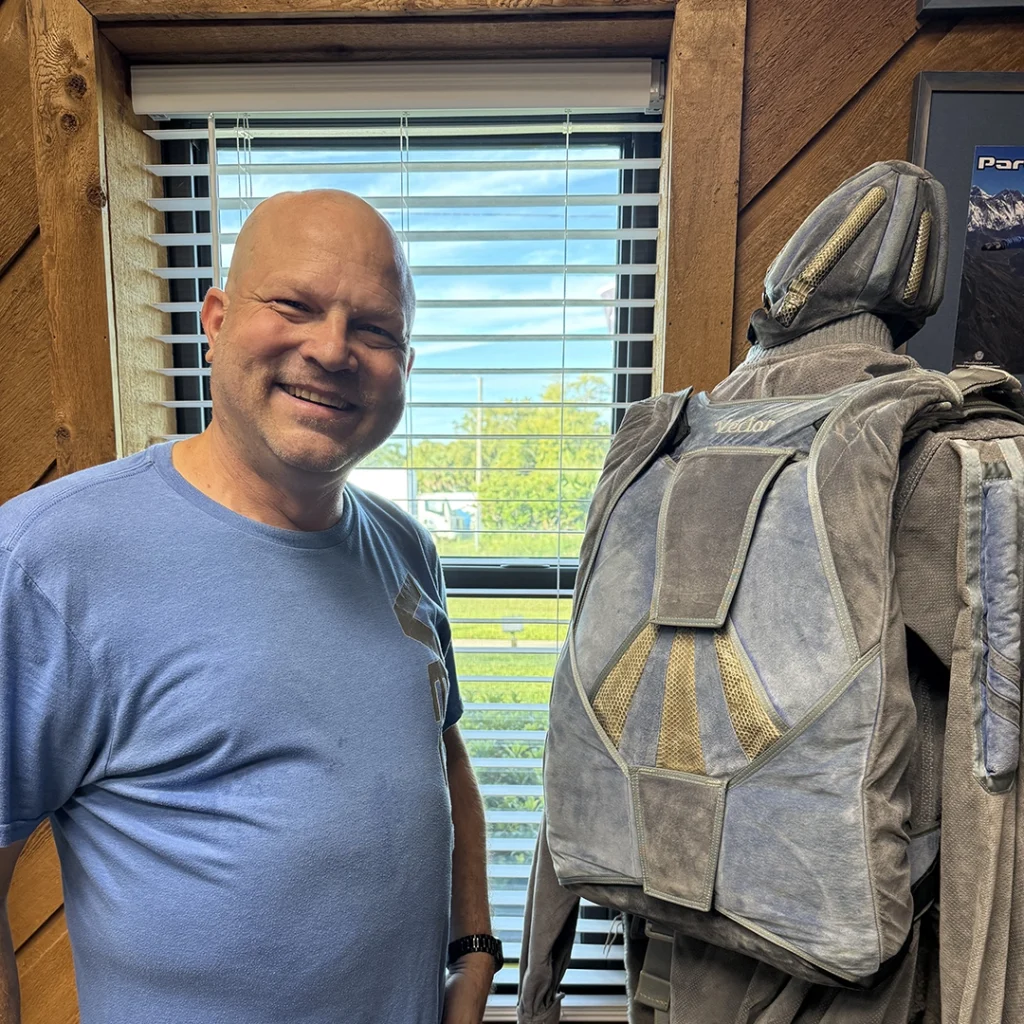
Fernando Caralt, a Barcelona native and Director at Icarus World, says that people have many misconceptions about skydiving. “I always thought skydivers were weirdos with green hair … but I was so wrong,” he says. “It’s an adrenaline sport, but it’s also very technical.” Icarus World’s manufacturing facility is in Spain, but Caralt felt the company needed a branch office in DeLand because it’s the beating heart of the sport. “Every skydiver, at some point in their skydiving life, comes by DeLand—it’s an iconic drop zone,” he says.
Manuel Martinez, 23, an aerospace engineering student at Embry-Riddle Aeronautical University in Daytona Beach, is another Barcelona native who heard about DeLand as a skydiving mecca while growing up in Spain. Martinez saw influencers jumping in DeLand on TikTok and Instagram and knew he would try it when he arrived in Florida for the first time in August.
He didn’t tell his parents back in Spain he had joined the accelerated free-fall instruction program at Skydive DeLand until after completing his third skydive—weeks after his arrival—because he was afraid of what they might say. “When the back door opens and you hear all the noise and the wind and the exhaust gases of the engine hit you in the face, that’s when the reality hits you,” Martinez says while having lunch at The Perfect Spot after a jump. “The first five or six seconds, you have the feeling like when you are in a car and hit a bump and feel tickles in your stomach.” For a moment, he reconsidered jumping but remembered the experience was nonrefundable. “I already paid, so I needed to go,” he says. “I didn’t want to lose the money.”
Caralt says that the popularity and accessibility of tandem jumping is helping grow the sport. Some people view it as a once-in-a-lifetime bucket list item, but others get hooked and progress from tandem jumps to solo jumps to competitions. Michael Johnston—who now owns Skydive DeLand following the death of longtime owner Bob Hallett in a car crash in May—has seen both the city and the sport evolve during his nearly 30 years as general manager. “When I first (came to DeLand in 1972), it was just transitioning from being a club operation to becoming an actual commercial operation,” says Johnston, a former Army paratrooper who jumped for 50 years before retiring six years ago. “Things were on a much lower scale at that time, and probably the only business in town was a parachute rigger who maintained the equipment.”
In 1975, UPT moved to town, and other companies followed, gradually turning the city into a magnet for everyone in the industry. “It’s now the technological center of parachute development in the world,” Johnston says. Skydivers come to DeLand from across the globe, including a few celebrities. Most notably, Johnston says Tom Cruise and Nicole Kidman learned to skydive in DeLand while filming “Days of Thunder” in nearby Daytona Beach in 1990. Cruise even flew his mother in to skydive with him on Mother’s Day that year. Johnston says skydiving was technically a violation of Cruise’s film contract, so his agent came to Skydive DeLand to collect his training and jump records.
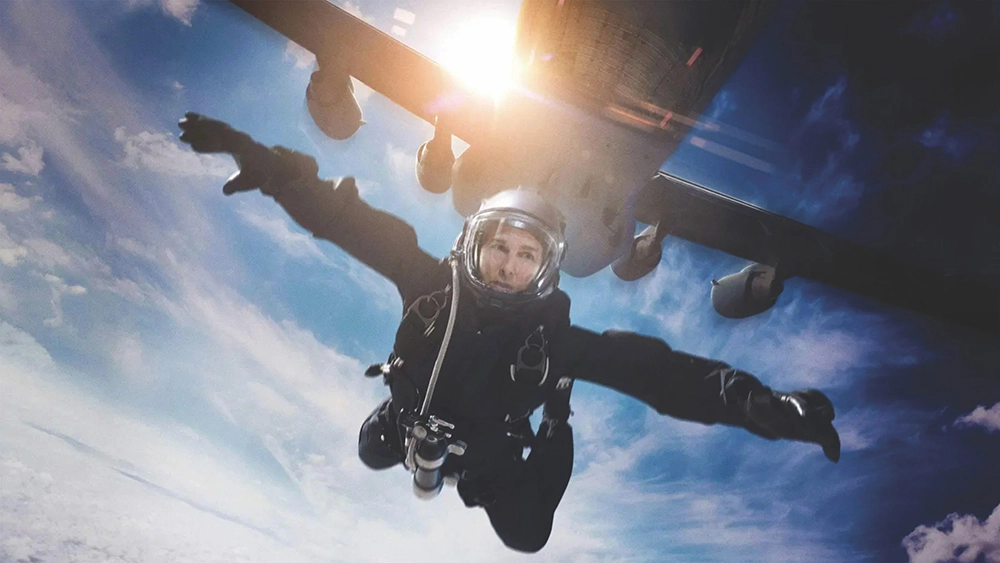
Johnston says Cruise went on to become a licensed skydiver—a process that requires 25 jumps. Years later, while filming a “Mission: Impossible” movie, Cruise called Johnston out of the blue. At first, Johnston didn’t believe it was actually him. “He told me, ‘I need my training records because I’m getting ready to shoot a movie with some skydiving scenes, and I want to do my own stunts.’” The records were long gone, but Johnston wrote a letter detailing Cruise’s jump history. Since then, Cruise has performed his own skydiving stunts in “The Mummy” (2017) and three “Mission: Impossible” films, including a scene where he completed a daring free fall with a camera strapped to him. For a skydiving sequence in “Mission: Impossible—Fallout,” Cruise said it took 106 jumps to get the shot they wanted. “It’s not that I don’t get scared (doing stunts),” Cruise told a CNN reporter. “It’s that I don’t mind being scared.”
Drop Zone
It takes about 11 minutes for an airplane to reach the typical jump altitude of 13,500 feet. Skydivers enjoy roughly a minute of free fall before deploying their parachute between 3,000 and 5,000 feet, followed by about two and a half minutes under canopy before landing. Martinez says his instructor gave him easy-to-remember hand signals, since it’s too loud to communicate verbally during free fall: An extended index finger means “deploy your parachute” and a shaking hand means “relax.”
What could go wrong? Plenty, but most skydivers say the sport isn’t as dangerous as many assume. “People think you’re crazy for doing this,” Manhold says. “But I call skydiving a relatively low-risk sport. With today’s equipment and pilots, I feel safer jumping than I would climbing a tree.”
“I am an engineer, and I have an MBA … and I like skydiving, so am I stupid?” says Caralt, adding the media often portrays the sport as “crazy.” “Like in life, being a bad skydiver is probably crazy. Becoming a good skydiver is only (the) result of hard work like in any other activity.”
Johnston points to statistics from the USPA as proof that deaths and serious injuries in skydiving are rare. In 2024, there were just nine deaths out of nearly 4 million jumps nationwide. By comparison, there were an average of 42 fatalities a year in the 1970s—an average that’s dropped to 12 fatalities per year in the 2020s. Meanwhile, 5.6% of USPA members experienced an injury in 2024 that required medical treatment, with ankle injuries during landing being the most common.
People think you’re crazy for doing this, but I call skydiving a relatively low-risk sport. With today’s equipment and pilots, I feel safer jumping than I would climbing a tree.
—Russ Manhold
Klingelhoefer acknowledges that skydiving is dangerous—but so is driving a car, he maintains, and most of us do that every day. “We mitigate the risks,” he says. Deaths and serious injuries, he adds, are usually the result of human error rather than equipment malfunction. Even the best in the world can make fatal mistakes. In 2004, one of Klingelhoefer’s friends, Pauline Richards, died while participating in a skysurfing competition in Australia. Richards had just won her fourth straight gold medal while competing the day before. “She was one of the best skydivers in the world,” he says. “One bad decision at the wrong time. Just super bad luck.”
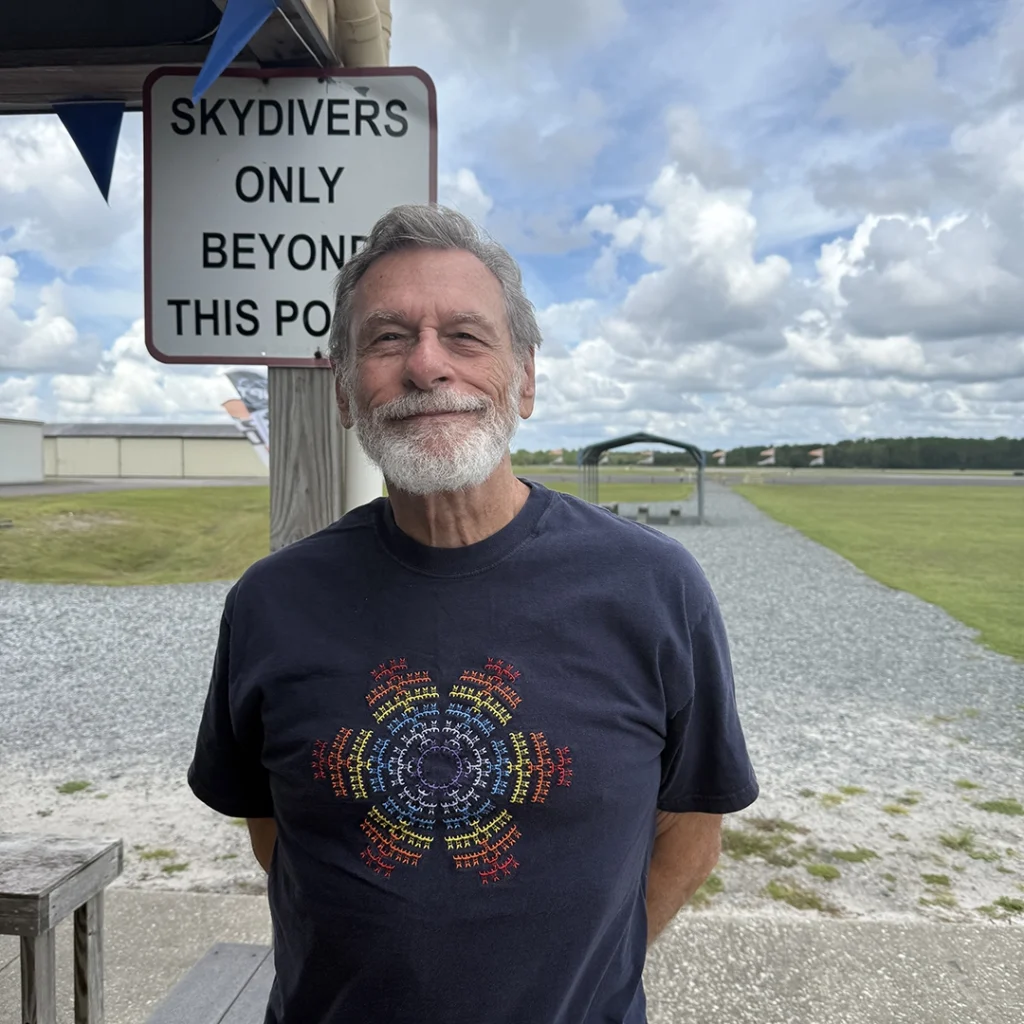
There have been fatalities at Skydive DeLand as well, though they are rare. Last year, a 42-year-old Brazilian man named Giulianno Scotti died after colliding with another skydiver in midair. In 2021, highly skilled skydiver Carl Daugherty died in a similar collision. And in 2022, a skydiver died after a parachute malfunction caused a hard landing.
Deaths were more common years ago. The Daytona Beach News-Journal reported in 2015 that between 2005 and 2015, there were 10 skydiving fatalities at Skydive DeLand—nearly one-third of the 33 total in Florida and Georgia during that decade. The year 2005 was particularly tragic for DeLand’s skydiving community. In January, Czech skydiver Jan Kadie died after a hard landing. Four months later, a plane collided with skydiver Albert “Gus” Wing III, severing both of his legs at the knee. He managed to land but later died from his injuries. In October of that year, a $1-million jump plane crashed, injuring the pilot and five others.
Experts say that the rate of skydiving injuries and deaths is likely comparable to skiing or snowboarding. Industry insiders say that Skydive DeLand uses top-quality equipment—much of it made locally—and employs some of the best instructors in the country. “The whole industry has done an incredible job not only designing the parachute and the systems, but also developing training procedures so that nobody gets on an airplane without knowing exactly what’s going to happen,” Caralt says.
Skydivers Over Eighty
Skydiving isn’t a cheap hobby, but you don’t have to be wealthy to get started. At Skydive DeLand, tandem jumps cost $229, with photo and video packages available for an additional $90. Jumpers who are already licensed and have their own equipment can jump at 13,000 feet for about $30. Martinez wanted to learn to jump solo, so he bought the seven-jump accelerated free-fall package for $1,350. He paid extra for the photo and video package, which he says was worth every penny. “Some of my friends were like, ‘Wow … you did that?’” he says. Martinez’s new goal is to complete 200 jumps to reach the threshold required to wear a GoPro and take his own footage. (The USPA recommends this so novice jumpers can focus entirely on jumping.)
Caralt says that skydiving is like a fraternity that’s welcoming to outsiders but still tight-knit. “You are either one of us or you are not,” he says. He met his wife, Judith Silva, a skydiver on the Spanish national team, through the sport, and says skydiving has been central to his life for decades.
Many skydivers begin with a tandem jump or a few solo jumps before progressing to formation jumping—where teams build shapes in free fall—or participating in artistic competitions. Formation jumping requires a tremendous amount of practice and coordination, especially for larger groups. In late 2025, a Florida-based team of more than 100 members will attempt to break a canopy formation record in Lake Wales, another Central Florida drop zone.
Klingelhoefer says skydiving is an egalitarian sport. “You could be a lawyer or a bum who lives in a bus, but when you’re at the drop zone, you’re both just skydivers waiting to get on the next load,” he says. Johnston says many high-achieving professionals flock to the sport. “For whatever reason, skydiving attracts a lot of Type-A personalities,” he says.
When the back door opens, that’s when reality hits you.
—Manuel Martinez
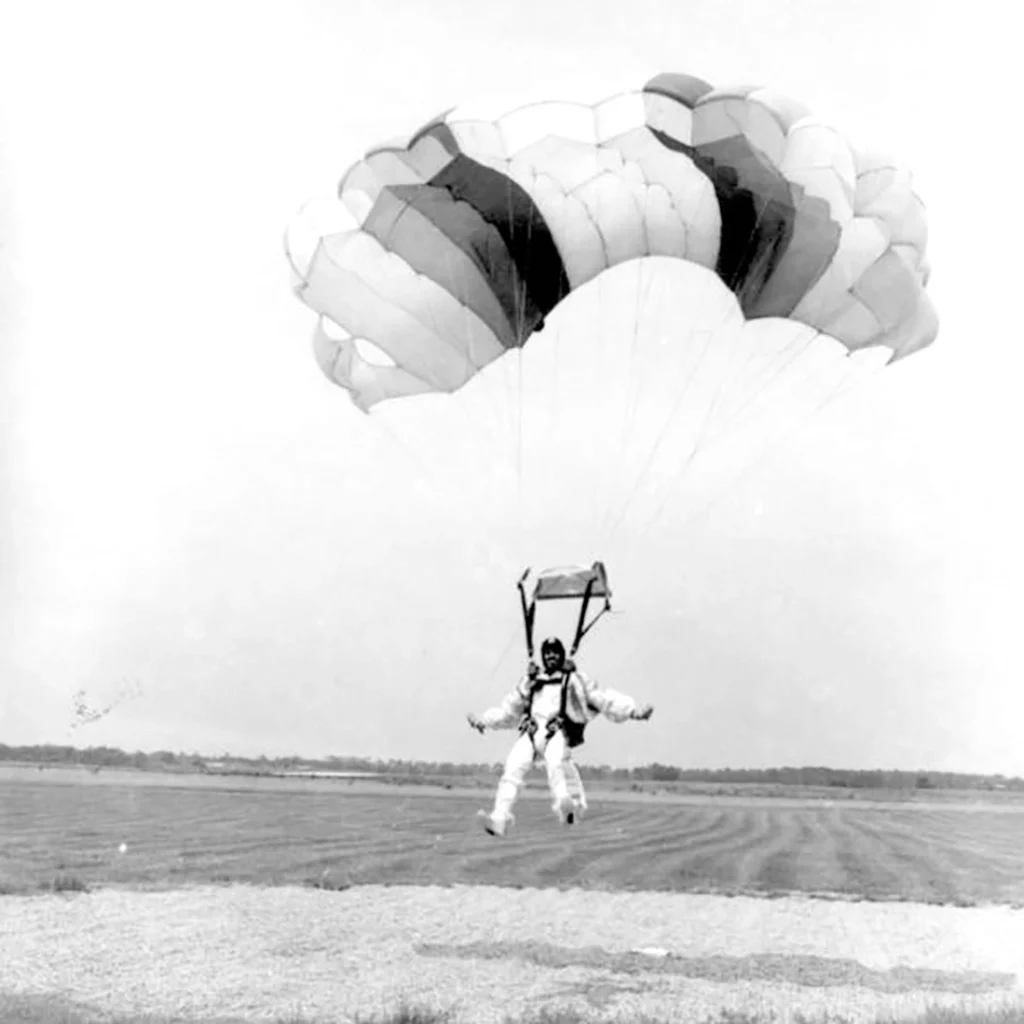
Klingelhoefer’s knee injury may have ended his jumping career, but the 82-year-old Manhold says he plans to keep skydiving as long as his body allows, hopefully until at least 90 or beyond. Skydiving as an octogenarian may sound risky, and Manhold admits injuries from past jumps have led to shoulder, knee and hip surgeries. But he still believes the sport is safe—and insists he’s young compared to some who show up at Skydive DeLand. His friend Pat Moorehead celebrated his 90th birthday with nine solo jumps in 2021.
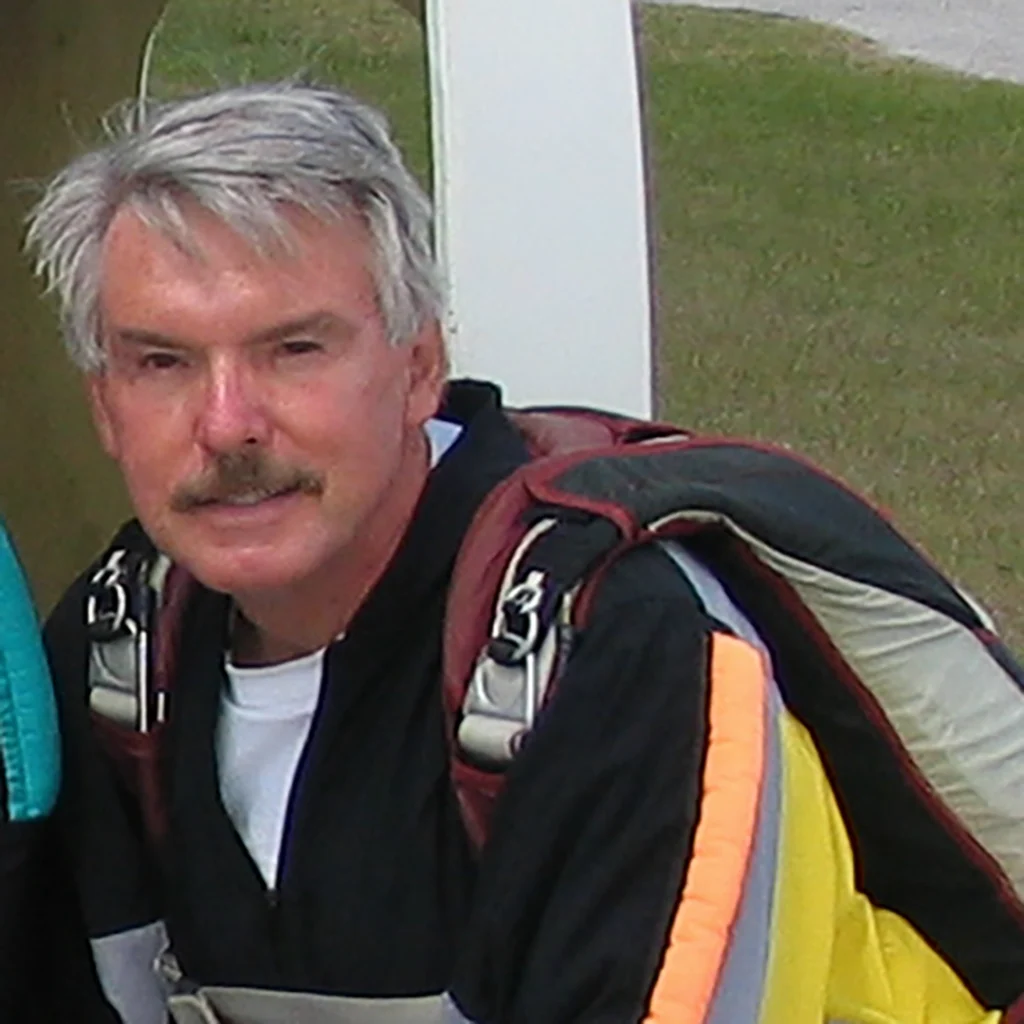
Manhold is part of a group called JOES (Jumpers Over Eighty Society) while Moorehead belongs to JONS (Jumpers Over Ninety Society). Manhold says there are currently 962 jumpers over 70, more than 300 over 80 and 25 over 90 involved in these clubs. Glendine Hamilton, a centenarian who lives at a senior community near DeLand, celebrated her 100th birthday last year with a tandem jump. When asked why she did it, she told local media: “So others could see that it’s possible, and if they want to—do it! It’s fierce. I loved it.”
Caralt says that if you’re considering trying skydiving, you should go for it—but be careful because it’s addictive. “Don’t say no. Just think about it and learn about it … you may decide to jump,” he says.