by | June 8, 2026
The New Dream of Professional Pickleball in Florida
In Tampa, rising stars and seasoned champions reveal what it really costs to chase the fastest-growing sport in America.

It’s already 90 degrees at 9:30 a.m. on a March morning in Tampa, and Rachel Dockter’s first match started off shakily—hopefully not a sign of how the rest of the day will go. She’s 28 and already a two-time Major League Pickleball champion. Today, however, it’s about this match, right now.
Dockter, who competes under her maiden name, Rachel Summers, and her partner, Martina Frantova, come out strong, pulling ahead 4-0. Their opponents take a break to try to shift the momentum and they score, and then they score again and again. By the time Dockter gets the serve back, her team is up by just two, 6-4. It shouldn’t be like this. Dockter and Frantova are favored by a long shot. But they don’t give another point, and the pair pulls out the win, 11-4.
This first-round match is part of the AdventHealth PPA Challenger in Tampa in March, an event open to both pros and amateur players. Pickleball has been central to Dockter’s life since she went pro in 2022—both professionally and personally. A few years ago, she was doing drills with two friends at a court in Naples when one of them spotted a guy they knew named Luke and invited him to join. After the game, Luke and Rachel continued hanging out—both on and off the pickleball court. The couple got married earlier this year. While she’s still listed on the pro circuit under her maiden name, Rachel Summers, she’s otherwise started her second life as Rachel Dockter after taking her husband’s last name.
In the second game of their best-of-three match, Dockter and Frantova absolutely dominated, as Dockter got an ace to clinch it 11-0.

I caught up to Dockter after the win. Wearing a long-sleeve T-shirt and shorts branded by her sponsor, the paddle-maker Selkirk, Dockter tries not to smile out of respect for the two women who lost. Despite finding continued professional success on the court, this tournament could be Dockter’s last on the pickleball pro circuit—for reasons completely unrelated to her play. But on the tournament court in Tampa, there’s a twinkle in Dockter’s eyes. “That’s a golden pickle,” she says.
Even though I play almost daily, I had never heard the term before. It means they didn’t just shut out their opponent—they never lost the serve. A golden pickle.
Where to stay and play on a statewide pickleball roadtrip.
I had come to the tournament held at the Life Time Fitness pickleball facility on Harbour Island in downtown Tampa to get an idea of what it takes to become a pro pickleball player. You’ve probably heard friends say that it’s one of the fastest-growing sports in the United States—some might call pickleball a once-in-a-lifetime sports phenomenon, with Florida as its epicenter.
The weekend in Tampa promised a showcase featuring young hopefuls eager to demonstrate their readiness for the next stage. But for some longtime players, the tournament marked one of the final times they could call themselves pros.

The Rise of Pickleball Pros
The origins of pickleball go back to 1965, when three dads invented the paddle sport to keep their kids busy on an island off the coast of Washington State. They took different parts of sports and created a Frankenstein’s monster: ping-pong paddles, wiffle balls and a game court drawn out in lines on half a tennis court. It spread slowly for decades. “Good Morning America” did a segment on it in 2008. The first pro tour was founded in 2019, but it was the pandemic that boosted pickleball’s growth as a sport that folks could play while social distancing. Now the sport boasts 24 million pickleball players in the United States, according to the Sports & Fitness Industry Association.
In 2022, I went to Delray Beach to report a Flamingo story on a mom and daughter who were tearing up the pro pickleball circuit. The mom was telling her daughter to skip college to chase pickleball dreams, and I had to hold back the urge to disagree. It’s a good thing I kept my mouth shut. The daughter, Anna Leigh Waters, is now the No. 1 female pickleball player in the world and the sport’s highest-paid athlete at just 19 years old. Throughout her career, Waters has won more than $7 million in tournament prize money (her doubles partner, Ben Johns, trails just behind her). Nike signed Waters as the company’s first pickleball professional at the beginning of the year.
Waters is now one of 160 pro pickleball players on the Carvana Professional Pickleball Association Tour. The PPA merged in 2024 with Major League Pickleball, which was founded with investments from hedge-fund manager Steve Kuhn, entrepreneur Maverick Carter and basketball stars including LeBron James and Kevin Durant. Unlike the PPA, where players compete in singles and doubles matches mirroring tennis, MLP is made up of 20 different teams that form their rosters through a league-wide draft. Four MLP teams are in the Sunshine State: the Florida Smash in Tampa Bay, the Miami Pickleball Club, the Orlando Squeeze and the newest, the Palm Beach Royals. Now, most pros end up playing in both leagues. More than a quarter of pickleball’s paid players live in Florida, the largest percentage of any state. South Florida is home to the largest cluster of players, followed by Tampa Bay, according to the PPA.
And while the top players can make millions, that’s not the case for most upstarts. A spokesman for the PPA and MLP told me they don’t release details on how much players are paid or the terms of their minimum contracts. But one aspiring pro, Tanner Wallace, who picked up the game in Fort Myers, detailed on social media how much going pro can cost, starting with $11,000 in yearly entry fees for tournaments and about $30,000 in travel costs. “It’s a harsh reality check for many aspiring athletes,” Wallace wrote.
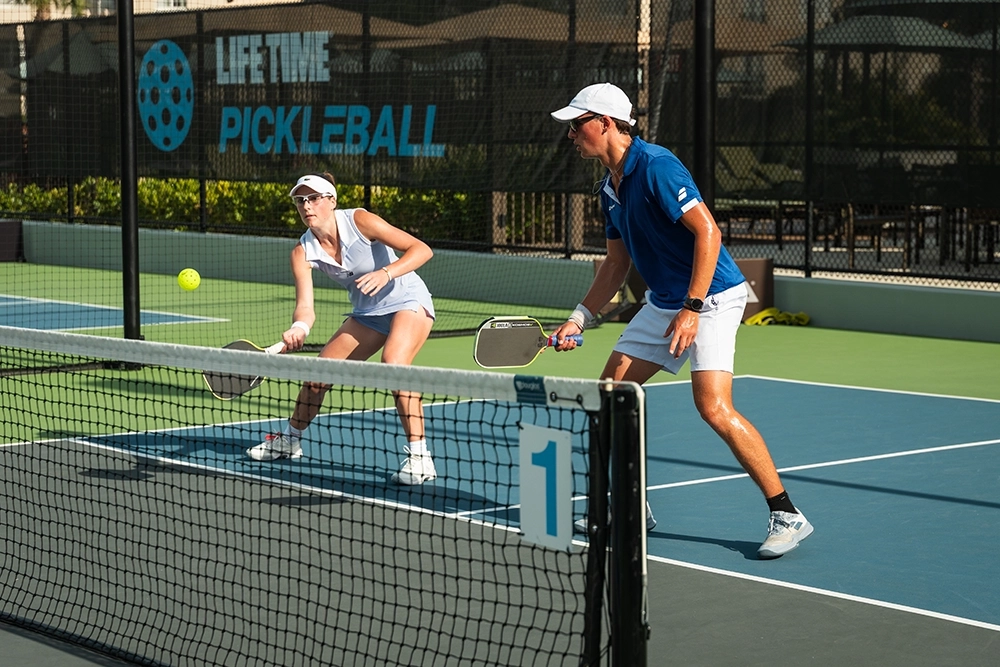
One of the newest pro players is Ava Cavataio, a 20-year-old student at Florida Atlantic University. Cavataio drove from West Palm Beach to the event in Tampa with hopes that a win there could prove she’s one of the sport’s next big stars.
Growing up in Vail, Colo., Cavataio started swinging a golf club when she was 5, and by the time she was 16, she was good enough that her parents relocated the family to South Florida so she could play more golf. But after her senior year of high school, she told her parents she didn’t know if she loved golf anymore. They asked what she wanted to do instead. Pickleball, she said.
Cavataio had been casually playing at her local clubhouse, and she was immediately good. She enrolled at FAU, where she’s the No. 1 women’s doubles college player in the nation. Pickleball remains a club activity, meaning not a sanctioned NCAA activity, but it’s growing fast enough on campuses that some universities have begun giving scholarships to players. In February, Cavataio signed a three-year contract with the PPA and won a gold medal at her first tournament as a pro that same month. Watch the videos on her Instagram feed, and you see a smiley teenager, endorsing sunscreen and offering dinking tips without ever letting up on that grin that fills her face. But then there’s the shots of her at gametime, hair in a braid and a killer expression of a pro athlete. She now has an agent. In February, the Austin pickleball team, the Texas Ranchers, drafted Cavataio, where she’ll play for the 2026 season that takes place this summer. “Ranking-wise, I’m just trying to be a top 10, maybe top five player,” she says. “That’s my future goal.”
I want to put in the work and see how good I can get.
—Ava Cavataio
Dockter also got her big break with the MLP. It happened unbelievably quickly. Back in 2020, she was a two-time all-American tennis player heading into her senior year at the University of Mary Washington in Virginia. Then the pandemic canceled everything, and she went to her parents’ home in Naples. She started playing pickleball with her folks to stave off the sadness over losing her final year of tennis. She was good, from day one. But she just wasn’t sure if it meant anything.
“In Naples, it was a lot of older people, and I’m beating up on 60- or 70-year-old people,” Dockter says. “And I was like, ‘OK, am I actually good?’” So she signed up for some amateur tournaments, first at the 4.0 level, which translates to very good. Then 4.5, then 5.0, almost the pro level.
At the end of 2022, an MLP team from California, the Bay Area Breakers, drafted Dockter. She traveled the country with the team the next year and lost only one match. “We were cruising through matches left and right,” she remembers. She won a pair of championships with the Breakers. Overall, with her 5.2 rating, she’d be the best player at any park near you.
But if this sounds like the upward trajectory of a lifetime pro player, there’s a catch. That’s due to a deal she made off the court, one that cannot be broken, even if it means giving up her pro career.

Where the Pickleball Pro Road Ends
At the event in Tampa in March, things didn’t start well for Cavataio. On the first day of play, she got word that her partner for the women’s doubles tournament was sick, forcing the pair to withdraw. The next day, she played in the mixed doubles tournament.
Cavataio and her mixed doubles partner, Clayton Powell, performed well, advancing to the semifinals with just one more match to play for the gold. Despite finding her footing on the court, Cavataio says she was still getting used to how pro tournaments operate: from keeping track of which court she’s scheduled to play on next, to how to talk with the other pros and what to do during the long breaks in between matches.
“I was like the new kid at school,” she says. “I had to get to know people, how the tournaments are run, and I was asking a lot of stupid questions that people know.”
In the semifinals, Cavataio and Powell took a tough beating, falling 11-1 and then 11-3. Ultimately, the duo placed fourth in the tournament. After the loss, Cavataio traveled back to Miami before flying the following day to another PPA tournament in Texas. Partnered with George Wall in mixed doubles, the duo won their first round in mixed doubles. In the next round, Cavataio and Wall faced Anna Leigh Waters and Ben Johns, the No. 1-ranked mixed doubles pair in the world. “So,” she says with a laugh, “that was an experience. Obviously, they’re the best.” She and her partner lost but managed to score six points across both games, which Cavataio considered a partial victory, considering not just anyone can even score a single point against Waters and Johns. Cavataio left Texas with an overall 18-11 record in doubles and mixed doubles, with a 5.5 rating.

On her plane rides home, Cavataio does schoolwork—a necessity given she’s taking 12 hours of classes at FAU along with a lab. I asked Cavataio if her goal is to be the next Anna Leigh Waters. “I mean, you never know,” she says. “Of course, you want to be that good. But I want to put in the work and see how good I can get.”
For Dockter, her tournament excellence in Tampa continued past her golden pickle in the first round. She and Frantova, in the women’s doubles bracket, won their next match in straight games and moved on to the quarterfinals, where they faced Isabella Dunlap and Mehvish Safdar in a best-of. While neither had particularly high rankings, both Dunlap and Safdar played Division I tennis.
Quickly, Dockter and Frantova fell behind 3-9. A few points later, Dockter slammed a high-bouncing ball in the kitchen—the section of the court near the net—to make the game 7-10. The final point came after Dockter’s strike sent the ball into the net. Dunlap and Safdar’s 11-7 win handed Dockter and Frantova their first loss of the day. The pair needed to win their next game, or else Dockter would finish her pro career in the quarterfinals.
Like all athletes, Dockter’s pickleball career has always had an expiration date—although her reason has nothing to do with on-court performance. Just before she got drafted into the MLP years ago, Dockter traveled to Tampa for a very different kind of event. She raised her right hand and swore to serve in the U.S. Army. In exchange, she’d go to med school debt-free. After she graduates from medical school at Florida International University this year, Dockter will head to Walter Reed in Bethesda, Md., to begin her residency in the hospital’s dermatology department.
Yes, that’s right: Dr. Dockter.
When Rachel and her husband head up to Maryland, Dockter knows she won’t have time for much else, especially pro pickleball tournaments. But she and her husband play together as partners; he’s ranked 4.5, which is very good—just not as good as she. “I think playing with him is fun because we can play at that slightly lower level,” she says. “We’ll always have that for sure.”
As for when she’s out of the Army in eight years, Dockter figures she’ll be “too old and out of shape” for pro pickleball. She imagines she may move back home to be near family. Perhaps she’ll find a job as a dermatologist in the Naples area, where she’ll regale her patients about her days in pro pickleball.

In the second game of her quarterfinals match, Dockter and Frantova fell quickly to 1-4. They called for a time-out, hoping to change the momentum. After tying it up 5-5, they got a bad call on a dink—one of those light shots that looks simple, but separates the pros from the amateurs. The game went back and forth: 7-7, then 8-8, with the match up for grabs. Anybody could win this thing.
When Dockter hit a drive into the net, I wondered about fatigue. With a feels-like temperature in the 90s, I was roasting just watching. I asked her about the heat at one point. “It’s infinity hot,” she says.
After getting the serve back, the other team went up 8-9 on an impossible-to-return shot down the middle. The opposing team scored again to go up 10-8 and get a match point while Dockter’s team was down by two. During the rally, Frantova popped up a ball over the net. Pickleball players call that candy, because it’s sweet to see a ball rising slowly in front of you. One of the opponents raised her paddle, forcing Dockter to backtrack in hopes of getting a spike at her feet that she could return. But her opponent’s slam sent the ball between Frantova and Dockter, with no way for a return.
I’m beating up on 60-or 70-year-old people. And I was like, ‘OK, am I actually good?’
—Rachel Dockter
Dockter and Frantova lost the game 11-8. Dunlap and Safdar went on to win the gold medal final in just two games. Dunlap won silver in mixed doubles the following day.
After the loss, Dockter and her partner headed to a shady spot. I asked Dockter how she was feeling. She was mad, barely able to speak from the exhaustion and disappointment. Shaking her head, Dockter blamed herself for unforced errors, something I saw her do very rarely that day.
In the aftermath of the battle on the pickleball court, Dockter looked past me. She looked past her opponents, past the tournament. Her eyes had the intensity of a doctor, of a soldier. Maybe one day Dockter will return to pickleball. But I bet that she will always, whatever she’s doing, operate at only one setting: champion.
To read about Anna Leigh Waters’s rise to pickleball stardom, click here.
About the Author
Eric has been a journalist in Florida for two decades, including stints at newspapers in Fort Pierce, Stuart and Sarasota. His role at Flamingo includes everything from interviewing chefs to first-line editing on cover stories and penning our monthly culinary newsletter, Key Lime.