Spellbound by Author Madeline Martin’s Latest Bestseller “A Time of Witches”
St. Augustine's Madeline Martin talks about researching England’s notorious witch trials, her latest novel and finding magic in the past.

Even as a young Texas high school graduate, Madeline Martin was drawn to ancient times and places. At 18 years old, she left behind an “Army brat” life that had taken her overseas and back for a future in St. Augustine. A self-described history nerd, Martin found exactly what she was looking for among the city’s centuries-old streets, and she never left.
More than 25 years later, the author has built a career anchored in stories of the past. From her St. Augustine home, where the walls are lined with history textbooks, she has written more than 40 books, many while juggling a career in business analysis. That balancing act ended in 2020 when Martin lost her job—a shift that allowed her to focus full time on writing and led to her first New York Times bestselling book, “The Last Bookshop in London.” In her latest novel, “A Time of Witches,” Martin, 46, transports readers between 17th-century England and present-day Savannah, Ga., where two women are tethered across time and distance to each other. The book’s perspective switches between Sybil, who lives in a time where witch hunters patrol cobblestone streets on horseback, and Lilith, who works in a cozy bookshop in Georgia. As Lilith begins to dream about Sybil and consulta local fortune teller, she uncovers details about the 17th-century stranger, and their lives unexpectedly intertwine.
“Both women are fighting for their independence, and the world is pushing back on that significantly,” Martin says.
Flamingo recently sat down with Martin ahead of the release of “A Time of Witches” to chat about researching witch trials in England, her passion for historical fiction and the magical powers of self-love. The following responses are edited for length and clarity.
What brought you to Florida?
Madeline Martin: St. Augustine is the oldest city in America, and I am a history nerd. So that’s how I ended up coming here. It’s funny because when I was in high school, I really couldn’t afford to go and do all the historic fun things. Then I had kids, and I didn’t have the time to go and do all those kinds of things. So now that my kids are older, my husband and I, once a year, have a little weekend getaway 20 minutes from our house in downtown St. Augustine. We play tourists with the little trolley stickers and everything.
Tell me about the beginning of your career as a novelist.
MM: Hugely pregnant with my second daughter, I went to my very first writing group meeting. That was really interesting for me because it was the first time that people asked me about me. Rather than me being somebody’s wife or mother, I was myself again. It was like I’d almost kind of lost myself without realizing that that had even happened, and writing kind of helped me get that back.
How did that writers’ group shape you?
MM: There was a woman there, and we did a critique of one another’s work. She was very kind, but I realized I had no idea what on earth I was doing. I really was not a very good author, and so I spent the next five years basically learning everything that I could about writing, and after those five years, that’s when I wrote my first historical romance, “Deception of a Highlander.” I submitted it to three nationwide contests, and I finaled in all three, and then I won first place in all three.
When did you know that writing would be a full-time thing for you?
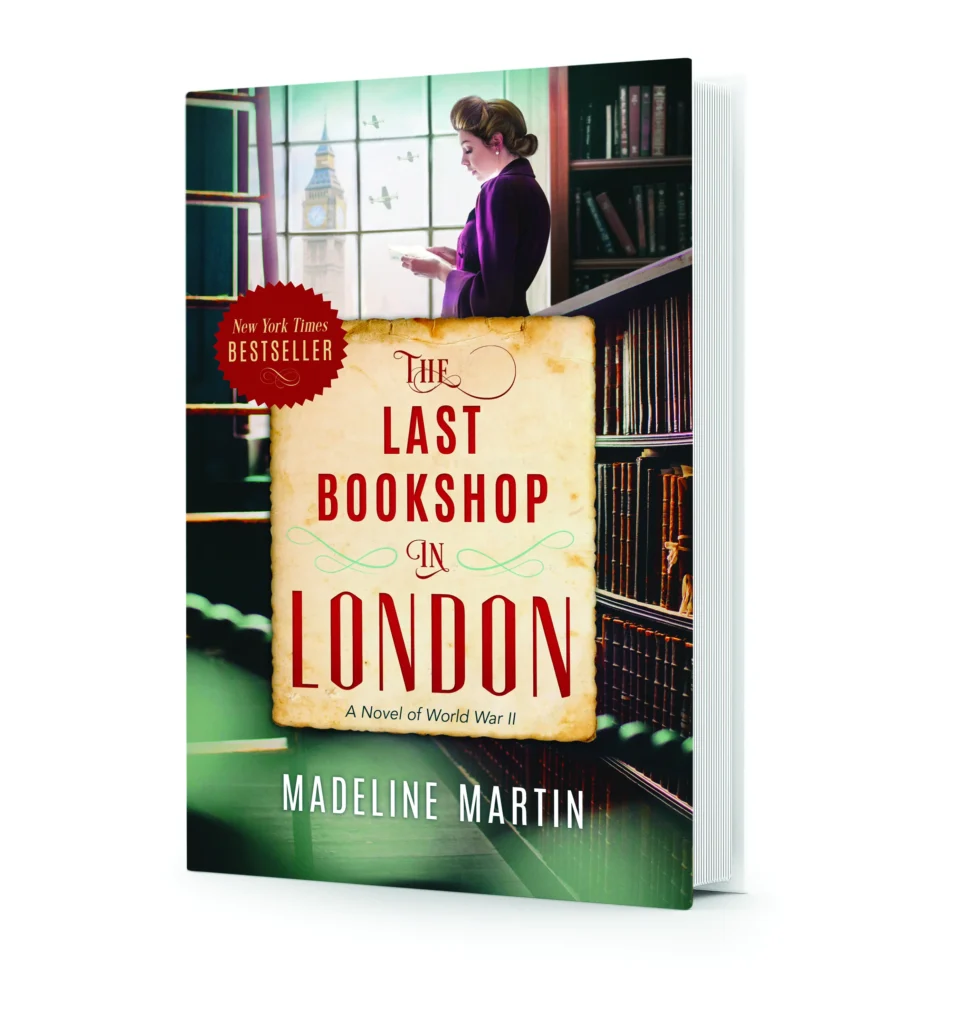
MM: I was writing six to eight books a year, working a full-time job and my daughters were everything. The writing was on the wall at work, and I told my husband, “If I get laid off, I think I just want to try writing full time. I’m tired.” So I got laid off, and I thought, “This is going to be so amazing. I’m going to have the entire house to myself, and it’s going to be quiet, and I can focus.” This was February 2020. The pandemic happened three weeks later, and I was robbed (of that). But it gave me the opportunity to really put the focus that I needed to do the research for my first historical fiction, which was “The Last Bookshop in London.” A year later, that book came out, and it hit No. 8 on the New York Times (bestseller list).
What did that moment feel like?
MM: I had written over 35 books. I had been writing for over 15 years. I never thought that was going to happen to me, and so I went home and I celebrated with a glass of wine while I was doing the laundry. Mom life doesn’t stop.

In your latest book, “A Time of Witches,” how did you collect the vivid details of life in 17th-century England?
MM: I traveled on-site to Bury St. Edmunds. I went there for over a week, and it’s funny because I took so many tours that the tour company actually put an article in a newspaper about me. They’re like, “author takes record number of tours,” and it was hilarious. I got to meet with a woman who specializes in historical herbs while I was there and just got to walk around and get the feel of the place.
How did researching the witch trials in Bury St. Edmunds inform the story?
MM: An interesting aspect of the research, for me, is that when you read about the witch trials in other places of the world, there is so much violent torture. It was thumbscrews and the Iron Maiden, the rack and all of these other things. So because they weren’t implementing those specific devices (in Bury St. Edmunds), they didn’t think of what they were doing as torture. They’re like: “Yeah, well, we’re just making them stay up. Oh, well, we’re just not getting them any food. Oh, we’re just making them walk back and forth. It’s not that big a deal.” They didn’t see what they were doing as torture.
Did this information alter your approach to writing the novel?
MM: After hearing about how they had been treated by these men, I wanted the men to pay. What you give to others, you’ll get that threefold.
What makes your story about witch trials different from others?
MM: When I’ve read books about witch trials in the past, I’ve always been disappointed that you don’t get to see inside the cell. Maybe that’s a little bit morbid of me. It’s like the witch trial essentially happens in the courtroom, and I usually find that to be a bit boring. So I really wanted to see what the process looks like from when they actually get arrested.
What modern parallels did you explore?
MM: I really wanted to showcase an independent woman in both particular time periods. As far as Lilith goes, she’s having to essentially fight for her independence as well—her decision to not get married and not have a child. She’s having to fight for that in a world where we are supposed to be so much more free to do what we want, but there’s so much societal pressure still.
How did you approach writing Lilith’s journey of embracing a part of herself she had suppressed?
MM: I wanted to approach it very slowly. I wanted it to be a gradual thing. I think a lot of women suffer from low self-esteem. I absolutely did. You don’t just wakeup one day and think, “Actually, you know what, I’m amazing.” It takes a lot of work and self-reflection to get to the point that you can appreciate the amazing person that you really are.
What did you learn about yourself through this process?
MM: The nature of magic and the appreciation of magic. So much of it really was going outside and paying attention to what’s around you. Thinking about how flowers know to bloom during certain seasons and how you know seeds will fall down that can make new trees. Just the cycle of life and going out and appreciating that. Feeling empowered by the sun, feeling emboldened by the moon and also really realizing that inside of you there is this power that is wonderful, and that it is pure, and that it is raw, and that it really is so much about self-love, and how empowering that can be.
What is it about historical fiction that keeps you writing?
MM: It’s the Tootsie Pop of the book world. It’s brain candy wrapped around a nugget of knowledge, and you walkaway feeling entertained and educated.
What Florida stories do you want to write but haven’t?
MM: There is one that I thought would be really interesting that has to do with hotel staff during Henry Flagler’s time. It’s sort of the idea of kind of like a “Downton Abbey,” with all the things that happen under the surface. But I mean, it’s so hard to see when I would have a chance to do that. I have so many books in my head. I have more books in my head than I think I have life in my body.
For more Florida authors, click here.
About the Author
Olivia Evans, the editorial and sales assistant at Flamingo, is a graduate of the University of Florida.