Korean Folk Art Meets American Pop Culture in the Fantastical Work of Tallahassee Artist Jiha Moon
Jiha Moon, Florida State University Professor, painter and ceramicist, uses color as a primary tool of self-reflection.
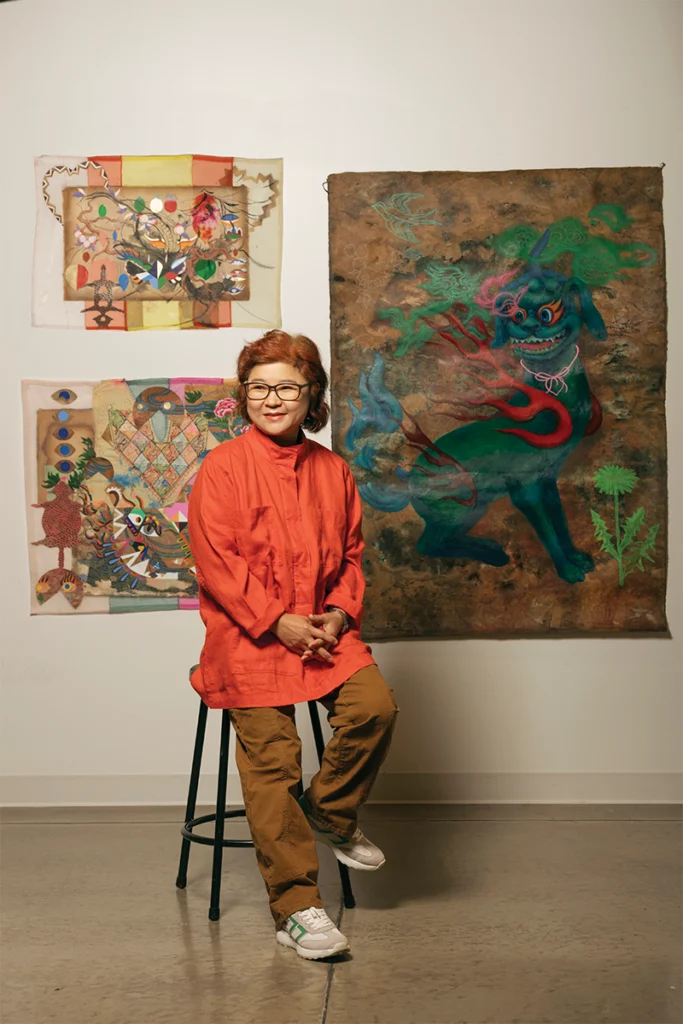
Stepping into Jiha Moon’s home studio in Tallahassee is like entering a world where ordinary objects might bust out dancing. In her vibrant paintings and ceramics, no style is off-limits: Korean folk motifs collide with American pop art, emojis, smiley face stickers, Disney characters, Chinese porcelain, cartoons, glitter, rhinestones and Pennsylvania Dutch themes, creating a raucous visual eld where high and low culture and East and West clash and clang.
“I’m like a sponge,” Moon says. “Absorbing and digesting. And I’m also a conductor orchestrating many different instruments or styles.”
A collection of partially finished clay sculptures dot work tables throughout the space, all part of Moon’s preparation for a solo exhibition at Shoshana Wayne Gallery in Los Angeles this fall.
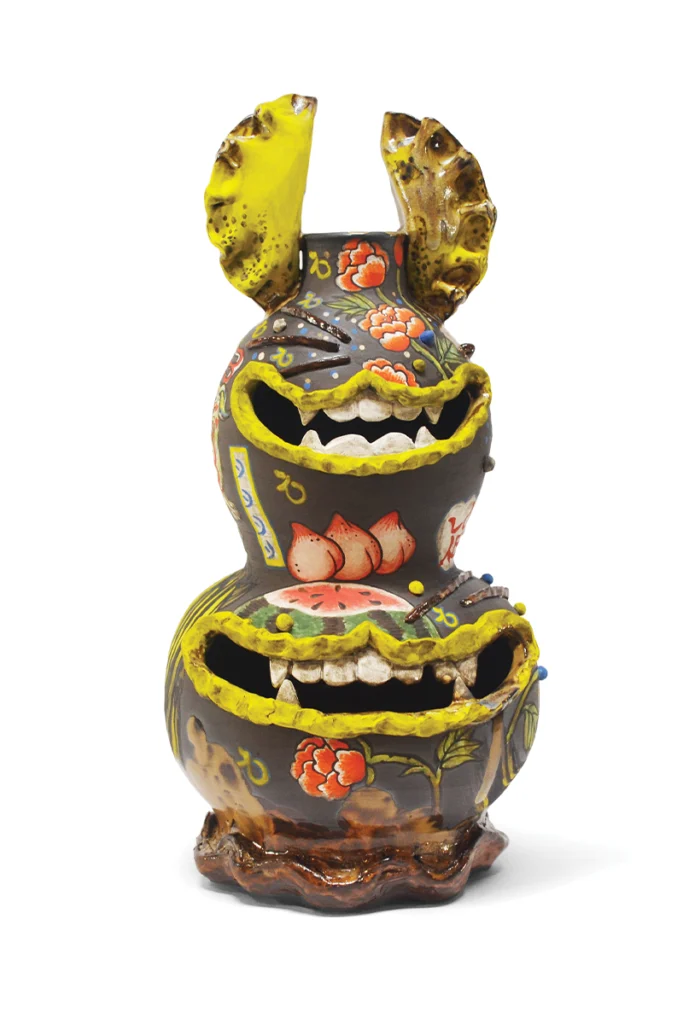
As we move through the studio, ceramic fortune cookies with painted eyes stare at us. Small statues of Korean haetae, mythical lion-like guardians said to ward off disaster, grin mischievously as they devour bruised banana peels. Nearby, soft pink peaches perch like offerings atop painted shelves, and a Grecian urn-like vessel balanced on babies’ feet threatens to tip into the jubilant chaos surrounding it.
Moon, a 2023 Guggenheim award-winning artist, earned a Master of Fine Arts in South Korea before coming to the United States in 1999 to pursue a second MFA at the University of Iowa. She later spent more than 20 years living and working in Atlanta before joining the faculty at Florida State University’s College of Fine Arts three years ago.
Art is everywhere. It’s not just meant for museums.
—Jiha Moon
“When I first arrived from South Korea at age 26, people constantly asked me, ‘Where are you from?’ And that kind of made me want to go to the bathroom and look at myself in the mirror and ask myself that question,” she says.
Color is one of the primary tools she uses for this self-reflection—brown recalls not only dirt and the palette of the Old Masters but also the muted texture of hanji, the traditional Korean mulberry paper she uses in her paintings. Blue carries multiple lives at once: blue and white porcelain, sky, ocean, supermarket orchids and even her husband’s eyes. But no color carries more weight or more contradiction than yellow.
“I have a simple concept when I start a painting. For me, it’s something like, ‘I want to use the color yellow,’” she says.
Fruit as Fodder
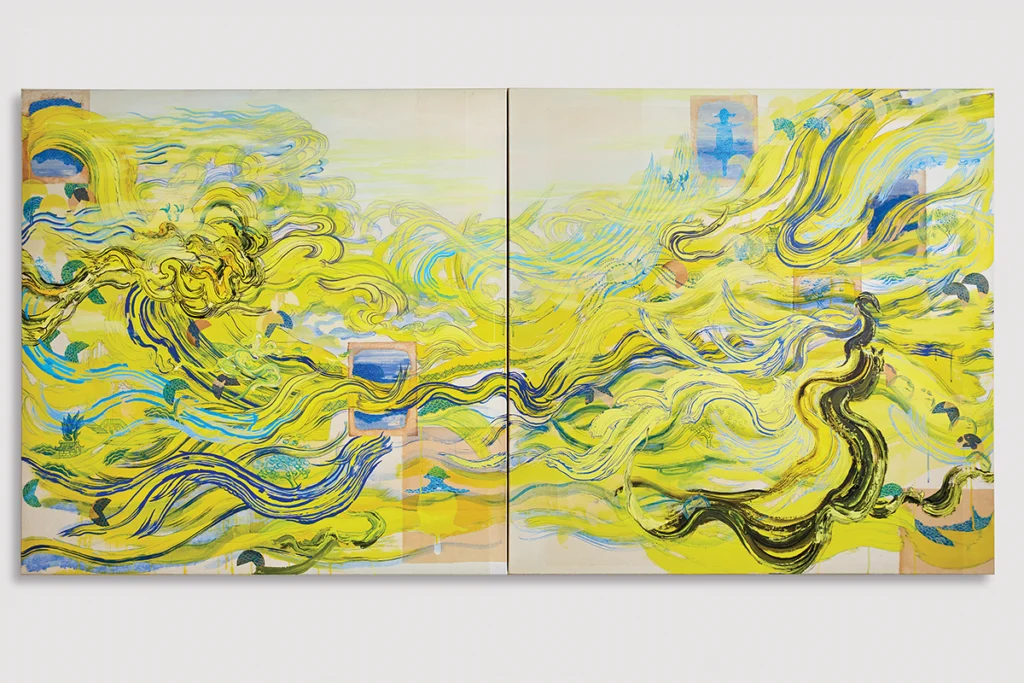
Yellow in Moon’s work is never just yellow. Her “Stranger Yellow” series of paintings and ceramics, exhibited at Derek Eller Gallery in New York in 2022, explores the complexities of being an Asian woman and immigrant. In one diptych, energetic ribbons of paint flow across the canvas in bursts, suggesting that identity remains in motion across histories and borders.
The series, which engages with Vincent van Gogh’s “The Road Menders” (1889), connects radiant yellows to the perspective of the outsider. But where van Gogh’s yellow signifies isolation, Moon’s use of the color is a meditation on belonging. References to skin color, sunlight and even Homer Simpson intersect in her paintings, transforming a familiar color into a vehicle for reconsidering how identity is both perceived and understood.
Those questions extend into a recurring symbol in her body of work: the banana.
“Yellow outside and white inside,” Moon says, invoking a racist trope historically used against assimilated Asian Americans.
The phrase became a point of departure in her studio practice in the form of an experiment. She decided to observe a banana slowly decaying in her studio. As her research unfolded, she noticed fruit flies gathering as the banana slowly wrinkled, darkened, shrank and eventually returned to the earth.
“Both the banana and the fruit flies disappear beautifully,” she says.
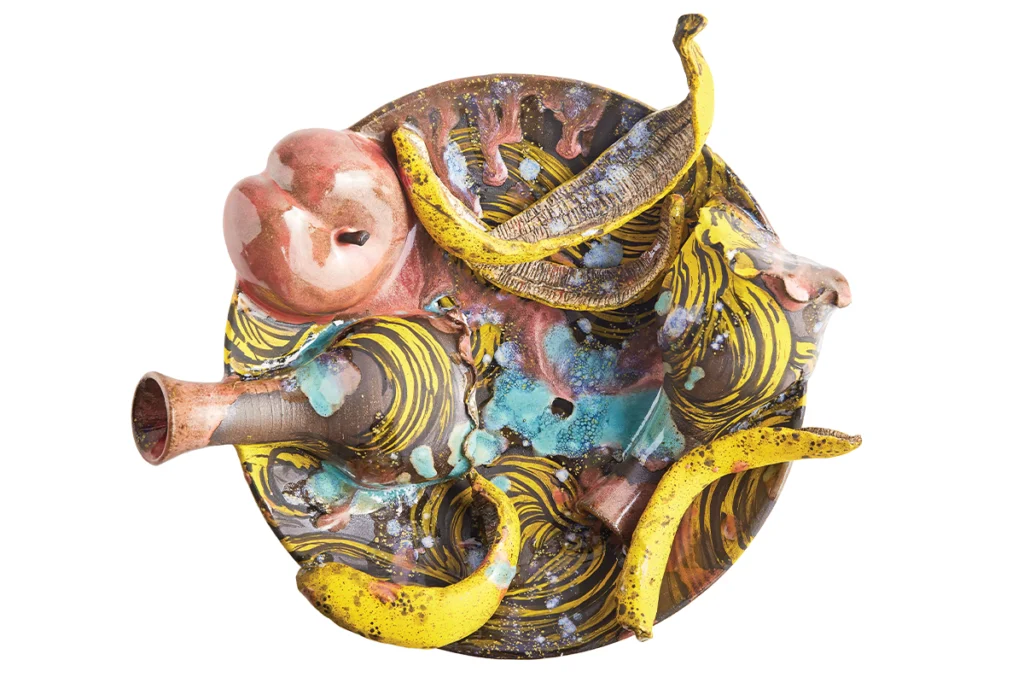
This investigation became an unexpected musing on aging as a woman. Rather than concealing the peel’s brown spots or signs of decay, Moon delights in them, reproducing blue and black mold in her ceramics. The peels, glazed and glistening, are split open and folded back on themselves, revealing an unexpected beauty.
“If you don’t celebrate you,” she laughs, “I’m going to celebrate for you.” Moon brings that humor and celebration to another fruit: the peach. In her practice, it carries both sensuality and absurdity.
“The peach looks like a baby’s butt and boobs at the same time!” she says, smiling. “It’s funny, but it’s also confusing.”
The fruit acts as a stand-in for the body, its curves slipping between comedy and maternal tenderness. In “Angry Peach,” a small round ceramic with a nipple-like top, Moon paints the furrowed brows of the Angry Birds characters directly onto the fruit. The meeting of maternal imagery and the visual language of children’s digital games reflects her pleasure in collapsing the boundaries between domestic life and popular culture
Beauty in the Everyday
Living in Atlanta for more than two decades intensified the fruit’s meaning. Georgia’s official fruit is everywhere in language and infrastructure. The word “peachtree” appears endlessly on road signs and buildings across the city, until geography itself begins to feel playfully disorienting.
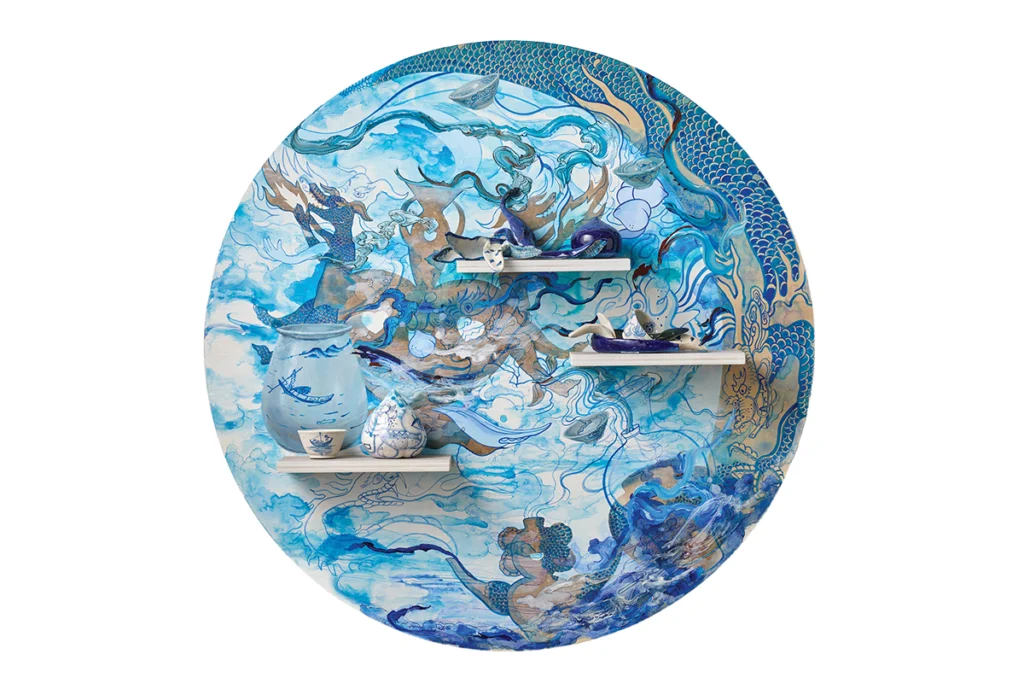
That sense of joyful instability echoes in Moon’s exhibition “Double Welcome: Most Everyone’s Mad Here,” which opened in2015 at the Taubman Museum of Art in Roanoke, Va., and toured more than 15 museums across the United States. In that body of work, blue dragon tails mutate into household objects, cultural symbols converge and childhood imagery drifts into surreal assemblages. Like Lewis Carroll’s “Alice in Wonderland,” from which the exhibition’s title is borrowed, Moon’s art embraces the pleasures and possibilities of getting lost.
On a nearby shelf, ceramic dumplings sit beside the peaches and fortune cookies, their pleated folds rendered with the same affectionate precision that Moon gives to bruised banana peels and watchful haetae. She says the dumplings recall afternoons making food alongside her mother and grandmother.
“My mom and my grandmother,” Moon explains, “are not artists, but they’re my biggest influence.”
Cooking, like sewing or folk painting, becomes another medium through which women pass knowledge from one generation to another. The women in her family taught her that beauty is already present in the world and that art can be made from everyday materials.
This belief explains the artist’s fascination with folk art. Whether she is looking at the folk art of the Pennsylvania Dutch or Mexican devotional imagery, she is drawn to the way these traditions exist to care for and strengthen communities, honoring the functions of daily life. She says she loves that these objects bless homes, celebrate families and pass on collective memory.
“Art is everywhere,” she says. “It’s not just meant for museums.” For Moon, creativity belongs as much to mothers making dumplings and grandmothers sewing quilts as it does to professional artists painting canvases and hanging them in galleries.
It is within those exuberant collisions that Moon has built one of the most original artistic languages working today, one that rejoices in both surprise and confusion, and in both seriousness and play.