by | March 2, 2026
Behind the Stories: A Decade of Flamingo’s Best
Unpack the backstories behind 10 years of Florida’s best features—told from the perspectives of the writers, photographers and editors who brought them to life.
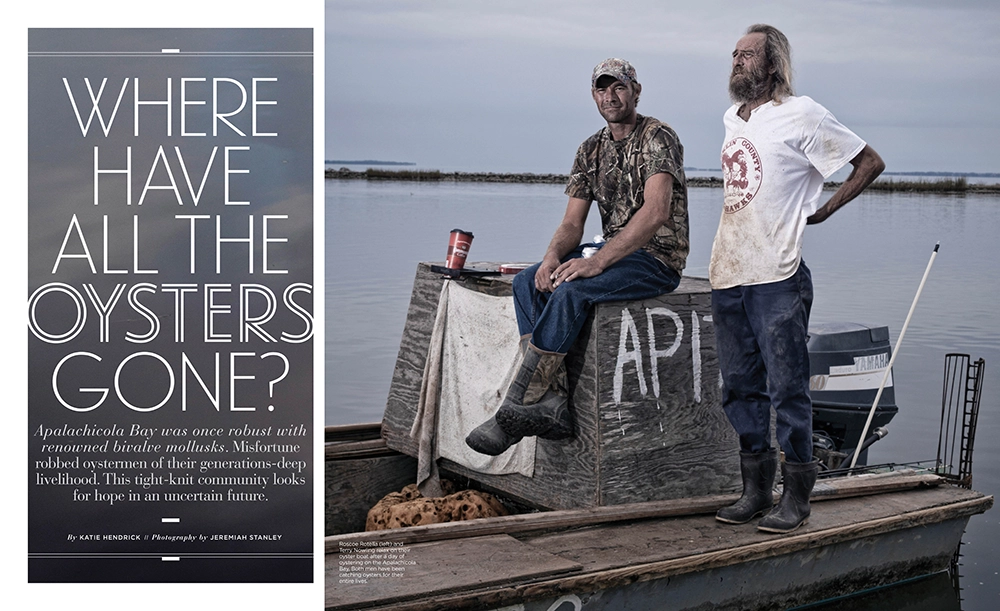
The Beauty of the Bay: 2016 Spring Vol. 1
Telling the generational sotry of Apalachicola oystermen
By Katie Hendrick Vincent, writer
I was living with my grandfather when I got the assignment. He was a quiet man, but I knew he was excited because the morning after I told him, he forwarded me an email chain he’d already had with his friends—whose family once owned an Apalachicola newspaper—to see if they still had contacts in the area. Soon, his friends’ friends had me in touch with Tommy and T.J. Ward, fourth- and fifth-generation oystermen, and I had a trip planned to the Panhandle.
In the meantime, I reached out to Southern food expert John T. Edge, with whom I’d emailed when I was an intern at another magazine. He appreciated that Flamingo wanted to spotlight the plight of this iconic industry and seconded that I needed to talk to the Wards. In addition, he recommended I interview Lynn Martina, a third-generation oyster dealer turned restaurateur. These sources, in turn, connected me with others. I was blessed that so many people believed in this story from the get-go and made sure I had the voices needed to bring it to life.
After an afternoon exploring Apalachicola’s waterfront, I spent two full days talking to oyster dealers, touring empty packing houses and patronizing local restaurants like Boss Oyster, which sadly was destroyed by Hurricane Michael in 2018. I left with a notebook full of information and a stomach full of bivalves.
When I write, I rarely begin with the intro. This time was an exception. I knew I wanted to capture the beauty of the bay—indeed, shimmering like sequins—and the peace of Florida’s Forgotten Coast.
On my way home, I spent a night at my dad’s cousin’s home in Sopchoppy. I debriefed her on my story, and she mentioned her friend who started farming oysters. I interviewed him a few days later and had my kicker. I was relieved to find something optimistic to end on.
“Where Have All the Oysters Gone?” won best feature story from the Florida Magazine Association in 2016. Accolade or not, this story was my proudest professional achievement.

The Design Madam of Palm Beach: 2017 Spring Vol. 5
On the hunt for vintage Lilly Pulitzer
By Christina Cush, editor
Let’s take a Technicolor time warp and uncover the making of “Long Lost Lilly.” Before I lived in Florida, my many years of magazine feature assigning and editing in New York City had well equipped me to tackle the logistics around this colorfully complicated 12-page feature story in my role as Flamingo’s executive editor.
First, we did our own research to get an understanding of what was uniquely Flamingo about Lilly Pulitzer’s designer tale. Turns out, it was the way she connected dots across the state, just like we aimed to do at the magazine. Writer Nancy Klingener, a former NPR correspondent based in the Florida Keys, shared that Lilly bridged Palm Beach country clubbers with a cadre of artists and small business owners in Key West. After squaring away the story angle and writer, we dug into how and where to find the best vintage Lilly threads in the Sunshine State and borrowed several pieces from two sources in South Florida: Nancy Noonan and Elinor Stephens.
To bring Lilly into the present tense, we hired a fresh-faced model, Eve Gay, who conveniently lived near our Flamingo headquarters in Ponte Vedra Beach and made herself available for a massive fitting. We also visited Emly Benham and Penelope T boutiques in Jacksonville Beach, obtaining accessories to keep Eve looking current and chic. Knowing we were going to make this story a combination feature and fashion piece, we had to get the location right. A scouting trip to Flagler University in St. Augustine, the surrounding streets and nearby Lightner Museum revealed that one Florida icon, Lilly Pulitzer, deserved to be photographed with another, Henry Flagler.
The day of the shoot, photographer Mary Beth Koeth arrived from Miami with her calm and positive demeanor. The weather and lighting were perfect. One of my favorite memories of that day was being on shoe patrol, making sure the bottoms of the borrowed Jimmy Choos that Gay was wearing didn’t get scratched by covering them with yellow sticky notes. This story went back in time, yet it was also precocious, evoking the Palm Beach cool that is currently reflected in Apple TV’s campy hit show “Palm Royale.”
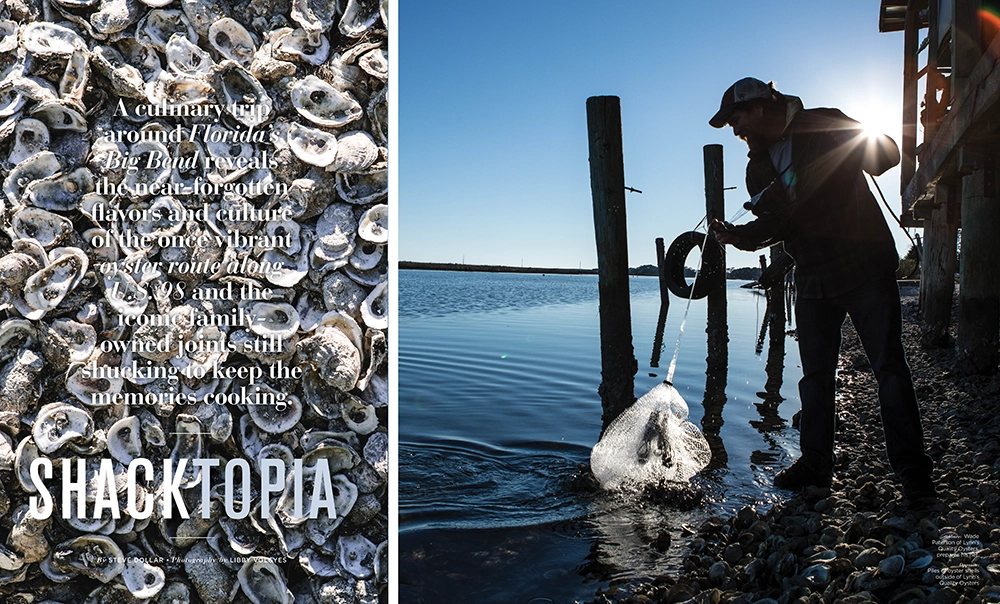
Bivales and Bygones: 2018 Spring Vol. 9
Reminiscing along the oyster route of U.S. 98
By Steve Dollar, writer
As a Panhandle kid growing up in the 1960s, it was easy to take everything for granted—all the beach trips and meals at seafood houses, the unspoiled shoreline of St. George Island, the perfect gem-like miracle of the Apalachicola oyster, the hint of coconut scent from the Coppertone sunscreen mixed with the salt breeze from the Gulf. You think it will all be there perfectly preserved forever, but time takes its course, and with it, hurricanes, ecological disasters, gentrification, politics and the rest erode the idealized picture frame of memory and leave the present reality.
My feature story was an ode to the oyster shacks of Highway 98, a yet-Edenic stretch of road that wraps along what locals still like to think of as the Forgotten Coast. It was inspired by a need to lock down feelings that lingered from those childhood experiences—back even when I pointedly refused to eat any kind of fish at all (I was always the kid who ordered a cheeseburger) and hid from the sun under my own improvised beach tent (otherwise I would fry like bacon). At the time I was reporting the story, which mainly involved eating a lot of raw oysters and drinking cold beer—God, I love journalism—my father had just died, so emotions were raw and memories vivid. Maybe it’s a cliche, but writing really was therapy and gave me a necessary way to ground to something elemental. At the time, I wouldn’t know that a pandemic and a pair of highly destructive hurricanes would bring more trouble to the delicate ecosystem that supported my cherished oyster dives, and that destinations fixed in my personal mythology—like Spring Creek Restaurant—would cease to exist. My reflections on indelible memories from a familial past became a snapshot of a coastal culture forever at the mercy of the shifting tides.
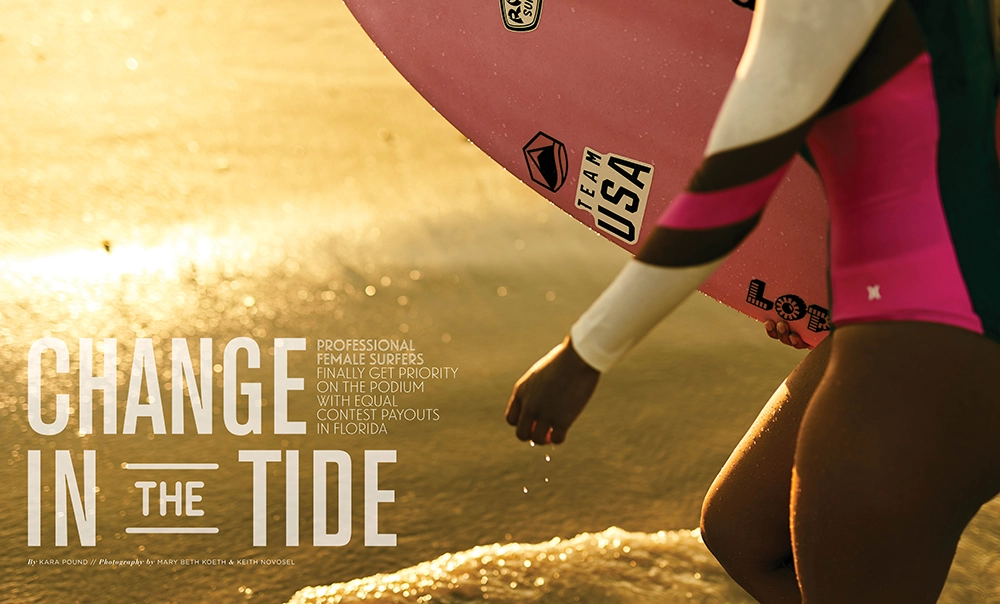
Leveling the Lineup: 2019 Winter Vol. 16
Making waves to ensure equal pay in local surfing competitions
By Jamie Rich, Editor in Chief
In the fall of 2019, our family’s weekends revolved around surf competitions. One Saturday, my daughters—then 8 and 12—surfed in the Void Pro/Am at the Jacksonville Beach Pier. At the time, Void was a popular local surf and skate magazine, and the contest drew amateurs and pros. Our girls surfed as amateurs, but several of their coaches and mentors—including Kayla Durden—competed as professionals.
After the finals, everyone headed to Surfer The Bar, a nearby restaurant and bar, for tacos and to hear the results of the pro divisions. While we ate, the emcee kicked things off by announcing that Durden had won the women’s pro shortboard division. She stepped onstage amid a storm of hoots and hollers and was handed an oversized check for $250. All was good.
Next came the reveal for the men’s pro shortboard division. Local favorite Cody Thompson had won and was presented with his oversized check for $1,250. The crowd went wild. I nearly choked on my taco.
A $1,000 difference? For the same event? What really made me upset was that the organizers themselves had young daughters competing alongside ours, and Durden was a hero to them all. Our family of four left that night hotly debating how this could still happen in 2019.
Later that night, a social media post went up advertising the upcoming Wavemasters, an even bigger pro/am competition. The men’s purse was $10,000, while the women’s was only $5,000. My head was spinning.
Flamingo wasn’t a player in the surf sponsorship world. But we were in the business of telling stories—and helping to create positive change when we could. We put up the $5,000 to equalize the women’s pro purse. People were elated, and women from as far away as California came to compete. We rooted for Durden, of course, but another rising Floridian, a then 14-year-old Zoe Benedetto, took home the top prize. Benedetto—and the right to equal pay in women’s surfing—became Flamingo’s Winter 2019 cover story.
I’m proud to report that our sponsorship made a lasting mark. Every professional surf contest held in Jacksonville since then has paid male and female competitors equally. At home, it was a chance to show our girls that when you see something that’s not right, it’s OK to make waves because it just may lead to a change in the tide.

Snake Hunting With the Lady Killers: 2020 Digital Edition
Riding shotgun for a nigth with female python hunters of the Everglades
By Mary Beth Koeth, photographer
In June 2020, I was asked to photograph Florida’s leading female python hunters. I spent the evening with Anne Gorden-Vega, a then 61-year-old Floridian who had captured more Burmese pythons than the 37 other hunters working for the Florida Fish and Wildlife Conservation Commission combined that year. Her background is in art education. Her resume does not include hand-to-hand combat with invasive species, but perhaps it should.
I met Anne at 6 p.m., just as the sun dropped low over the Everglades, and stayed with her until 10:30 that night. She typically hunts until 2 in the morning, which quickly clarified the difference between professional endurance and my own. We drove slowly along dirt roads, massive lights mounted on her truck flooding the swamp with artificial daylight. Hunters are trained to look for iridescence and a pattern—subtle visual cues signaling a python hidden in dense vegetation. Anne scanned with ease. I squinted with optimism.

Throughout the night, we encountered several other female hunters. Many reminded me of my childhood schoolteachers—kind, composed women who look like they might gently remind you to sharpen your pencil, not wrestle a 7-foot python after sunset. They spoke calmly, joked easily and hunted with quiet authority. There was no bravado, no theatrics—just hours of looking, waiting and driving at roughly 6 mph.
The work is not especially lucrative. Some nights yield no snakes at all, effectively making this a minimum-wage job with unusually high stakes. Anne spoke less about money than she did about the absence of wildlife—the raccoons, foxes, birds and small mammals the pythons have erased. The urgency, she explained, leaves little room for hesitation.
At 10:30 p.m., I headed back to Miami Beach, genuinely disappointed to leave. I told Anne I wished I could stay until 2 a.m. She nodded, as if that were reasonable, and kept scanning the swampy terrain.
If photography ever stops working out, I will not become a python hunter. But I would make an excellent truck companion—cheerleader, moral supporter and snack provider. Some roles are about knowing your strengths. I’ve always been great at snacks.
Keeping Florida’s Frontier: 2021 Fall-Winter Vol. 19
On the ranch with the real rawhide cowpokes
By Craig Pittman, writer
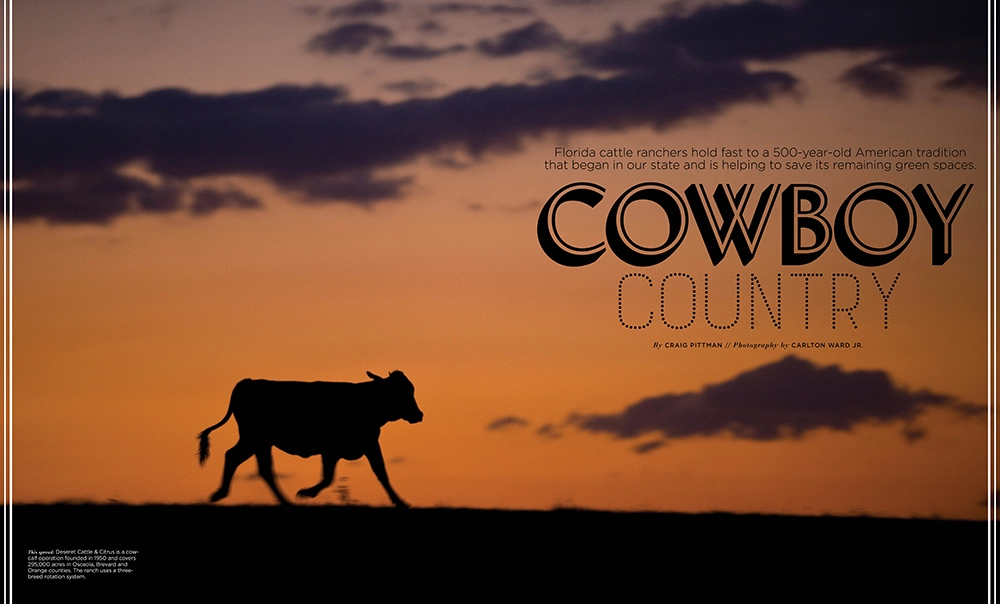
Driving out to Myakka City that morning in 2021 felt like a journey back in time. I left behind the roar of Interstate 75 as I rolled further into Florida’s rural past, finally ending up rumbling over the shells that covered Coker Gully Road in Manatee County.
I was heading for Blackbeard’s Ranch to spend some time with Jim Strickland, a rancher who had grown up in Florida’s cattle industry. The acclaimed photographer Carlton Ward Jr. had recommended him, so I expected Strickland to look and act like one of the rugged characters from Carlton’s photo book “Florida Cowboys: Keepers of the Last Frontier.”
I tried to control my excitement. When I was a kid, I was obsessed with cowboys. I wore cowboy boots and a straw cowboy hat every chance I got. I was glued to the TV whenever it was time for “The Lone Ranger” or “Rawhide.” Now, I was about to meet a real one!
But Strickland was not what I expected. He wore a cowboy hat and jeans, of course, but also a vented fishing shirt that made him look like he’d just stepped off a boat. And, instead of boots, he wore a beat-up pair of sneakers.
Strickland had a New Age approach to ranching. He tried to gently herd the cows so they wouldn’t lose any weight through anxiety. He was concerned about the environment. He had a keen sense of the history of his industry, in part because he’d lived through it.
Helping Strickland were some freelance cowboys he’d hired for the day. Usually, there would be a ranch foreman running the show, but he’d come down with COVID-19.
So along with the freelancers, Strickland was getting help from a couple of volunteers. One was a lean 71-year-old neighbor who was spattered with mud from head to toe. The other was the 11-year-old son of one of the ranch hands who’d wanted to accompany his dad to work. He was the only one I saw wearing cowboy boots.
Here were my “Rawhide” cowpokes. While Strickland was laid-back as could be, these two were clearly having the time of their lives—working cattle, being outdoors on a nice day, big smiles on their faces. Of course, I had to work them into the story.

An Ode to Boy-Band Mania: 2022 Spring-Summer Vol. 20
Still beaming over Orlando’s pop icons
By Maddy Zollo Rusbosin, writer
Everyone was in white. And glitter. So much body glitter. That was the first thing that struck me as I stepped foot into the atrium of the Sphere this past August in Las Vegas. Then it was the music: all Backstreet Boys, of course, but not the “I Want It That Way” level singles. Those were for later. Instead, it was a curated playlist of tracks that never made the radio waves. Naturally, I still remembered every word. Even though the fans around me had also made the pilgrimage to Vegas, I was still surprised almost everyone knew every single word as well.
If you remember my 2022 feature story, this evening wasn’t the first time I had seen the Backstreet Boys (it was the eighth, I think?), nor was it the first time I had seen them in Sin City. I had been to a previous residency years ago, but the energy this go-round felt wholly different. More alive. And as I listened to the near-constant screaming as the Backstreet Boys got beamed onto stage from their spaceship that was zooming around on the surrounding screen, it was hard not to smile. Boy-band mania was most definitely back, and it was a day I wasn’t sure I’d see again.
Having grown up in Orlando, the home of the Backstreet Boys, I had always been intrigued by the evolution of these groups. Plus, these teen idols shared my Central Florida roots, so it felt appropriate to write a story on them. The journalist side of me wanted to explore exactly how the boy-band sausage was made, while the ex- teenybopper side wanted an excuse to interview the guys who used to plaster my bedroom walls. Luckily, I was able to do both of those things. Cue 13-year-old Maddy shrieking in excitement.
While reporting the article, nearly everyone I talked to noted there was something special about that moment in pop music, a phenomenon that hadn’t happened since. After watching the set in Las Vegas this past summer, I noticed another phenomenon at hand: Boy bands are officially cool again. In fact, the Backstreet Boys’ “Into the Millennium” stint has been one of the Sphere’s most successful acts to date. While the stream of boy bands coming out of Orlando has dried up, we still have Kevin, Nick, AJ, Brian and Howie gyrating onstage like it’s Y2K, and maybe that’s all we need.

A Quest for Tupelo Honey: 2023 Spring-Summer Vol. 22
A trip to Wewa reveals the plight and peril of North Florida’s liquid gold
By Jessica Giles, editor, writer
There’s not much I can thank my ex-boyfriend for, but this story is one of them. We took a trip one weekend to stay with his best friend, who told me all about his hometown of Wewahitchka. After he spent about 10 minutes teaching me how to pronounce it (WEE-wah-HITCH-kuh), I learned the Panhandle town’s claim to fame was tupelo honey. He assured me he’d bring me back a bottle the next time he visited his parents. Little did he know I’d beat him back to his hometown.
This conversation sparked my curiosity about tupelo honey and the people whose entire livelihoods depend on this finicky nectar. So our photographer Mary Beth Koeth, editor in chief Jamie Rich and I piled into the car and pointed our wheels west. I’d chatted over the phone with beekeeper Ben Lanier of L.L. Lanier and Son’s Tupelo Honey, but his personality was larger in person. Before I even got my first question out, he began rattling off my past work experience, as though he’d memorized my resume. “See, I did my research too,” he said.
Later, the Laniers took us to visit some of their hives. Before we got out of the car, Ben’s wife casually handed me a beekeeping veil. I accepted it with gratitude, but silently wondered where the rest of it was. Didn’t beekeepers wear full-body suits? What about gloves? Not wanting to seem like a wuss, I pulled on the veil and stepped outside with faux confidence. I had expected the professionals to handle the buzzing insects, but before I had a chance to protest, Ben thrust one of the hives into my hand. This is the part where I would have screamed had my boss not been present. It dawned on me, as the honeybees crawled all over the hive dangling from my bare, pinched fingers, that I actually had no idea if I was allergic to bees. I had never been stung.
A Night in Old Florida With the Great Apes: 2024 Spring Vol. 24
Sleeping in a cabin among the orangutans and chimpanzees of Wauchula
By Eric Barton, writer
I walked out onto the screened-in porch before putting the coffee on, and I heard it. A hoot, somewhere deep in the trees. Then came an answering whoop. Suddenly, the whole forest seemed to speak in its own language.
From the porch of a little clapboard cabin, situated on the property of the Center for Great Apes, I watched the sky turn pastel over the live oaks. Nearby, primates and their human handlers started their days. Doors slid open in the night houses. Metal clanged. Voices—some human, some not—called to each other, like friendly neighbors passing each other on the way to work.
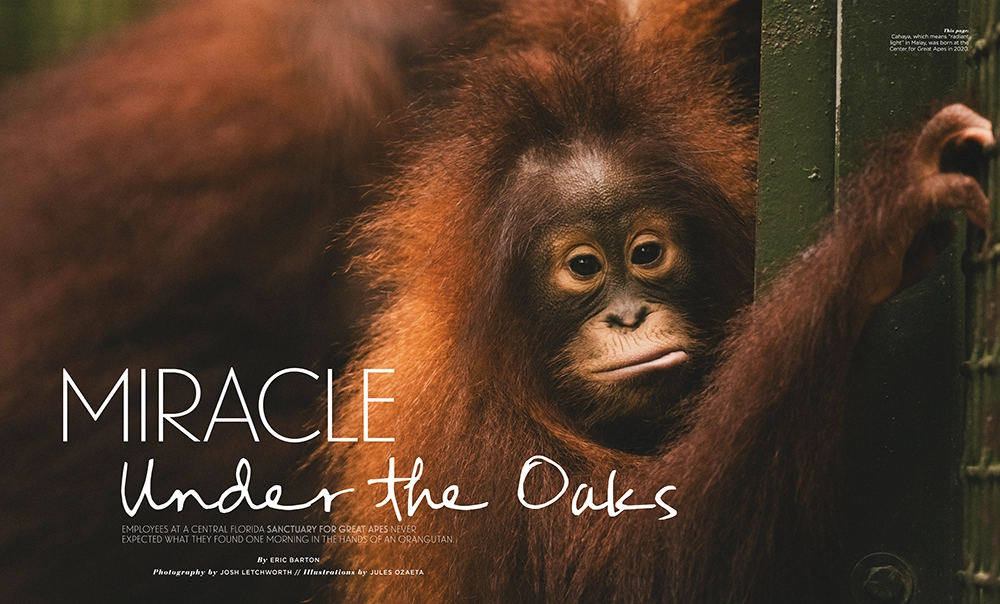
I’d arrived the morning before to the small city of Wauchula, three hours northwest of Miami. Founder Patti Ragan drove me around the 150-acre sanctuary in a golf cart, pointing out family trees of apes, noting the aggression of the young one who had just arrived and the sweetness of a chimp who stuck his muscular arms through the bars to request a hug. Every enclosure came with a backstory: a former roadside-attraction chimp, an orangutan who once worked in movies and Cahaya, the surprise baby who became the center’s “radiant light.”
Because it would’ve been a long round trip, the staff offered me a cabin that usually houses an intern. Out on the porch the night before my tour, I shut off the lights and listened. Croaking frogs and buzzing insects filled the darkness with sounds wild and unknown to me. And occasionally a distant rustle reminded me I was sleeping near dozens of apes.
In the morning, as the primates called to one another through the canopy, it felt like eavesdropping on a language older than all of us. If Patti’s plan works, someday there won’t be any need for this sanctuary, with apes living only in freedom. This patch of Old Florida, then, won’t have the voices of primates every morning—just the ancient, magnificent sounds of the forest.

Getting Chest-Deep in the Everglades: 2025 Winter Vol. 30
Wading through the swamp with Gladesmen
By Josh Letchworth, photographer
drive south into the Everglades. The landscape demands your attention. Leading up to my trip, I had spoken to both Dave and Jack Shealy, owners of the Skunk Ape Headquarters and two of the last remaining Gladesmen.
“OK, Monday sounds good, but call me on Sunday to remind me. We have the Alligator Festival all weekend,” Dave said.
Shortly after 1 p.m., I pulled up to the Skunk Ape Headquarters, a green, low-slung building with a Bigfoot-like statue standing in front. I noticed a man in a camouflage top, snake boots and dark sunglasses sitting at ease, finishing an ice cream sandwich. He put out his free hand. “You must be Josh.” I knew right then I was in for a wonderfully unique time.
Dave took me through the gates of the property, which backs onto a vast expanse of the Everglades, bordering Big Cypress Reservation. In addition to Skunk Ape HQ, the Shealeys’ property includes campsites, chickees, ponds, swamp buggies, their homes and a warehouse full of relics like airboats, gator skulls and even one of Totch Brown’s very own pole boats.
Later, I met Jack. His vibe was more familiar to me—closer in age and shared similar interests like fishing, traveling, the outdoors and our taste in music. We spent the afternoon pushing through swamp in wooden pole boats. At one point in our tour, I jumped into the water up to my chest, fully clothed in jeans, a rain jacket and muck boots to get the shot I wanted. I love this kind of stuff. The land of no fences, no signs and no guardrails.
My favorite part of what I do as a photographer is going on the equivalent of blind dates with peculiar kinds of folks. And on that short date, I get to listen, observe and take notice of what makes them so unique, and translate that into a photograph. It’s quite a rush.
I’m grateful for having this opportunity to help bring light to the unique facets of this great state and the people in it that have embraced all that she has to offer. It’s right where my heart resides.