by | February 24, 2026
Guy Harvey On His Legacy and New Documentary
Marine wildlife artist Guy Harvey shares about his beginnings in Florida, his proudest moments and his upcoming documentary.
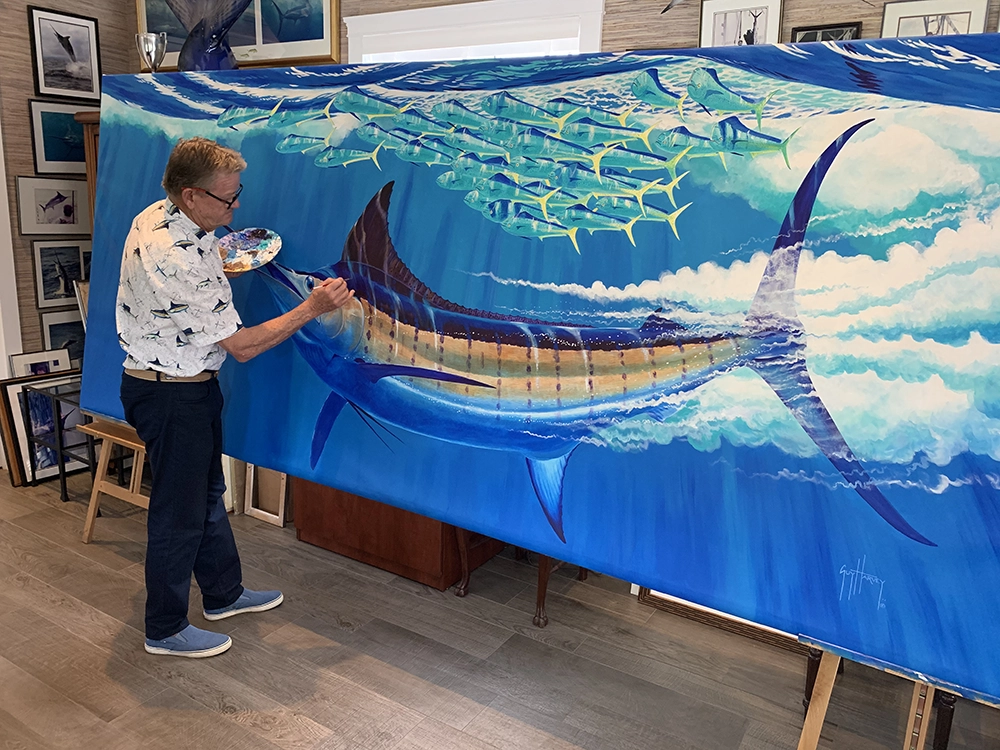
Fort Lauderdale holds a special place in Guy Harvey’s heart. Arguably the world’s most successful marine wildlife artist, Harvey’s work appears on clothing, home decor, posters and outdoor gear worldwide—while his original paintings command collector status.
In 1986, though, when the then 31-year-old made his debut at the Fort Lauderdale International Boat Show, marine artistry was just his hobby. Instead, Harvey worked as a professor of Marine Biology at the University of the West Indies. A year earlier, the positive response to an exhibition of his work in Jamaica, where he called home, had convinced Harvey to take his art even further afield.
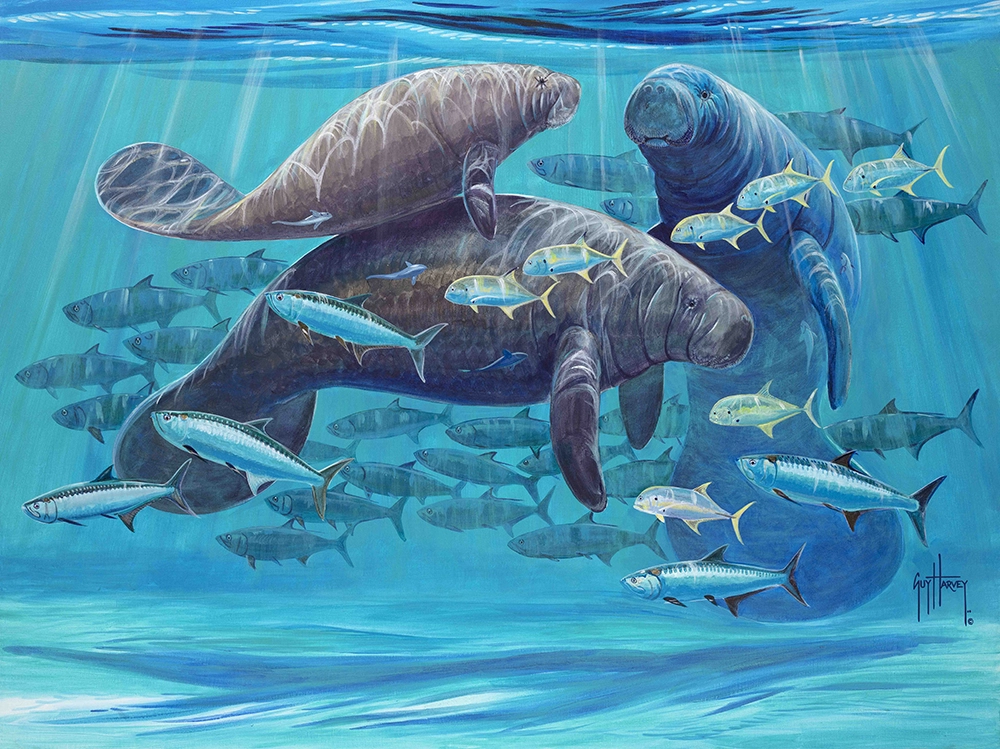
“The 1986 Fort Lauderdale International Boat Show is where I actually got my start,” Harvey tells Flamingo. He sold everything he brought with him at the event. Nautically inclined collectors were captivated by the scientific precision, saturated color and kinetic energy of his underwater scenes.
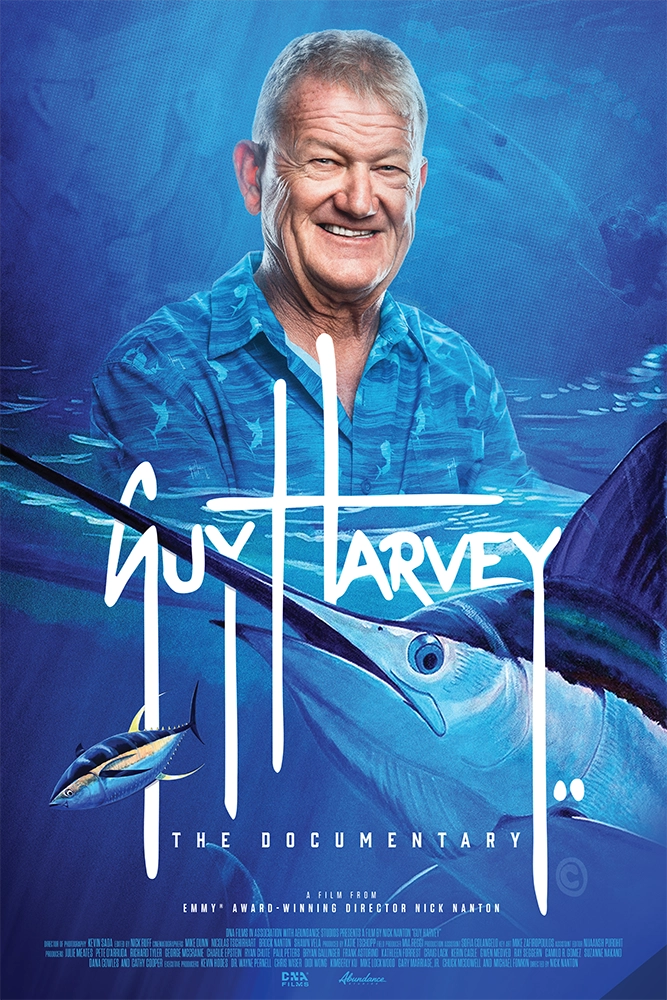
It’s fitting, then, that “Guy Harvey: The Documentary” premieres Feb. 28 at the Museum of Discovery and Science during the 40th Fort Lauderdale International Film Festival. Directed by 24-time Emmy winner Nick Nanton, the film traces Harvey’s evolution from artist to scientist, educator and conservationist.
Painter and Protector
Spreading the message of ocean conservation is why Harvey agreed to be the subject of a documentary. Though he has written three autobiographies—his preferred way to share his ethos—Harvey had also been involved in numerous nature documentaries, including “Guy Harvey Expeditions,” “Guy Harvey’s North American Fishing Expeditions,” and “Guy Harvey Presents: This Is Their Ocean: Sea of Life.”
But Harvey had always been hesitant about making a documentary on his life, because he’s not “really that great at talking about” himself. While he was immediately impressed by Nanton’s background, it wasn’t until the director revealed and proved himself to be a keen fisherman that Harvey decided he was the right person to make the film. Over the course of 18 months, Nanton filmed Harvey at his home in the Cayman Islands, in his South Florida headquarters—and even winning a fishing competition in Panama.
Despite his travels across the world to paint, research and adore sea life, Harvey always returns to the Caribbean. It was in Jamaica where Harvey fell in love with the water. Both of his parents—who worked as cattle farmers up in the Jamaican mountains—were huge fans of the ocean and would regularly take him out fishing. But while Harvey’s time in Jamaica was full of wondrous adventures where he explored the fish and wildlife across the island, he spent just as much of his youth traveling across the Atlantic to Sherborne, England, where he went to high school.
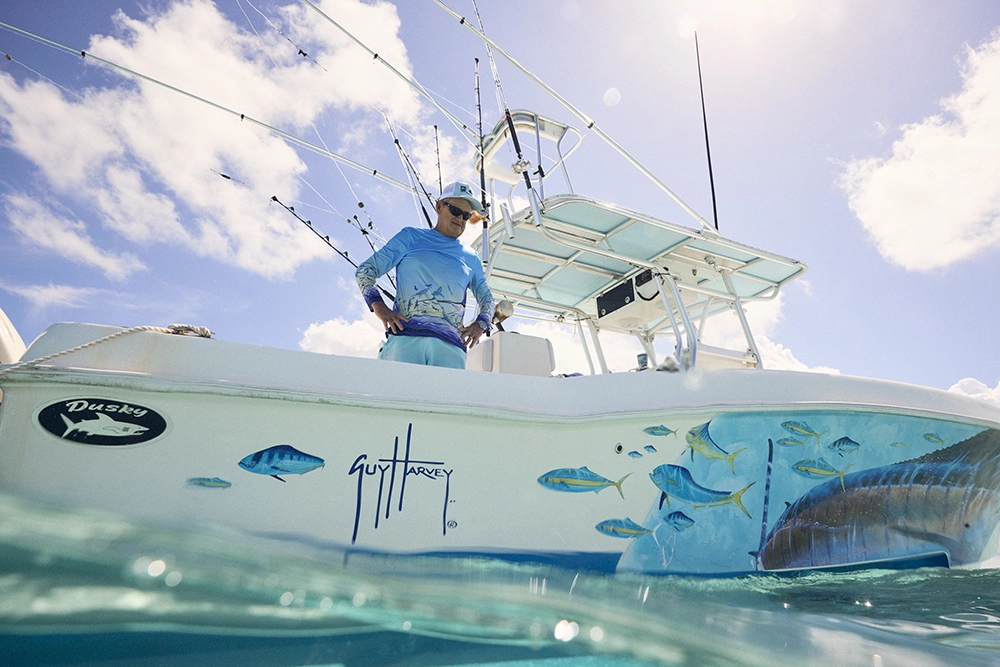
Whenever Harvey suffered bouts of homesickness, he turned to a copy of Ernest Hemingway’s Pulitzer Prize-winning 1952 novella, “The Old Man And The Sea,” that his mother gave him when he was around 12 years old. The book’s depiction of small boats using hand lines to fish was so evocative that it immediately made Harvey think of Jamaica. “That’s how people on the island would fish,” he says. “We grew up fishing in a boat that was made out of a tree. It was a canoe that had an engine on the back.”
While the copy gifted to Harvey didn’t have illustrations, when he found a version that did, he instantly thought to himself, “I can do a much better job.” At the age of 17, Harvey had to spend a few extra months in the UK so that he could retake some examinations. Looking for a creative outlet, Harvey decided to do 45 drawings that told the story of “The Old Man And The Sea.” While he was pleased with the results, he put them away for over a decade, instead completing his degree in marine zoology from Aberdeen University in Scotland before getting a doctorate in Fisheries Management from the University of the West Indies.
My knowledge of the physiology, anatomy and ecology of these animals has allowed me to paint like that. You need to have, what I call, the hunter’s eye.
—Guy Harvey
After moving into teaching at the same Jamaican college he graduated from, Harvey took the plunge in 1985 and showcased his passion project at a one-man exhibition in Kingston, Jamaica. The response to his work was so overwhelmingly positive from anglers and art-lovers that Harvey decided to transition into being a marine wildlife artist full-time. He eventually made his hobby his profession in 1988, traveling across America to boat shows, fishing tournaments and seafood festivals to sell his paintings, as well as clothes and memorabilia bearing his art.
Harvey believes his work—which can be seen across Florida at the likes of Fort Lauderdale Airport and SeaWorld Orlando—resonates with people because his upbringing allowed him to get up close and study nature. “My knowledge of the physiology, anatomy and ecology of these animals has allowed me to paint like that. You need to have, what I call, the hunter’s eye.” Harvey also admits that he was able to develop his style and voice as a painter through “trial and error,” adding, “You have to find out what works for you. Don’t be too influenced by other people’s work. Create your own style and be authentic.”
Guardian of the Seas
As well as running Guy Harvey Enterprises and Guy Harvey Inc., which are dedicated to his artwork, branding and licensing, Harvey used his money to launch the Guy Harvey Research Institute in 1999, followed by the Guy Harvey Foundation in 2008. The Research Institute has published 185 peer-reviewed papers on sharks, stingrays, mahi mahi and other species.
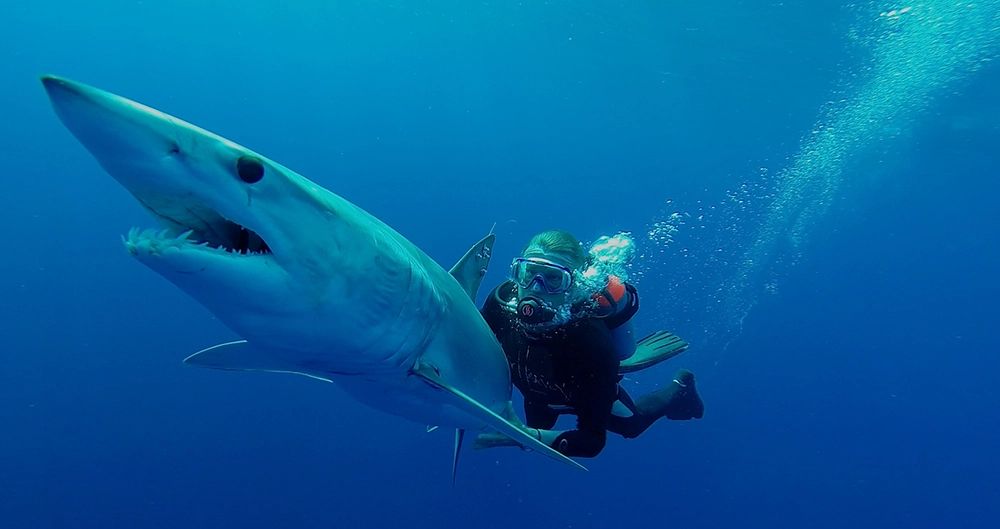
“The steady accumulation of published papers is probably my greatest achievement,” says Harvey. “Because it’s not one single thing. It’s years of doing it on different subject matters and then making changes.” In 2008, Professor Mahmood Shivj started tagging shortfin mako sharks because they were under severe threat from industrial fishing in the Atlantic. Their research discovered that 30% of the sharks were being caught and killed. They then worked with the National Marine Fisheries Service to establish a moratorium on harvesting them. “Our data on high mortality rates is very influential and instrumental in getting things changed,” Harvey says. “That’s why we do this.”
Meanwhile, across Florida, the Foundation’s marine science education initiative provides a science curriculum, digital resources and teacher training so that children can learn about ocean conservation in a fun and impactful manner. “We fund a lot of scholarships and a lot of educational programs, because marine science isn’t really taught in Florida schools,” says Harvey. “We’re using our data, experience, footage from our expeditions and the artwork to make the message even more effective for the kids.”
Rather than distract from his conservation work, Harvey’s art has amplified it—giving him a global platform for ocean advocacy. Harvey’s Foundations might have helped organizations and scientists from across the world conduct research and improve the habitats for marine wildlife, but he concedes “traditional methods of conservation just aren’t working.”
He points to the fact that too many people are consuming marine life and there’s over-harvesting of certain fish and species. That’s why the Guy Harvey Foundation has turned its attention to educating children, so that they can understand the issues from an early age.
At 70 years old, Harvey remains relentless in preserving the world that has brought him so much joy and success. “We want to keep expanding our data collection and database so that we can have marine protected areas, because we can’t keep overfishing without severe consequences. I’m still very active around it. As long as I have my health, that is my driving force.”