by | September 4, 2026
Professional Florida Women’s Basketball is Back
From the new Upshot league, the Jacksonville Waves are writing the next chapter in Florida women’s professional basketball history and keeping the dream of a WNBA return alive.
With just under two hours until tip-off, That Bar At The Arena is abuzz. It’s the last night of July, a hot-but-bearable evening in Jacksonville with a slightly overcast sky. Inside the bar, conditions are just as they always are on game days. Servers bounce from kitchen to table and back again, delivering blackened fish tacos and spicy chicken sandwiches to families and clusters of friends. The bartender spins in her station like a top in a box, smiling, pouring and bantering. Some people order beers, others take shots.
It’s busy. The hometown Jacksonville Jaguars don’t kick off their 2026 season for another few weeks, but there are two other games in town tonight and the fans for both have pooled here for a bite and a swig before they fork into their respective venues. At around 6:00 p.m., the majority head across the street to Vystar Ballpark to see the Triple-A Jacksonville Jumbo Shrimp on the baseball diamond. The rest, clad in deep teal and coastal blue, mosey next door to VyStar Veterans Memorial Arena to see the city’s newest team, the Jacksonville Waves, take on the visiting Savannah Steel.
The Waves, Steel, Charlotte Crown and Greensboro Groove make up the entirety of the brand new Upshot women’s basketball league. Established in 2025 and headquartered in Jacksonville, Upshot began play this summer with backing from big names like Tamika Catchings, Cheryl Miller and Ann Meyers Drysdale. The league provides another avenue for talented women to make a living playing basketball in the United States. The inaugural commissioner, Donna Orender, previously served as President of the Women’s National Basketball Association and many Upshot players spent time in the league. The looming hope for most is to reach, or return to, the big show—just this week Michelle Onyiah of the Charlotte Crown became the first Upshot player to receive a call-up, inking a developmental contract with the Indiana Fever. Upshot offers the opportunity to compete in the sightline of the WNBA franchises they hope to someday play for.
I can see inside of them, see the talent and see what this league means to them.
—Andie Dann
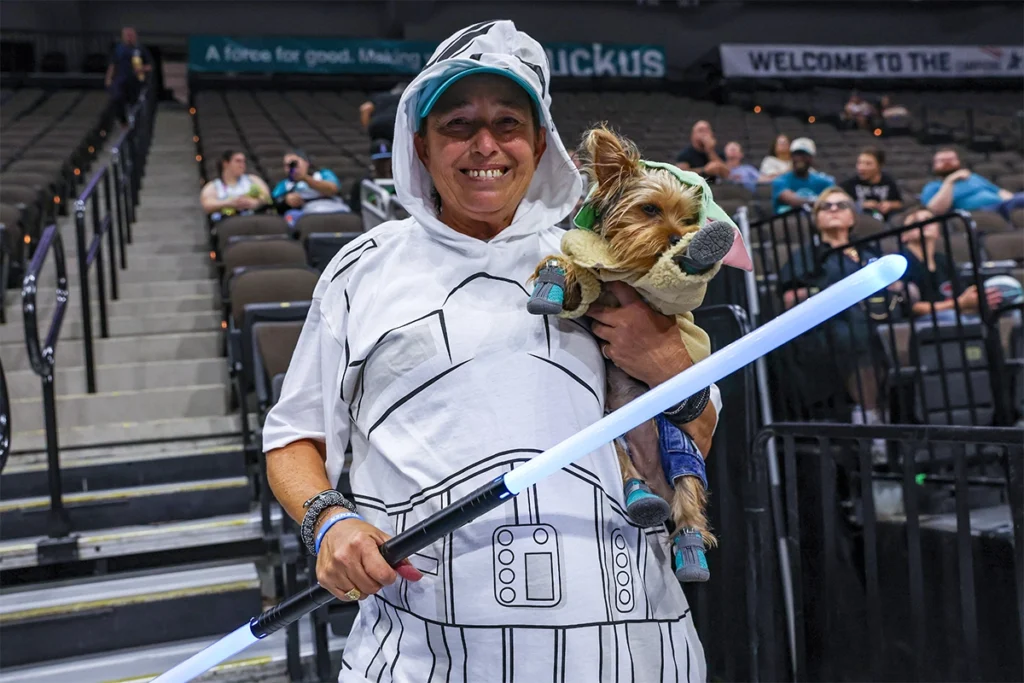
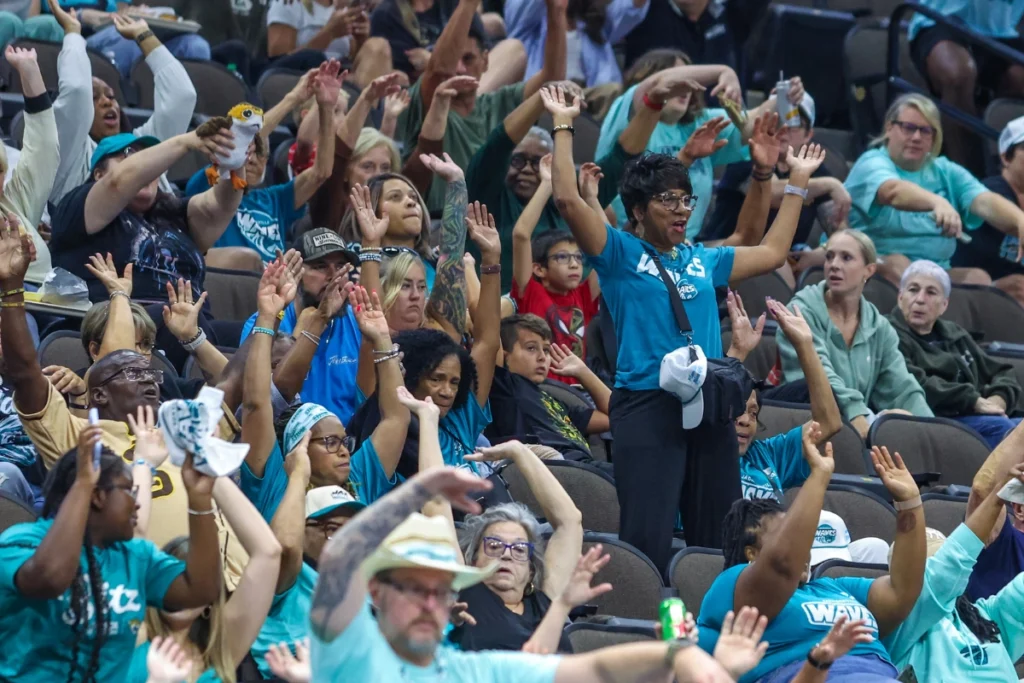
Inside the arena, Waves fan Andie Dann watches both teams warm up from her front row seat in section 104 that she shares with her 7-month-old service dog, a Yorkie named Wynter. Before this summer, Dann, a Navy veteran, had no interest in basketball. She attended the first Waves home game in May and was taken with the passion, positivity and camaraderie that she saw. She liked the idea that women who were so close to their dream now had a means of keeping it alive.
“I can see inside of them, see the talent and see what this league means to them,” Dann says. “The WNBA is not all that new, but the hype surrounding the WNBA is. You figure the draft has what 20, 25 people every year … So I think this is a good thing.”
Following her first game, Dann requested a season ticket and has been to every home game but one. Tonight, she is rocking custom Waves Vans. Wynter, who has been named the unofficial team niece, is wearing a Waves hat (with earholes), a jersey signed by team members and teal booties. They know almost everyone who walks by their seat, from players and coaches to administrators and Millie, the turtle mascot.
“In not even a whole season—we’re all one big happy family here now,” she says.
Professional women’s basketball arrived in Florida in 1999 with the WNBA’s Orlando Miracle. The next summer, the Miami Sol tipped off. It was a different time in “the W.” Sellouts were rare. Teams flew coach to away games. Without social media or regular coverage on national sports talk shows, community outreach was the name of the off-court game. Athletes and coaches spent real time connecting with fans, inviting them along for the ride up. For some former players, those moments, and the relationships they fostered are among the most enduring memories from playing in the league during its earliest stages.
Robin McComas sits a few seats down from Dann and Wynter in section 104 and is part of the crew that meets at That Bar before home games. A lifelong Floridian, she lived through the Miracle and the Sol, but wasn’t a basketball fan at the time. She only became interested in the game last summer, when the WNBA’s Indiana Fever caught, and held, her attention. Fandom agreed with her, and the timing was perfect: the women’s game was returning to Florida. She attended meet-and-greet with the newly-established Waves at a local Hotel and promptly bought season tickets for her and her husband. Her son even serves on the team’s Ball Squad.
“It’s a second chance for the girls to do what they love,” McComas says of the Waves. “You can see it on the court. They do what they love.”
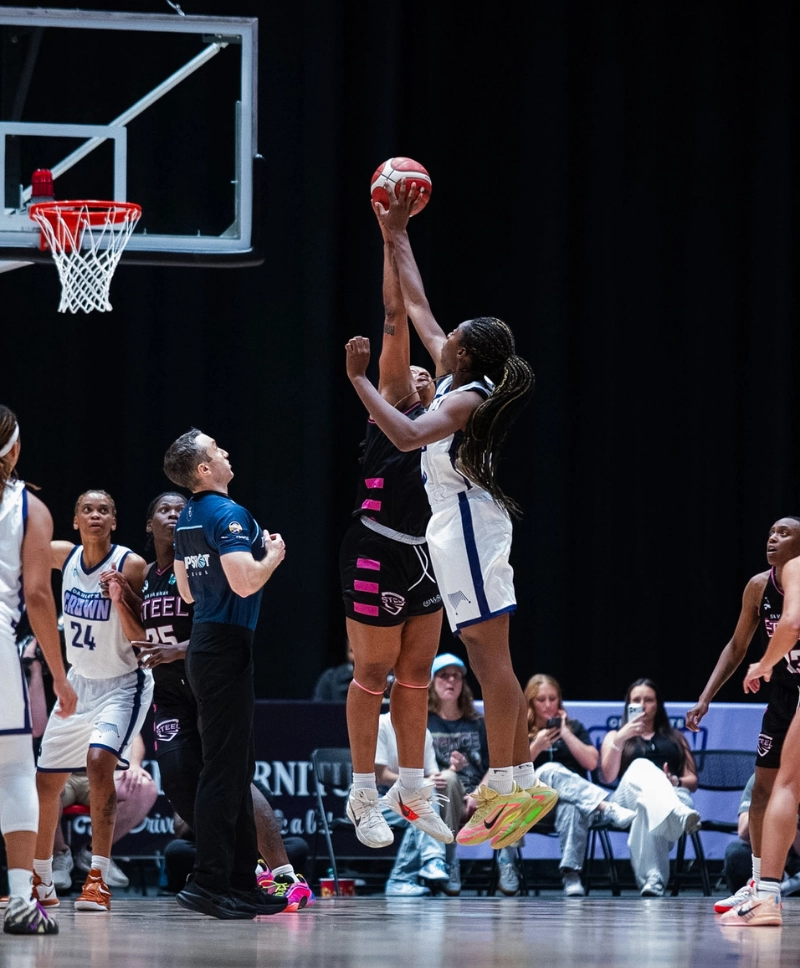
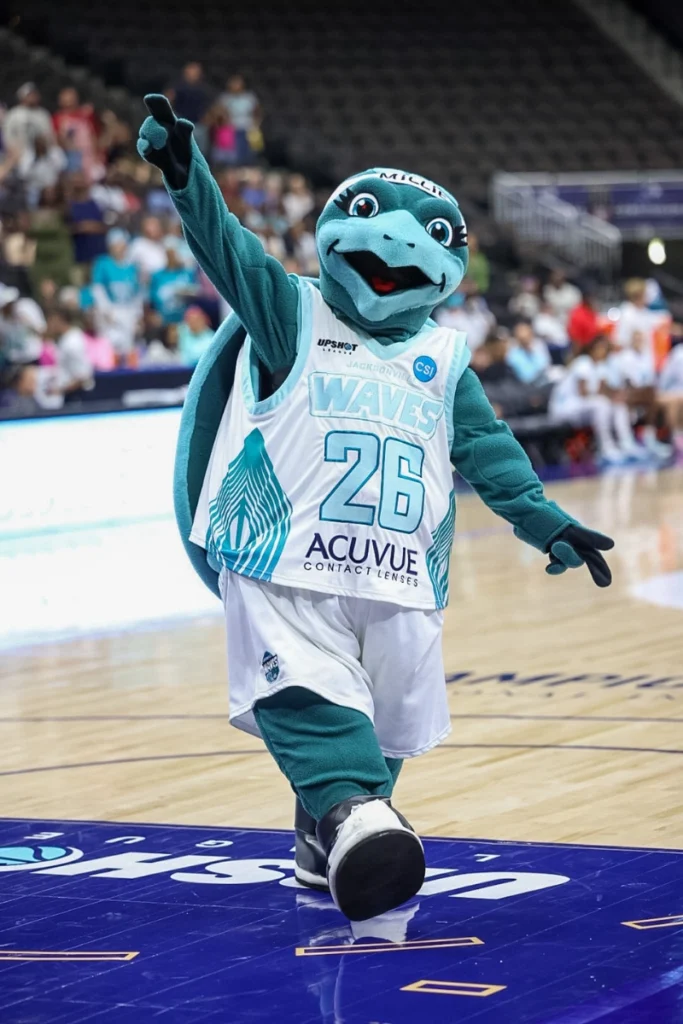
The Vystar Arena lights are shut off and Lil Wayne’s “A Milli” begins bumping from the speakers. A spotlight shines on a giant inflatable egg set just off the corner of the court. As the song climaxes, the egg deflates, revealing Millie the mascot. The crowd erupts as the “hatched” turtle sprints to midcourt and begins dancing. Children shriek, players watch. Then the lights return, the starting lineups are announced, and the ball is tossed.
Professional Team Moms
Before Wynter, there was Cookie Mom.
A grandmother and retired optician from Coconut Creek, Beverly Durham was a Miami Sol fan from the start. Her email address was Sol themed. Her wheelchair, a major part of her life since her multiple sclerosis diagnosis two decades prior, was Sol red and decorated with a Sol license plate. She was all in, even during the team’s first season in 2000. That was the year she met Kisha Ford, then a reserve guard for the brand-new franchise.
It was a chance encounter on the elevator at the arena, a brief exchange, but the moment proved pivotal for both women. When Ford suffered an injury soon after, Durham baked a batch of get-well-soon pecan chocolate chip cookies for her new friend. Ford was touched, so Durham repeated the gesture for the following game, doubling the batch so there were plenty to share with teammates. The game after that, another batch. The cookies were a huge hit. Cookie Mom was born.
“I will never forget the Durhams,” Ford told the South Florida Sun Sentinel in 2001. “I will never forget Cookie Mom.”
She kept her word.
“She was always there early, she was the last one to leave,” Ford (now Ford Torres) says of Durham, 25 years later. “Just the biggest smile on her face all the time … if you think of like a team mom for an organization, I would say she would have been it, at least for me.”
Ford played for both Florida WNBA franchises. After being drafted by the New York Liberty in 1997 and playing two seasons in Manhattan, she was selected in the 1999 expansion draft for the league’s newest franchise, the Orlando Miracle.
Her personal life flourished in Orlando. She met the woman she would ultimately marry and formed several lifelong friendships. She was introduced to Puerto Rican cooking, going to the family homes of her new friends for homemade dinners. As part of a community outreach effort, she served as the guest coach for the girls’ varsity team at Bishop Moore High School, where one of the players on the team happened to be the younger sister of her future wife. Orlando drew well in its first season, averaging 9,801 fans per game, and the franchise provided apartments and passes to local amusement parks and movie theatres for its players. All of it agreed with Ford, enough so that she returned to live in the area many years later after retiring from basketball. Unfortunately, her basketball life wasn’t keeping pace.
“I just didn’t feel like it was the best fit for me,” she says. “I felt like I would have been more useful with a team that focused more on defense.”
Ford was released by the Miracle just before the 1999 All-Star break and thought her basketball playing career was over. She returned to New York and took a job working for the YWCA while applying for other corporate positions, including a front office opportunity with another newly established WNBA franchise in Florida, this one in Miami. It was a desk job, a day job, and she was okay with that. Soon after filing her application with the Sol, her phone rang. It was Jenny Boucek, the team’s assistant coach.
“She was like, ‘What are you doing?’ And I was like, ‘What do you mean? I’m trying to get a job,’” Ford remembers. “She goes, ‘You need to come down and try out.’”
Ford flew down, attended an open tryout with several other women, and made the team.
Like in Orlando, Miami provided housing for its players. Ford moved into a condo right on South Beach with valet parking and a view of Biscayne Bay. She threw herself into city life, exploring the culinary scene, learning how to Salsa and Merengue at nearby establishments, going for runs on the boardwalk and hitting the beach. Former Miami Heat Head Coach Ron Rothstein was hired to lead the team, and the Sol operated with the same attention to detail that their Heat had already become known for.
“They had a certain culture there that really was very supportive,” remembers Ford of Miami. “It just was a professionally run organization. It was great.”
The Sol finished just 13-19 in its debut campaign in 2000 but was finding its way in a crowded South Florida sports market thanks to a growing fan base. Cookie Mom and her husband, James, made a giant yellow poster anointing their section, 119, as “Kisha’s Korner.” After the games, both home and away, it was a tradition for the players to meet fans at a nearby bar for some postgame food, drink and revelry. Family members, former teammates and supporters mixed and mingled. Personal relationships were built, community was formed. It was, Ford says, “the best time ever.”
The following season, 2001, Miami posted an average attendance of 8,857, sixth-highest in the league. It was also the franchise’s best year on the court: Led by Sheri Sam, Sandy Brondello and Black, the team finished 20-12 and made the playoffs before bowing out in the first round.
It marked back-to-back appearance by Florida teams in the playoffs. The previous year, during the Sol’s lackluster debut in 2000, Orlando made its first and only playoff appearance before also falling in the first round. The Miracle then used its two top draft picks ahead of the 2001 season to select Katie Douglas from Purdue University and Brooke Wyckoff from Florida State University. The rookies gave the franchise a plan for the future, and, in Wyckoff’s case, a bit of regional rapport.
“People knew me in Florida,” Wyckoff says. “That was part of the cool factor of being drafted right down the street, you have a built-in kind of just recognition and fan base.”
Many of the fans who cheered for Wyckoff in Tallahassee became Miracle fans by proxy, easing her transition from college to professional life. It was a good landing spot: She had Douglas to grow with and veterans like Nykesha Sales, Shannon Johnson and Taj McWilliams-Franklin to learn from. The team usually practiced in the morning, leaving the afternoons open for the swimming pool, meals with teammates and local appearances at malls, theme parks and area businesses. It was an exciting period of life and an exciting time in the league. Wyckoff and Douglas shared a car and spent many afternoons and off nights exploring the city together. Her former college teammate and roommate at Florida State, Levys Torres, played for Miami and the two visited each other’s apartments when in town for away games.
“It’s just so cool to think back on those days, and like, wow, we had two WNBA teams here,” says Wyckoff, who is now the head coach at Florida State. “It was just a neat experience to play the other, to have two teams in the state.”
While Miami was surging to the 2001 playoffs, Orlando stumbled to a 13-19 record during Wyckoff and Douglas’ rookie year. After the season, Miracle head coach Carolyn Peck resigned to accept the same position at the University of Florida. Her replacement, former Orlando Magic guard Dee Brown, was only a few weeks removed from playing in the NBA when he was hired. Brown had no coaching experience but commanded immediate respect with his knowledge of the game and relatability. He was still young enough to scrimmage with his new team and had two young daughters of his own, including future WNBA player Lexie Brown.
“He had a passion for basketball, but also he was coming from the perspectives of having two young girls,” Wyckoff says of Brown. “Those two things combined [made it] a special experience both for us and for him, I think.”
Under Brown the Miracle equaled its best record, going 16-16 in 2002. The Sol finished just a game behind at 15-17. Neither made the playoffs, but there was momentum to build on in both cities. There was no reason to think it would be the WNBA’s last season in Florida.
There should be a WNBA team here. I don’t think there should be a question about it.
—Kisha Ford
The big blow came a few months after the season ended when the league announced a restructuring effort that included selling the WNBA franchises to their local operators. Up to that point, the WNBA was operated collectively by the owners of the 29 National Basketball Association franchises. The new shakeup placed the onus on the individual franchisees to find corporate sponsors and pay player salaries. Unable to secure necessary partnerships, RDV Sports relinquished control of the Miracle in October. The franchise was ultimately purchased by the Mohegan Tribe and moved to Connecticut. In November, the Heat Group, which owned the Miami Sol, announced the folding of the franchise, citing the league restructuring. Within two months Florida went from having two WNBA teams to none. Both Ford and Wyckoff have returned to live in Florida for their post-playing careers. Both think the state is ready for another shot.
“There should be a WNBA team here,” Ford says. “I don’t think there should be a question about it.”
A First Ever Championship
Following the final horn of a 73-57 Waves win, a group of fans streams to the lobby of the arena and forms a line running alongside an exhibit for the annual Georgia-Florida football game held in Jacksonville. People of all ages chat excitedly, greet one another and laugh. They are waiting for the postgame autograph session that has become a tradition. The attending players vary by the night, but this time it is Adut Bulgak, a former first-round WNBA draft pick, and Emma Von Essen, fresh out of college at Hofstra University. The women represent the two pools of Upshot players: those trying to make it to the WNBA and those trying to make it back. The fans erupt as the pair emerges into the lobby and takes their seats behind the counter to begin greeting fans, signing memorabilia and posing for photographs. While not at a bar, it is not dissimilar to the postgame scenes Ford described from her time in Miami.
The WNBA is expanding, with two new franchises beginning play this summer and three more expected by 2030. The league has not announced any plans to return to Florida, but the Waves are a good starting place and Upshot is also growing. Next season, two more franchises will tip off in Nashville and Baltimore, offering two more possibilities for players to make their way and fans to find a home. But first, the league had to put the period at the end of its first stanza.
Nearly a month later, on Saturday, Aug. 29, VyStar Arena was the site of the final game of the 2026 season, the inaugural Upshot championship game. The host and top-seeded Waves led for 32 of the game’s 40 minutes and by as many as ten points in the fourth quarter before the visiting Charlotte Crown stormed back and gritted out an 81-76 upset victory, the final buzzer marking the start of a first-ever offseason for the league. Crown players, clad in championship t-shirts and hats, gathered at center court to hoist the league trophy in front of their fans who, like Dann and McComas and the rest of the Waves faithful, had backed a new team in a new league and cheered them on all the way through to the end. In that way, for everyone in attendance, whether donning the Crown’s purple or Waves’ teal, the night marked a commemoration of a journey taken together. Every league, every team, everybody starts somewhere. For them, it was right here.