by | September 30, 2026
The Legacy of St. Augustine’s Datil Pepper
Sweet, fiery and famously finicky, the datil pepper has inspired generations of culinary lore in America’s oldest city.
If Peter Piper picked a peck of datil peppers, where would he go to pick? Legend has it that he’d have to hightail it over to St. Augustine, where the exact combination of sandy soil and salty air grows datils strong and spicy. Around here, pepper people love to brag, showing off the bright green and orange chilis in closely guarded family recipes handed down over a century and smiling at outsiders when they take their first bite.
As all good food folklore goes, the origin of the datil (Capsicum chinense) in Florida isn’t clear. A popular theory—especially loved by the locals—is that Menorcans imported them in the late 1700s, sewing the coveted seeds into their clothing for safe transport first on their journey to Florida from Menorca, an island off the coast of Spain, and later on their 67-mile walk to St. Augustine from New Smyrna, where the immigrants had suffered horrible abuse working at an indigo plantation. Another story claims that a Cuban jelly maker named Esteban Valls brought the pepper to town around 1880, and yet another tale says no, the fiery fruit really came from Africa via the slave trade. Origin theories abound, but one thing is certain: Datils are a cultural, culinary icon in America’s oldest city—there’s even a festival dedicated to it—and most folks outside of the area have never heard of them.

A pepper’s intensity is measured by a tool called the Scoville Scale, with the amount of heat expressed in Scoville Heat Units (SHU). A jalapeno pepper has 2,500 to 8,000 SHU. A datil pepper measures anywhere from 100,000 to 300,000 SHU, about the same as a habanero. Datils, members of the nightshade plant family, are intensely hot, but there’s a sweet, fruity side to their personality that tries to apologize for its spiciness. They range in size from about 1/2 inch to 4 inches and change in color from light green to orange, growing hotter by the day on the vine.
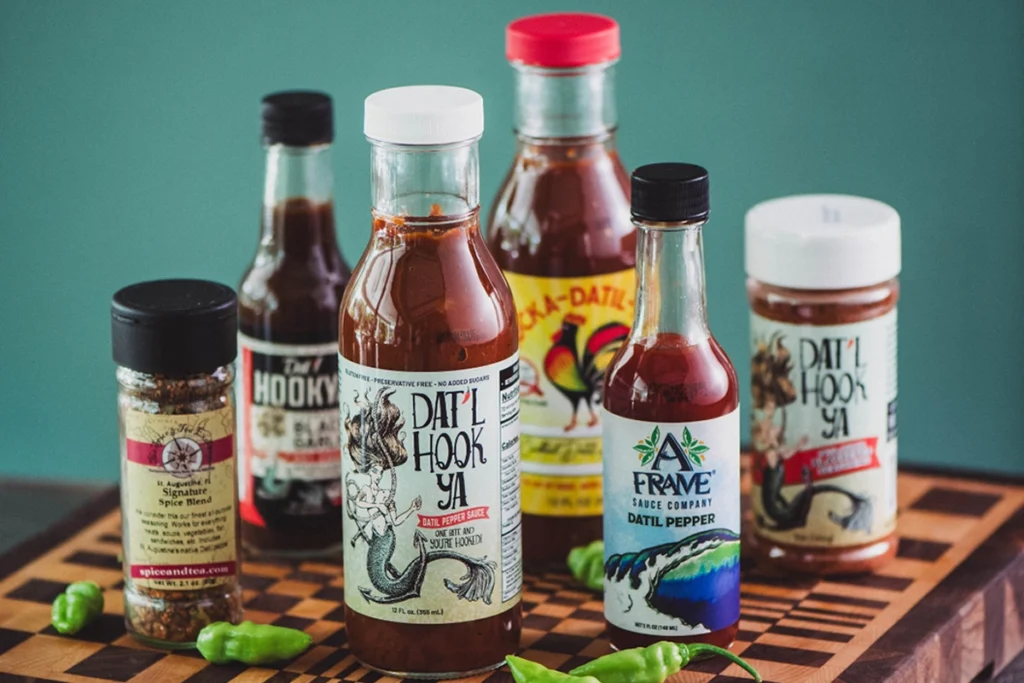
Since the beginning of the pepper’s recorded history, datils have been churned and chopped into recipes, pureed into sauces and mixed into relishes, mustards, jellies and red-hot Menorcan clam chowder. Back in 1981, Chris Way opened his seafood restaurant, Barnacle Bills, in St. Augustine. He’d been making a datil sauce at home that he’d place on tables for his customers, and he noticed they kept disappearing. He decided to bottle and sell the blend, and in 1982, Way, then 25, started commercially selling Dat’l Do-It. One year, he brought in an estimated $4 million, according to Way. Following Way’s success, local companies such as A Frame, Cocka-Datil-Doo and Dat’l Hook Ya have taken a seat at the table, selling their own proprietary blends and touting secret recipes.
For a Florida take on a Bloody Mary, try this datil pepper version.
Caleb Cooper, 44, and his business partner, Scott Herlihy, 41, developed A Frame Sauce after a surf trip to Nicaragua in 2008. They scouted organic coffee bean farms in Jinotega while there, but it was the country’s spicy peppers that got their attention. When the two returned home to St. Augustine, they decided to grow datil plants in their backyards and make sauces to pass around at parties. Friends loved the first run of the liquid heat and asked to take home bottles. Soon after, Cooper and Herlihy launched A Frame Sauce Company, named for their love of surfing A-frame waves.
“Everything is about the pepper. It’s all about the pepper, nothing else,” Cooper says, noting that A Frame makes their own ketchup for the sauce to eliminate high-fructose corn syrup. “We’re not muddying up our recipes with additives because the datil is what people want to taste.”

Datil peppers are commercially grown in rural towns such as Elkton and Palatka, just outside of St. Augustine. Farmers take orders from businesses toward the end of the year, begin growing the plants under shade cover or greenhouses after the last freeze and start harvesting in late May.
Wendy Revels, 53, owns Revels Pepper Company in East Palatka, where she has almost exclusively grown datils since 2021. The all-female team, consisting of Revels, her two daughters and granddaughter, grows about 1,250 potted plants each season and can harvest peppers eight to 10 times from the same plant before the shrubs go dormant in December. She’s not a “seed person,” she says, and instead buys seedlings from a grower in Elkton. Revels contends that commercial competition is getting stronger, and she’s devising new ways to keep the datils growing year-round. “The plants love it here. They don’t grow anywhere else like they do in this area,” she says, surrounded by rows of plants bursting with bright green peppers.
Everything is about the pepper. It’s all about the pepper, nothing else.
—Caleb Cooper
Wes Register and his cousin Frank Crosby use an old family recipe and source the peppers for their Cocka-Datil-Doo sauce from Revels. Register agrees with Revels’s observation that datils are finicky, and they don’t cotton to the environment in many other areas. To prove his point, he tells a story of when one of his buddies visited him in St. Augustine and took seeds back home to Tennessee to share with another friend who planted them.
“He’s up there in Nashville trying to grow a datil pepper and just can’t get it to grow,” Register, 46, laughs. “That just ain’t gonna happen.” Cocka-Datil-Doo has its origins in rowdy Thursday night football gatherings, when Register and his friends would taste-test every sauce they could get their hands on, “and ours won out every time,” he says. “We’d use our recipe on wings, and that was everybody’s favorite wing.”

But it’s not just the sauce that datil-lovers crave. Sliced, diced or ground into dust, a datil’s tear-jerking flavor is hard to miss. Deanna Park, 55, is a St. Augustine-based chef who loves the local history surrounding the devilish datil, but more than that, she loves the flavor. “When you cook with them, you’re adding not just heat, but depth. They’re perfect for jellies, sauces, chowders and even desserts.” Park is passionate about developing recipes from locally sourced foods, and the datil stars in some of her favorite creations. She’s not alone. Grab a menu from many restaurants in the area and you’re likely to see a datil-inspired dish.
The datil will always have its roots entrenched in St. Augustine’s history, no matter how many seeds of debate have been planted over time. And as for Peter Piper, he would have had to pick about 1,500 datils to make a peck. That’s a lot of peppers, but at least now he’ll know where to go.