by | July 22, 2026
Carlton Ward Jr. Captures an Unexpected Barred Owl
A hidden camera trap in the Florida Panther National Wildlife Refuge reveals a night barred owls.
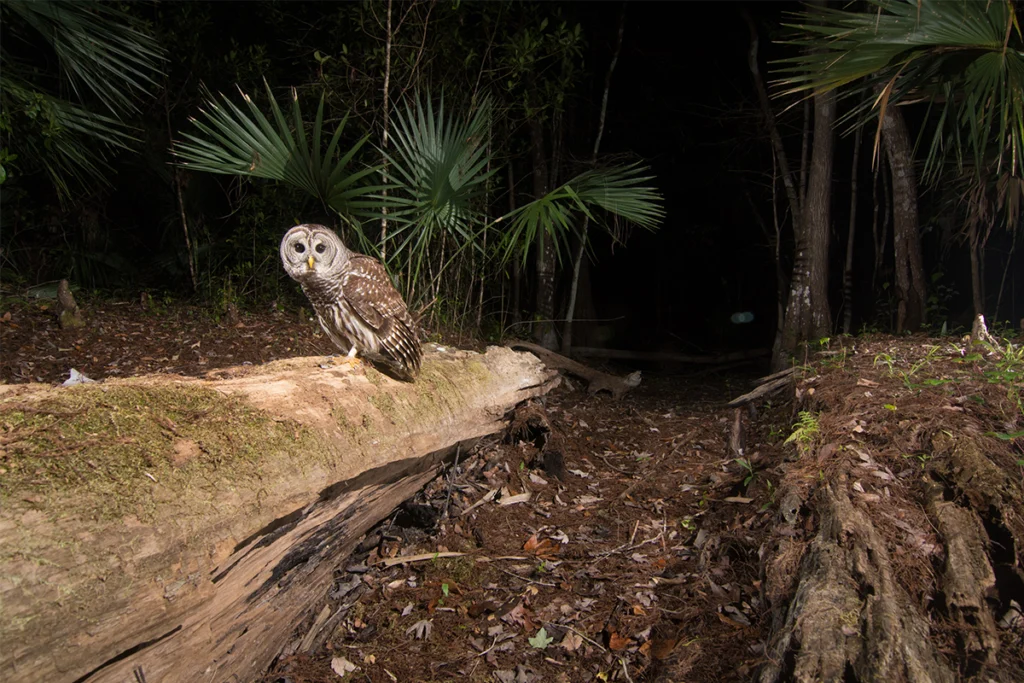
When I first set out to capture photographs of the Florida panther—an endangered and elusive cat that I had never seen in the wild—I knew I was going to need to use camera traps. I hide these professional cameras, protected in waterproof boxes, on wildlife trails and connect them to an invisible beam that acts as a trip wire, so that when an animal walks (or flies) by, it takes its own picture. But because panthers are most active at night, we need to add lights. In this scene, four lights flash to illuminate the foreground and background. You’re essentially building a photo studio in the woods—and then you wait.
The field studio was located on a long-abandoned logging road eroded by the swamp in the Florida Panther National Wildlife Refuge, at the northern end of the Fakahatchee Strand, about 25 miles east of Naples. My intention in selecting this site, with the cypress and sabal palms, was to hopefully portray the panther in a setting that felt like Florida. After several years of servicing the camera every two weeks with my team at Wildpath—and enduring multiple hurricanes and fires—I ultimately captured the image I had in my mind, which you can see on the cover of my book “Path of the Panther,” published by National Geographic in 2022.
What I learned along the way is that a panther would come by this camera about once a month at night, but only a couple of times a year during the day, and that the swamp would fill with water for about half the year. I also witnessed the diversity of other wildlife that shared the path with the panther. There were expected suspects: bears, deer, bobcats, alligators and the occasional coyote. And there were surprises: a family of otters and this barred owl. You can see a sample of these photos in a section of my book dedicated to this camera site.
For years, I had heard the distinctive whot-whot-whot-whooo of the barred owl echoing through the swamp, and I had once seen its wide eyes quietly watching high in a cypress tree. But I did not expect to see a barred owl—named for the horizontal bars on its throat—at ground level staring into my camera (nor would it have expected the lightning strike of flashes breaking the darkness). I hope I didn’t interrupt its hunt. I learned in a college biology class that the barred owl’s hearing is so good that it can localize a scurrying rodent with remarkable precision in full darkness. So despite the interruption, I am confident the owl was fed—and I’m grateful for its addition to the list of species whose paths we share.
Notes
-Location-
Florida Panther National Wildlife Refuge
-Season-
Winter
-Time of Day-
8:33 pm
-Subject-
Barred owl
For more of Carlton Ward Jr.’s field notes, click here.