by | March 12, 2026
Inside the Abandoned Orlando Sun Resort
The demolition of the abandoned Orlando Sun Resort near Disney World exposes the human cost of Central Florida’s housing crisis.
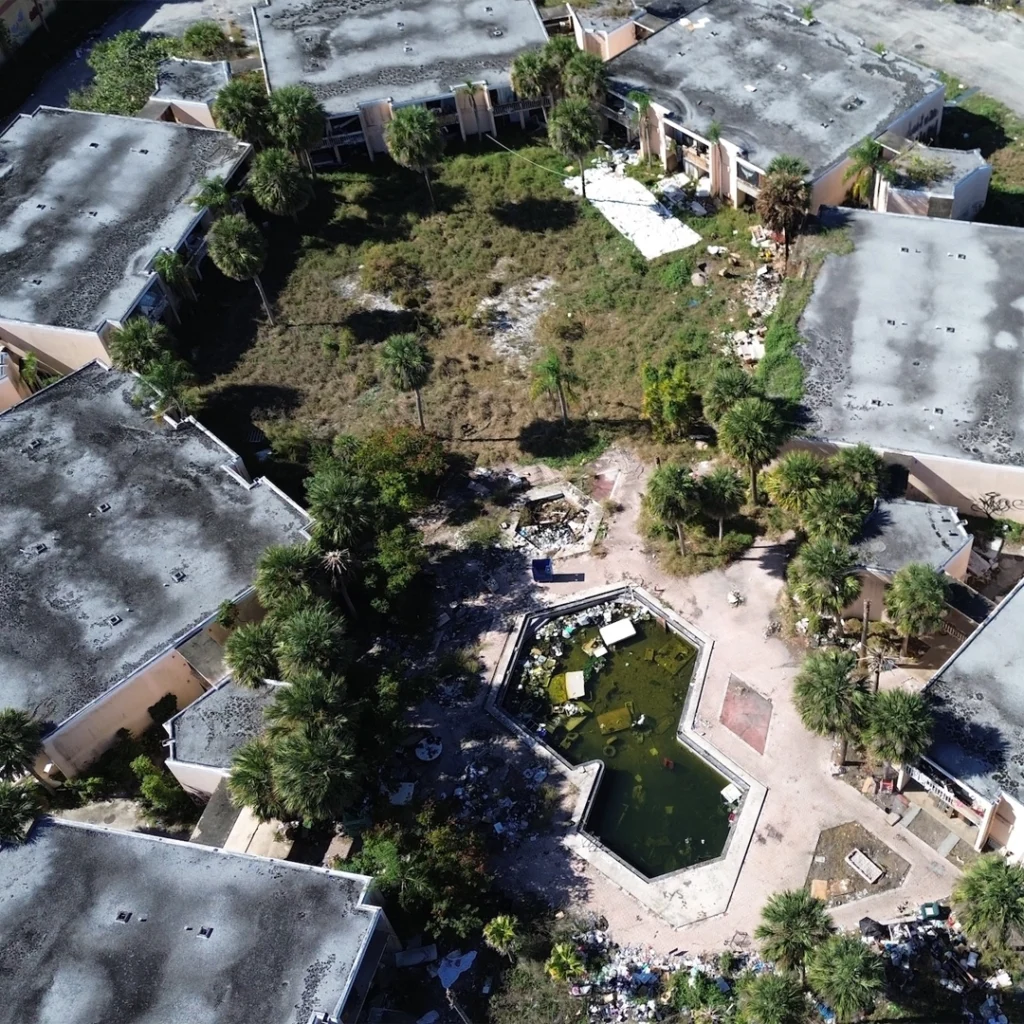
The first living thing I saw at the abandoned Orlando Sun Resort, a once upmarket hotel and convention center, was a baby turtle basking in the sun on a filthy mattress floating in a stagnant, algae-choked swimming pool. I inched closer, and noticed more debris inside—four more mattresses, a sunken shopping cart, crusty old tires and an upholstered dining chair. There was no water left in the adjacent jacuzzi—just mountains of broken glass, mounds of debris and a discarded box of Captain Crunch cereal. The hotel rooms situated inside the pod of four two-story structures that surround the decaying pool had just three walls left but there were still signs of life. Plywood boards and sheets were strung up to cover the missing walls, and one unit had a homemade-looking door with a colorful wreath on it.
This was once the largest resort in Central Florida when it opened in 1972, months after Disney World—located about a mile away—opened its doors on October 1, 1971. The Carolando Corporation, the original owners, had bold plans to build a 600-foot-tall Space Needle to provide panoramic views of the Magic Kingdom. But the 1973 recession and the resulting tourism downturn squashed those plans, and the resort was sold to Hyatt, which operated it for the next thirty years. It later became a Ramada and then the Orlando Sun, until the place was abandoned—with all of its furniture and fixtures left to rot—in 2012. As I crept around the apocalyptic space on a Monday afternoon in November, I noticed there still weren’t any fences or “no trespassing” signs, but I still wasn’t sure if squatters had been chased off the property or not.
Finding Hope in Unexpected Places
By the time I noticed the holiday wreath, I’d already spent nearly an hour walking around, passing dozens of old mattresses, piles of trash and discarded household goods. The new owners, the Myers Group—a developer based in Aventura—have plans to bulldoze the 77-acre property and build a new resort and entertainment district called Ovation Orlando. Their website describes the future space as the “newest dining, retail, hotel, attraction and entertainment destination in 2027 and beyond,” with “live music around every corner,” three new hotels and “acclaimed restaurants and bars.”
I had only seen one person near the entrance—a mustachioed man with a New York accent named Tom, who was riding a bike. I asked him to show me around, and he said he’d be right back. I gave up on him after waiting for about twenty minutes.
As I inched closer to the ground-floor wreath room, a man emerged from behind the door, scaring the daylights out of me. It was Tom. His door was open wide enough that I could see he had turned his trashed hotel room into something resembling a comfortable studio apartment, with a king-size bed full of pillows, a flat-screen TV and a humming generator. “I’d show you the place, but my girl’s sleeping,” Tom said. “I know it looks like shit out here … but it’s a great way to save money.”
Tom, 57, grew up on Long Island in an Irish-American family and had been living in his own home in St. Cloud before, as he put it, “things went south” in 2023 after his wife of 34 years died. He said he was a “glass guy” who had always worked for himself installing shower doors, mirrors and tabletops, and did well. “My kids got older, I didn’t need it anymore,” he said of his old home. “I’d rather not say why.”
Tom told me his luck started to improve less than a year after his wife died when he met Lisa, his current partner. “God helped me out right away,” he said. When they were down on their luck and needed somewhere to go, a friend told them about the abandoned resort, which they’d nicknamed the “Bando,” short for abandoned. It was a coincidence because, years ago, Lisa worked at the hotel as a concierge when it was briefly a Ramada.
Things will turn around. My luck will turn around always every day.
—Matt, a Bando resident
As we wandered around the dilapidated grounds, stepping over tires, broken glass and debris, I asked Tom if there were any upsides to squatting in an abandoned resort. “At the end of the day, there’s no landlord, there’s no bank,” he said, his voice trailing off. He introduced me to Matt, a soft-spoken 36-year-old Orlando native who took over the tour. Matt explained that he first came to the Bando three years ago for a job extracting copper wires and other valuable assets from the property. “We ended up getting screwed, and we didn’t get paid,” he said. Nevertheless, he said he’s stayed on at the place for lack of anywhere else to go.
We walked through a cluster of rooms called Hibiscus that was in ruins—covered in graffiti and filled with trash and rubble—as Matt outlined his story. He said he used to work at a Waffle House and also as a stagehand at music festivals. Matt said that he and his wife had marital problems—“It’s a long story,” he said—and his three children are currently living with his brother. “I love ’em to death,” he said. He has struggled with drug abuse, particularly fentanyl, which he said is the most addictive drug he’s tried.
“It’s a physical addiction where if you don’t have it every day … you’re sick and you go and get it regardless of what’s going on in your life,” he said. “People will steal. They will do anything. Steal from their own mamas.” He did time in prison on drug charges, he told me as we tiptoed through the wreckage. (Much later, I found out that he also had convictions for grand theft of a motor vehicle in 2024 and 2025). While he was away, someone trashed the room at the resort he had fixed up for himself. Later, he did more prison time for a probation violation after getting caught driving with a suspended license. Now he can’t get a license, which makes finding a job even harder than it would be. But he remains curiously optimistic. “Things will turn around,” Matt said. “My luck will turn around always every day.”
We were joined by a cheerful woman in a hoodie who introduced herself as Bella, a 47-year-old Tennessee native. She came out of her room to get some dog treats I brought and to meet me. “They’re my ladies,” she said of her three dogs. Bella agreed to join our tour as we headed toward the wrecked convention center.
When I asked her how she wound up living at the resort, she said, “drugs,” and laughed hysterically. I asked her which drugs she had a problem with and she said, “Uh, all of them,” and laughed even harder. Bella shared that she had been clean for 15 years but relapsed after a devastating F5 factory tornado killed her daughter and destroyed her home in Cookeville, Tennessee, on March 3, 2020. After losing their home, her husband suggested they relocate to his home state of Florida. They ended up living in a tent in Orlando. She, too, went to prison on drug charges, but she says the experience “wasn’t too bad.”
They took me up to the roof of what was once the convention center to see the view. “That’s one thing I like about my room, I’ve got a beautiful view of the sunset,” Bella said. They both described losses they’d experienced while living at the Bando. Bella mentioned that her husband died of cancer in September and her neighbors helped her through the experience. “They made sure I was fed and okay,” she said. “I have family here.”
We wound up our tour back at Tom’s place, where a host of people and dogs were hanging out. There was Jessica, a New Jersey native who lived at the Bando on and off for the last three years; Carlos, a Chicago native who said he came to the resort to escape gang violence and stayed; and Lisa, Tom’s partner, who was hiding out in the back in what Tom called her “woman cave.”
There were empty Gucci and Christian Dior boxes artfully displayed against one of the walls. “Lisa likes luxury brands and stuff like that,” Tom explained. “(Lisa’s) giving you permission to enter her woman cave,” Tom said, leading me to an alcove at the back of the room, hidden behind a curtain. Lisa’s woman cave felt like a tiny dressing room fit for a Hollywood actress. In a tight but well-organized space, she had an abundance of hats, scarves, wigs, lotions, jewelry, and enough makeup to stock a Sephora.
Some people think living like this is a failure, you know, and I don’t think it is. I think it’s survival.
—Lisa, a Bando resident
“Why are people fascinated with the homeless?” Lisa asked as I looked at her stuff. I didn’t have a good answer, and she segued into her thoughts on how people perceive her. “People think we’re lazy, but we’re not,” she said. “I worked my whole life since I was nine years old.” Lisa said she and Tom had lived there for about a year after living previously in a home in nearby Intercession City. When I asked how she wound up at this place, she said, “It was a mental illness, and thankfully that’s over.”
When the conversation turned to the bulldozers that would arrive when construction commences on Ovation, the new development, Lisa said she wasn’t bitter that they would soon be kicked out of their makeshift home, which she’d spent so much time trying to make homey. “We benefited to stay here this long, you know, and that’s a privilege,” she said.
When I asked if any of the residents of the Bando had family members who could take them in, Lisa said many were too proud to ask relatives for help. “Some people think living like this is a failure, you know, and I don’t think it is,” she said. “I think it’s survival.”
Back to the Bando
I returned to the resort on Black Friday with pumpkin pies, whipped cream, two dozen juicy dog bones and a few bags full of clothing and supplies. “Sorry man, I just woke up,” Tom said when I knocked on his door around 9 a.m. “I gotta get out of this place.” Tom and Lisa had new neighbors—Mel, a tall Black man with graying hair, his emaciated white girlfriend and another friend of his.
Mel said he has a big house in Atlanta that he shares with his mom, and was living at the Bando for a few weeks because he was behind on his phone bill and because of his girlfriend. “(She’s) on drugs and I can’t just take her to the [house],” he explained. Mel and I took a walk through the trashed honeycomb clusters of buildings, and he told me his story.
Originally from New York, Mel said he once had a maintenance business that had done well. But he isn’t optimistic now. “Florida don’t care about their residents,” he said. “They care about their tourists.” He said the country’s inequality and lack of affordable housing are the reasons why squatter communities like this exist. “This country got too much money, too many billion-dollar people to have this many poor people,” he said, nodding his head towards a sewage-filled pool full of mattresses, tires and debris.
My first visit to the resort was a sort of chamber of commerce visit where I was impressed with the unusual sense of community that had emerged in this unlikeliest of places. But this time opened my eyes to some uncomfortable realities.
Although Bella was excited about the pumpkin pie and the bones for her dogs, she looked sad when I asked her about the holidays. “Me and Christmas are not best friends right now,” she said. She said Christmas reminded her too much of her late daughter. “I’m going to celebrate (Christmas) with my dogs,” she said and laughed.
Florida don’t care about their residents. They care about their tourists.
—Mel, a Bando resident
Data sourced from the Homeless Services Network of Central Florida revealed that in January 2025, there were 2,781 homeless persons counted in the Orlando metropolitan area. That figure was nearly identical as 2024’s homeless persons population. It’s unclear if they counted the residents of the Bando and, in any case, the official count may not include families staying in motels, cars or with friends. More recent signs are worrying. Scott Billue, founder of the nonprofit Matthew’s Hope, told news outlets in January that his team is seeing 30% more homeless people this year compared to last year.
Orange County Public Schools also identified nearly 9,000 homeless students in the 2024–2025 school year, the highest number of any district in the state, and a 50% increase since 2019. According to the Florida Council on Homelessness’s Annual Report, there were 28,498 homeless individuals across the state in 2025, a 9% decrease from the prior year. But critics say that HB 1365, a 2024 state law that bans sleeping in public and camping, is pushing the homeless deeper into the woods, or into places like the Bando, hindering accurate counts.
A Change in the New Year
The holidays came and went before I returned to the Bando for a third time on Jan. 15. The uncertainty that once hung over the place had morphed into a collective sense of desperation. At least three residents were arrested, Matt lost his leg, a fire ravaged Bella’s room and hopes for any kind of détente with the developers had collapsed.
Several residents told me they were given three weeks’ notice to leave and I had arrived at the beginning of week three. Construction crews had already begun clearing vegetation and organizing debris around the property, though the main demolition hadn’t started.
I was back at the resort because Bella said there would be a meeting with representatives from the Meyers Group and she said she wanted me to come. Residents hoped that they would receive information, resources or perhaps some help. Lisa and Dianne, an out-of-work accountant who moved into the Bando a month ago, waited at the entrance to the resort for hours but no one came.
“I was really hopeful,” Lisa said of the meeting that didn’t materialize. “When we heard there was going to be a meeting, we thought maybe something good was finally happening.”
Matt was arrested on a parole violation after officers found him at the resort. While in custody, he was taken to the hospital for an untreated leg wound he’d sustained. The infection turned severe. “He got gangrene,” said Carlos, a Chicago native who has lived at the resort for more than a year. “They ended up cutting his leg off.”
Another resident, Jessica, said her boyfriend was arrested after police found drug paraphernalia in a room adjacent to the one they were cleaning out to live in. And Dianne said that nine police officers showed up to arrest her boyfriend at the resort on a parole violation two days before Christmas.
Despite the chaos, many residents pushed back against the idea that the people living here are lazy or unwilling to work. Diane said she moved into the Bando in her RV after losing both her job and her apartment within a month. She bristled at comments left on my YouTube videos about the place, labeling residents as addicts and freeloaders. “We’re not here just…doing nothing and being drug addicts or whatever,” she said.
Bella’s apartment at the resort burned down in a recent fire, and she lost most of her belongings, though she said she’s lucky to still have two tents. “I know the days of this place are done,” she told me. After losing her home, her husband, and her daughter in a tornado years ago, she now faces eviction again.
Days after my third visit to the Bando, a large sign was posted warning residents to vacate as demolition would commence on Feb. 2. The sign advised residents to contact the United Way’s 211 hotline for help. Flamingo reached out to the United Way and to the Meyers Group for comment. The Meyers Group did not respond. A spokesperson for United Way Heart of Florida said that they do not directly provide housing, but rather information, referrals and pre-screenings for shelter. No one I met had been approved for assistance.
Bella emailed me two days after demolition began to say that the police forced everyone out on Feb. 2. She had to leave some of her possessions at the resort and now she cannot access them. “All I was able to get out was three suitcases and my dogs,” she said. When I asked where she was, she wrote back, “In hell in the woods with no tent because my dogs ripped it to pieces. Wanting to die.”
Dianne said more than a dozen police officers arrived at the resort on Feb. 2 around 11 a.m. and gave them just 30 minutes to leave. They later extended the deadline to 3 p.m., but she couldn’t get the lift on her RV to work and was arrested for trespassing. While in jail, someone stole her bike and many of her other valuables. She says she exhausted her nest egg paying bail and an $800 bill to tow her RV out of the resort.
A spokesperson for the Osceola County Sheriff’s Office said that 20-30 residents were still at the resort past the demolition deadline. Most, they say, left without incident. They claimed that one resident was arrested because he had a warrant for his arrest. Dianne was arrested because they claim she “refused to leave.” (She denies this claim.) They say her RV wasn’t towed by the police, but rather by Peace of Mind Demolition Company.
Bella also had sad news regarding Matt.
“It’s with a sad heart that I’m writing to you,” Bella wrote in one message. “Matthew passed away yesterday. We don’t know any details. But I just thought you would like to know.”
Just weeks before, Matt was giving me a tour of the Bando, and now he was dead at 36. I found out that four days before his death, Matt was convicted of possession of methamphetamines. A representative at the County medical examiner’s office said that he was found unresponsive in an abandoned building (the resort) on Jan. 26. His next of kin was notified, but more than a week after his death, his body still hadn’t been claimed. “If his kin don’t claim him after thirty days, the county will bury him,” the representative said.
The Good Samaritans
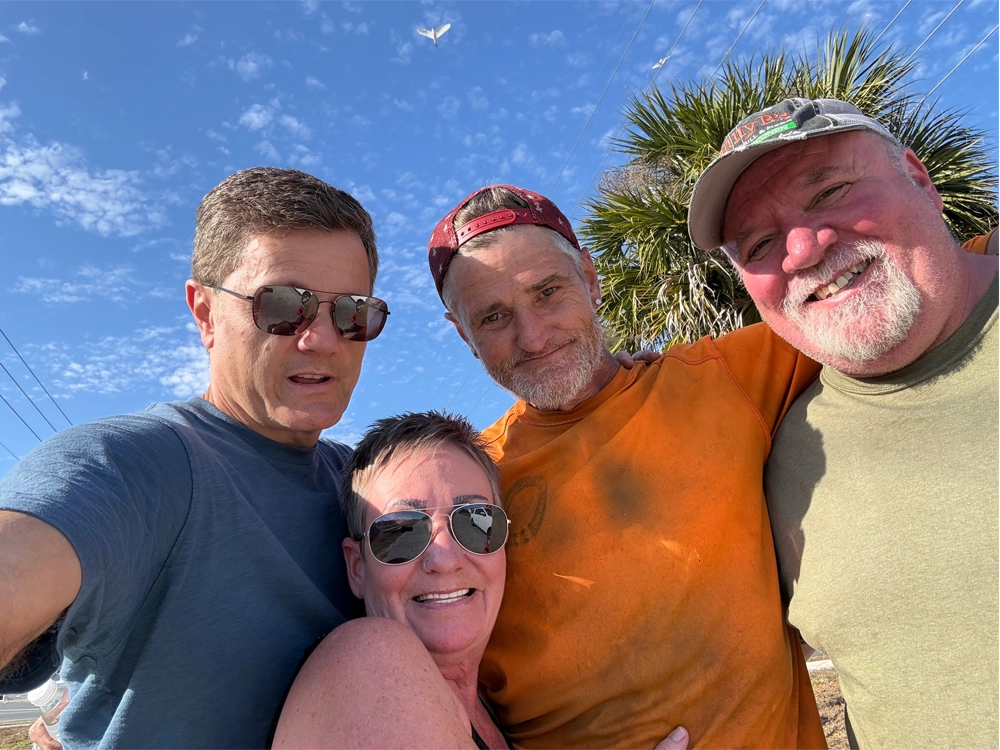
A week after demolition of the Bando had started, I got a text from Bella telling me I should meet a couple whom she called “Good Samaritan snowbirds”, Johnny and Trish Badaliacco, who feed homeless people living in the shadow of the Magic Kingdom. I had sent my video series to more than a dozen charities tasked with servicing the homeless in the area but none had responded. And so I jumped at the chance to spend a Monday afternoon with the Badaliacco’s because Bella said they knew nearly every homeless person in the area.
The Badaliacco’s own and operate a restaurant, Johnny B’s, in Couderay, a small town in northern Wisconsin. For the last five years, they’ve been cooking and delivering gourmet quality meals, and a lot more, twice a week to the homeless in and around Kissimmee, their winter home. I piled into the backseat of their Ford Expedition SUV, every inch of which was stuffed with coolers full of bottled water, goody bags, baby wipes, tents, umbrellas, supplies and sixty individual meals. “Today, we’re serving homemade Italian-seasoned pork sandwiches,” said Johnny, 66, who makes and sells his own spices. “On Thursday, it was chicken alfredo.”
We spent nearly five hours zigzagging around Osceola County making stops to feed their regular clients and searching for other hungry homeless people in the area, of which there are many, often hiding in plain sight. Camping is illegal in Osceola County, and yet hundreds or more desperate people are living hidden in wooded areas, often just steps from major thoroughfares like West Irlo Bronson Memorial Highway. “When you see garbage or these little paths into the woods,” Johnny said pointing to an area behind a Sunoco station, “you know there’s people living in there.”
Although their ostensible mission is to use their culinary experience to feed the hungry, I quickly found out that they often do much more than that. They had tents for some who had requested them. A mute man with sores all over his body who was covered in flies, we found lying on the pavement at a bus stop got an umbrella. Jenny, a young woman wearing a Trump hat and most of her belongings, got food for her cat in addition to her meal and goody bag.
A man named Ken who lives in the woods with his son across from a pond that flanks flashy new townhomes got a generator and a grill courtesy of some of Johhny and Trish’s benefactors. “I love THIS man,” he said, tears streaming down his face as they shared a tight embrace. “THIS man and his wife are the BEST people in this city!”
We look at them not like they’re homeless but like they’re family.
—Johnny Badaliacco
“I’m alone 65 years old living in a goddamned swamp,” Ken yelled as I asked him to tell me his story. “I need medical and I can’t get it! I’m gonna die out here in these woods and no one is gonna give a shit.” No one, save for Johnny and Trish, he meant.
On our next stop, we met a former carnival performer from Gibsonton named Dave, who survives by dumpster-diving outside restaurants. He asked us why the task of feeding the homeless fell to people like Trish and Johnny. “Why doesn’t Disney help us?” he asked.
On a surprisingly pretty, wooded lot overlooking a lake, we met a diminutive homeless woman named Hailey, who works at a Pizza Hut across the street making chicken wings. “I’m not tall enough to bake pizzas,” she joked. She tearfully embraced Trish and Johnny, and was perhaps the third or fourth person I’d seen who called them “mom” and “dad.” She told us that she’d just won the employee of the month award at Pizza Hut, but the $800 or so per month she earned wasn’t enough to rent an apartment in the area. Still, she was full of gratitude for Johnny and Trish, who found her and her husband, Jose, the prime camping spot we were standing in and had bought them a tent, a grill and many other supplies.
Hailey said they lived in fear of the police, who could take away their makeshift home at any time. She said a cop had recently stopped her while she was riding her pink bike to scold her for not having functional brakes. “I was afraid they were going to ask me where I lived,” she said. Resident after resident we met said the same thing: Osceola County is a terrible place to be homeless because there is no tolerance for camping. We reached out to Osceola County to ask them what resources they have for former residents of the resort and other homeless people in the County, but they didn’t respond prior to our deadline.
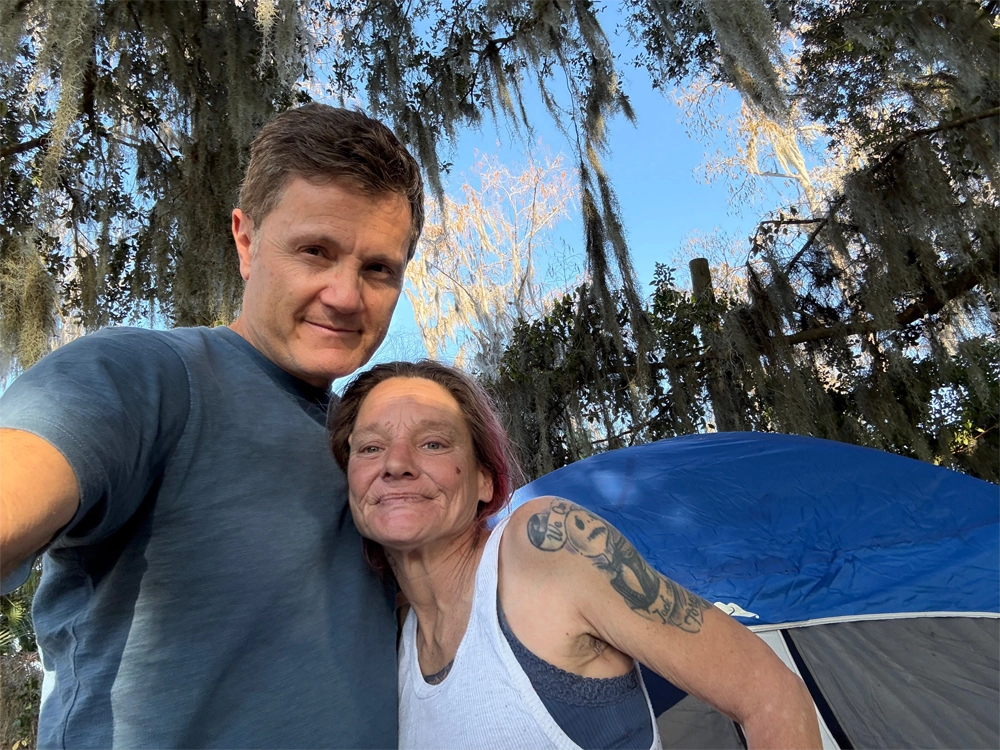
The campsite where Bella and several other former residents of the Bando live is hidden in the woods across the street from the entrance to a subdivision. Bella and her dogs were sharing a tent with a male friend from the Bando whom I hadn’t met before. She was in a hopeful mood because she said Johnny’s food was “banging” and a woman from Tennessee who had watched my videos had gotten in touch with her and bought her some dog food, a new tent, and other supplies. “I’ll be okay,” she reassured me. “The sun’s out today and it feels so good.”
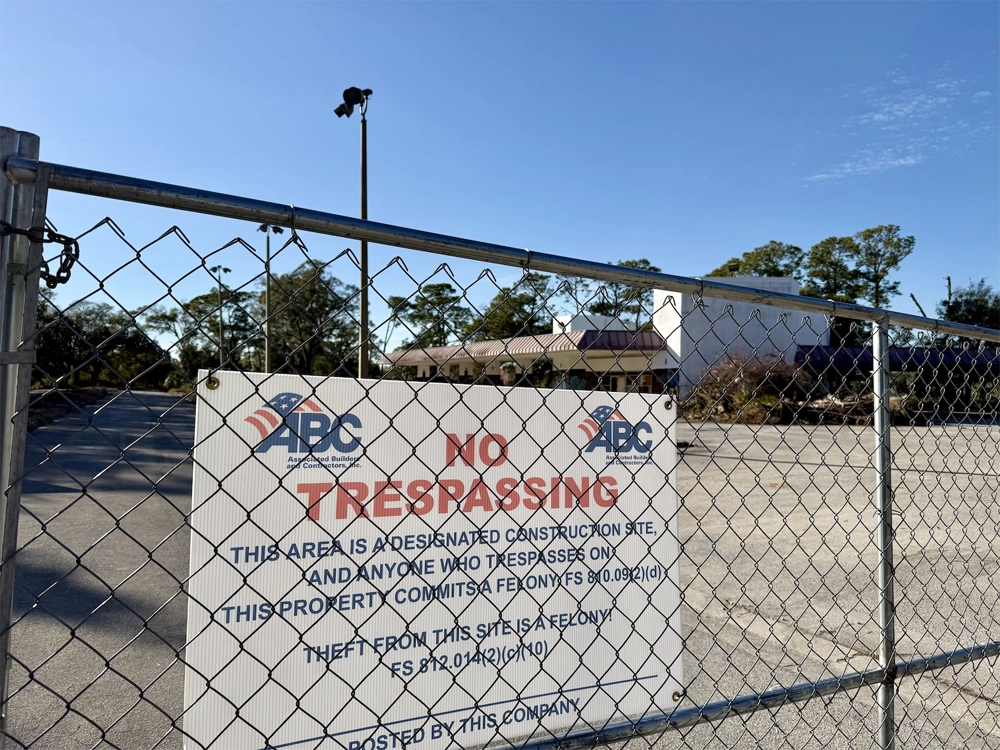
The faded mustard-colored Orlando Sun Resort sign hasn’t been taken down yet, but the place is fenced off and there is a security guard there watching videos on his phone to pass the time. The police said the fencing had been trampled, but it was fully intact and adorned with no trespassing signs on this day. The guard said they were still cleaning the place up, and it wasn’t ready for wrecking balls yet.
The residents of the Bando have now been scattered into the surrounding woods, where they live in fear of being evicted again every day. But the meals and hugs and favors Trish and Johnny give them twice a week sustain them in a way that no government agency could.
Johnny said their work was rewarding but also draining. He tries to solve the problems of the people he meets and carries their burdens as though they are his. “A lot of people are afraid when they see a homeless person on the street,” Johnny said. “We look at them not like they’re homeless but like they’re family. If you walk past someone who is in need and you don’t have anything to give them…look them in the eye and say ‘hello’ and they’ll appreciate it.”
At one of our final stops of the day, we met Redd, a former resident of the Bando, whom I had never met before. As Johnny handed him a tent he purchased for him and his lunch, a man in a parked car who was watching us beckoned me over. “How can I volunteer?” he asked. “I want to help too.”