by | January 7, 2026
The 5-Year Apalachicola Oyster Ban Is Lifted
The forgotten oystermen of Apalachicola return to the bay in search of bivalve bounty from Jan. 1 to Feb. 28 of this year.
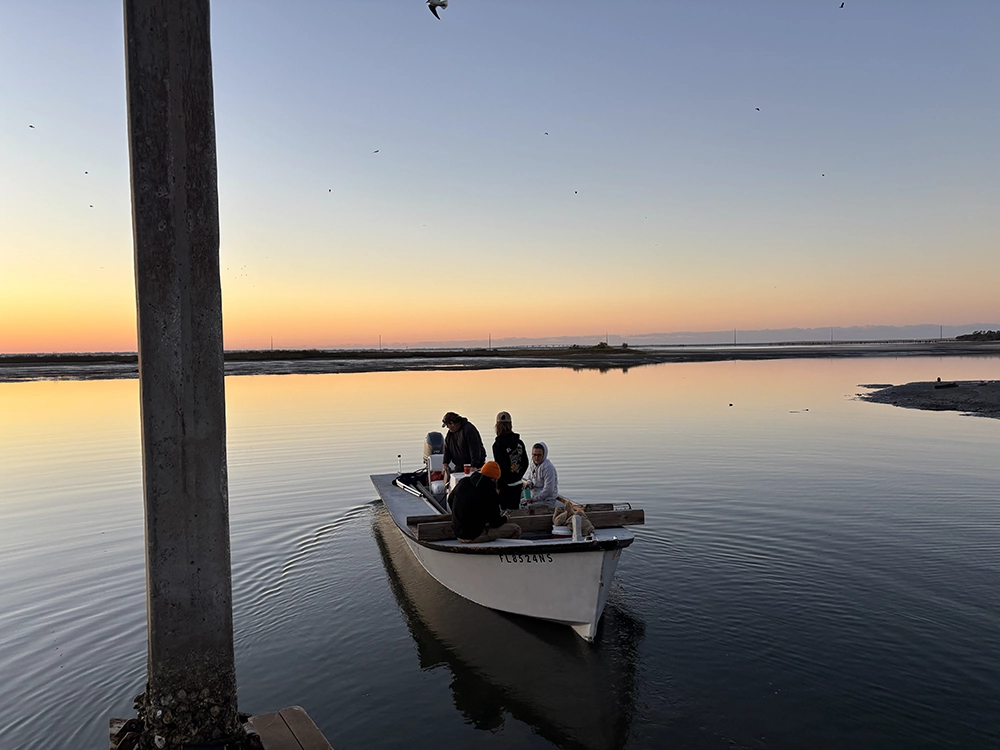
At dawn on New Year’s Day, as the sun painted the sky in rosy hues, oyster boats slipped into the water one by one from a public boat ramp near Apalachicola. Onboard were families—husbands and wives, fathers and sons, a pair of brothers. One aging skiff held three generations of Apalachicola oystermen.
Jan. 1 marked a bittersweet moment for many local oystermen and women; for the first time in over five years, they were allowed to harvest wild oysters from Apalachicola Bay.
The sleepy Panhandle town was once famous for the briny delicacies, the way Maine is known for its lobsters and Maryland for its blue crab. Oyster houses lined the waterfront in Apalachicola and the neighboring town of Eastpoint. Tonging, culling and shucking were skills passed down in families from one generation to the next.
At the industry’s peak, the region supplied 90% of Florida’s oysters and 10% of the nation’s. But the oysters began declining in the 80s, until the fishery finally collapsed in 2013—taking with it a way of life that had defined the region and its people for over a century.
They call this the Forgotten Coast. Well, we’re the forgotten fishermen.
—Dewitt Polous
In 2020, in an effort to salvage remaining oyster reefs, the state of Florida issued a five-year ban on wild oyster harvesting in Apalachicola Bay. Ongoing restoration efforts have led to glimmers of recovery in some areas where oysters historically existed; enough that the state was persuaded to reopen the bay for a partial harvest season from Jan. 1 to Feb. 28 in 2026. To protect the still-fragile oyster population, there are extremely tight limits on how many oysters can be harvested—just 31 bags per person for the entire season—making the activity more of a hobby than a side-hustle for local oystermen.
“No one is going to be quitting their day job,” says Chad Hanson, a science and policy officer with the Pew Charitable Trusts who is involved in the restoration of Apalachicola Bay.
As they maneuvered their skiff into the water in the early-morning light, brothers Dewitt Polous and Dwight Polous registered the conflicting emotions of many longtime oystermen: excited curiosity to see how the oysters looked after so many years, tempered with resignation—and some frustration—over the bay’s slow recovery and the strict new rules around harvesting. Both brothers had given up oystering years ago as the bay deteriorated; Dewitt became director of Franklin County’s mosquito control program (now retired), and Dwight worked as a school bus mechanic. But oystering still runs in their blood. Dwight proudly displays a black-and-white photo of his father hand-tonging oysters in Apalachicola Bay on his phone.
“They call this the Forgotten Coast,” Dewitt remarks, referring to this stretch of relatively undeveloped coastline in the Panhandle, characterized by small towns like Apalachicola. “Well, we’re the forgotten fishermen.”
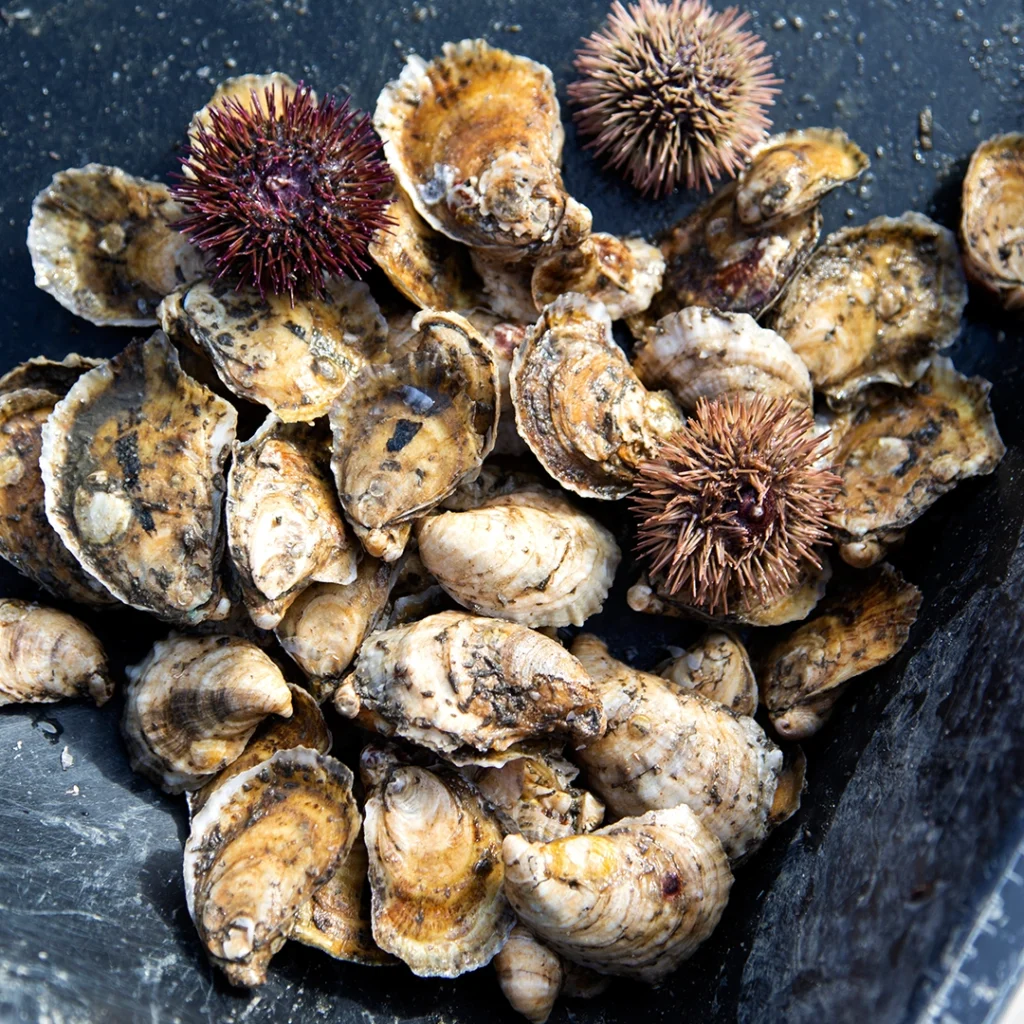
Make Way for the Clean-up Crew
The collapse of Apalachicola’s oyster fishery reflects a global trend: 85% of the world’s oyster reefs are either extinct or in severe decline. Until recently, the Gulf was considered one of the last remaining areas where oysters were still abundant, but as of 2023, all U.S. Gulf states have reported severely depleted oyster resources. Apalachicola Bay, once home to 10,000 acres of healthy oyster habitat, now has fewer than 500 acres; a 95% decline.
Harvesting is not the only, or even the main, reason for the decline. Oysters are sensitive to fluctuations in water salinity and temperature, and Apalachicola oysters have suffered from reduced levels of freshwater flowing into the bay from the Apalachicola River, due to urban water demands upstream. Warming waters, which invite predators and disease, have also taken a toll, as have hurricanes.
But oysters are too valuable, ecologically and economically, to avoid rescuing. They’re powerhouses when it comes to removing harmful nutrients from the water. According to the Nature Conservancy, restoring 1,300 acres of oyster reef would have the same effect as building a wastewater treatment plant.
Oysters also create habitat for other wildlife, including several fish species that support the recreational fishing industry in Florida. In that way, oysters are “like the coral reefs of the estuary—except we can eat them,” says Hanson.
The goal of restoring Apalachicola Bay is to recover, to the extent possible, a sustainable wild oyster fishery, says Hanson. But, he adds, “The (other) tangible benefits from having a healthy oyster reef system are that it helps produce habitat … and helps improve water quality. So it all goes into the package of having a healthy ecosystem and a robust economy around that.”
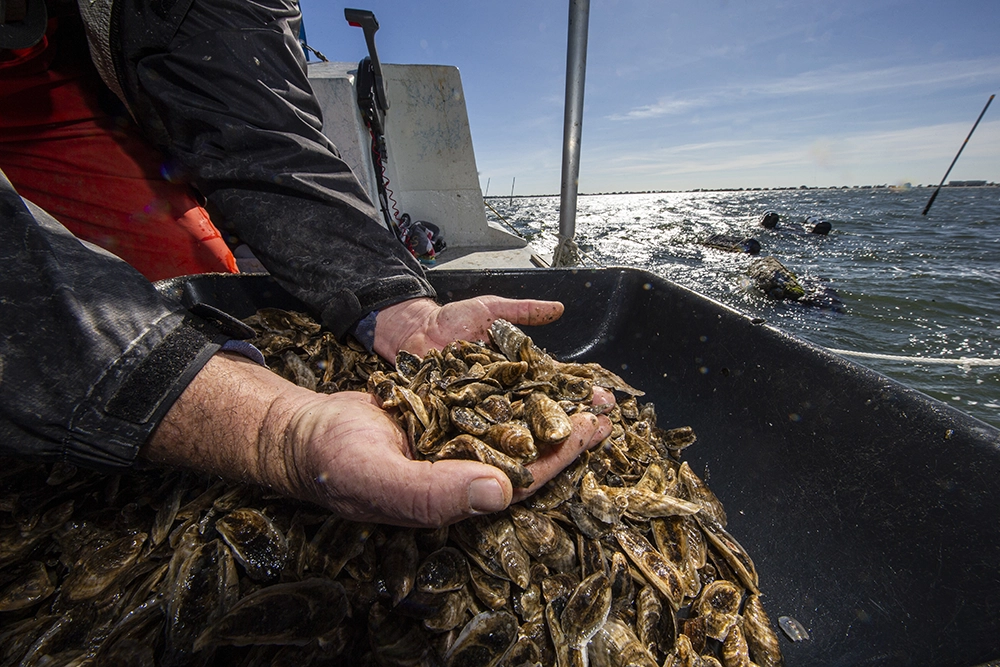
A Dying Breed
Restoration depends in part on recreating oyster reefs. Oyster larvae attach to shells left behind by previous generations of oysters, adding a new layer of shell as they grow—but they will also grow on almost any stable, durable material. Because so much of the natural reef in Apalachicola Bay has been lost, researchers from Florida State University and the Florida Fish and Wildlife Conservation Commission (FWC) are experimenting with using materials like concrete and Kentucky-sourced limestone to replace it. The limestone is dug out of the ground, put on barges and shipped to Florida—a long, slow, expensive process that nevertheless has yielded promising results in some areas like Apalachicola Bay.
Still, oyster restoration is “on the order of not just years but decades,” says Hanson. Meanwhile, those with a long history of oystering in Apalachicola Bay are getting older, and there are few to replace them.
“We’re a dying breed,” says local oysterman Roger Mathis. Now 68 years old, Mathis started learning the trade from his father at age 6. From 1982 to 2017, he owned an oyster house where he processed the oysters he and his crew caught, then drove them down to his longtime customers in Tampa and Lakeland.
In the years since he was forced to close his oyster house, Mathis has become a land-based Jack-of-all-trades, working various maintenance, carpentering and painting jobs. “I’ll do whatever it takes,” he says.
He’s excited about the bay reopening for wild harvest, and he’s also played a role in the restoration, ferrying FSU researchers around the reef as they track signs of recovery. But, he says, “It won’t ever be what it used to be, at least not in my lifetime.”
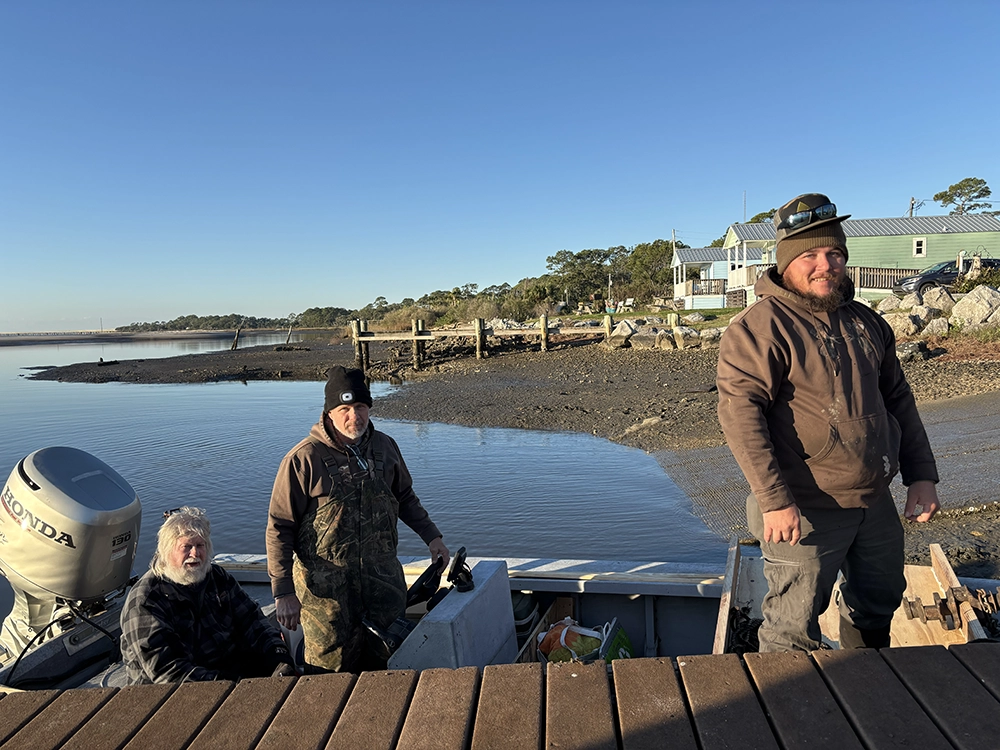
Harvesting Hope
Despite their gray hairs, the men and women taking to the water on New Year’s Day exhibited signs of pluck; many venturing out in boats that were also showing their age, with oyster tongs and other equipment that had lain unused for years. Dwight Polous had a box of Saltine crackers and a bottle of Tabasco tucked under his arm, and he wasn’t the only one.
Commercial harvest limits are low enough that no one is depending much on the cash. This day, along with the following weeks, is more about savoring traces of a way of life that’s been lost. “It’s in our blood, it’s our legacy,” one oysterwoman said as she headed down the dock.
Yet from the first day came hopeful signs. “I’ve never seen oysters so big out there,” says Mathis. He and several others sold their modest harvests to Barber’s Seafood, a local market. “People were coming out of the woodwork to eat them.”
The bustle was reminiscent of the way life in Apalachicola used to be. Mathis is no longer a young man, but the feel of oyster tongs in his hands, the physical labor of tonging and culling for hours in the sunny, salty air—it was still satisfying.
“I’m a little sore today, but anyway, it felt good.”
For more stories about Florida’s Gulf oysters, click here.
About the Author
Stephanie is an environmental journalist based in Gainesville. Originally from Tampa, she has a master's degree in ecology from the University of Florida and a bachelor's degree in English from Florida State University. She tries to justify cheering for both schools' sports programs.